Wednesday, June 23, 2010

Red & White

Heather recently informed me of a striking chromatic difference between Japan and North American/Western society.

In Canada, and America, and likely most of the European nations, it is understood that white and black are binary opposites: chromatically as well as philosophically. Were you to try to illustrate the concept of a binary to someone, it is likely that the first example to come to your mind would be “well, it’s like black and white, really.”

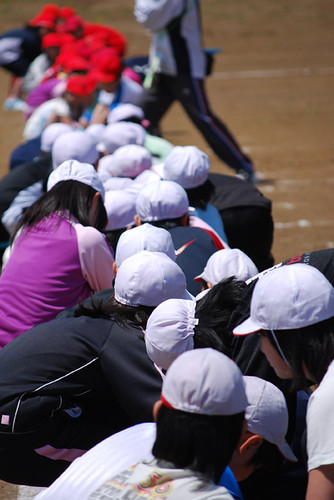
In Japan, however, it is white and red that are opposites, and not white and black. Such a chromatic revelation is not so shocking in a country that had to invent the notion of green—or midori—as the result of foreign influences (before green was just another shade of blue to the Japanese, and traffic lights are still considered to be red, yellow, and blue). However, the fact that red and white are opposites becomes necessary context when you realize just how often the two colours appear together in this society. The Japanese flag, of course, is the most obvious use of red and white. However, there are also the graduation ceremonies in the schools, wherein the rooms are ringed with white and red striped curtains. And in the day to day, my elementary students, from first grade to six grade, all have reversible red/white caps hanging from hooks on the sides of their desks: ready to be deployed in any activity that calls for splitting the class into teams.

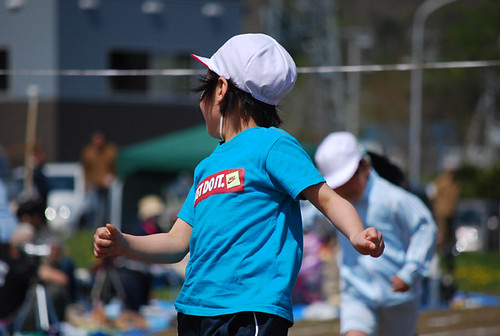
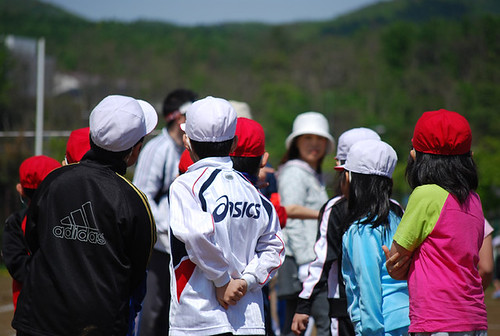
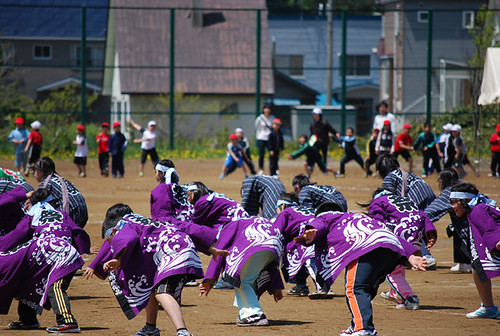
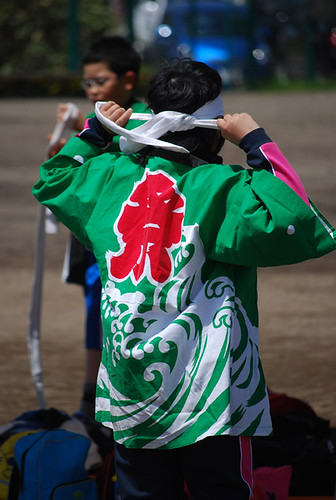
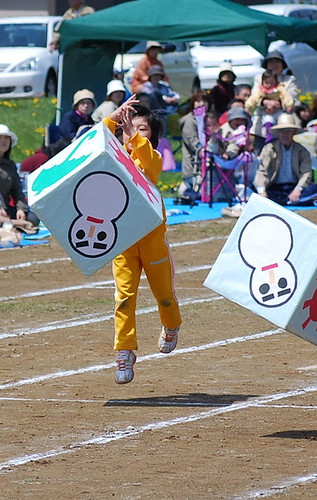
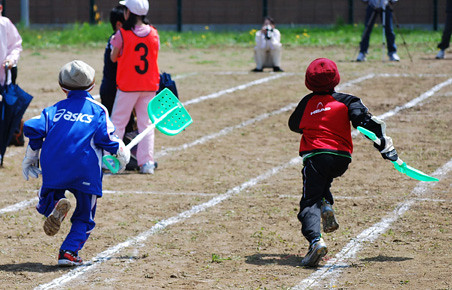
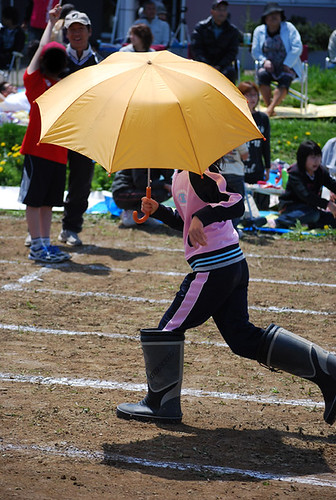
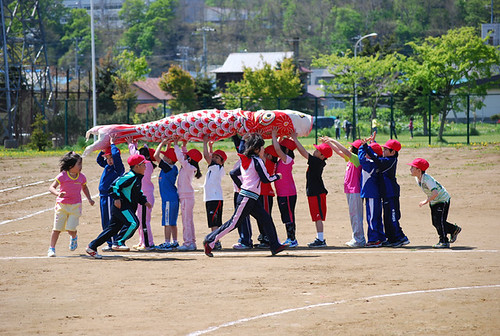
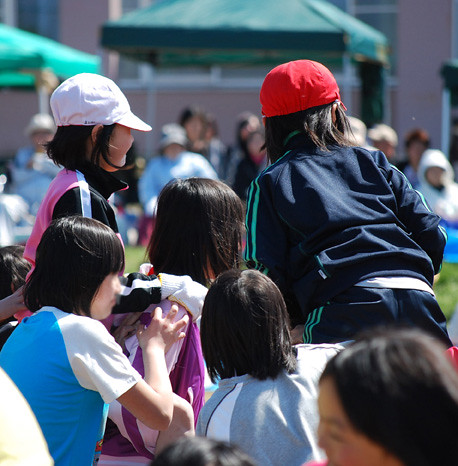
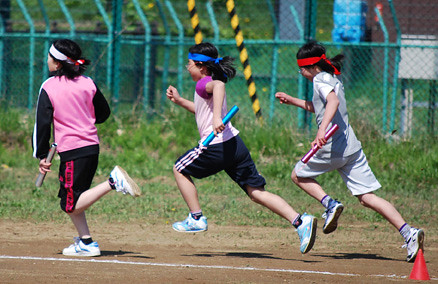
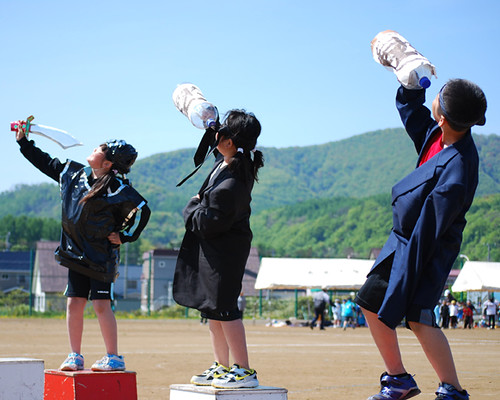
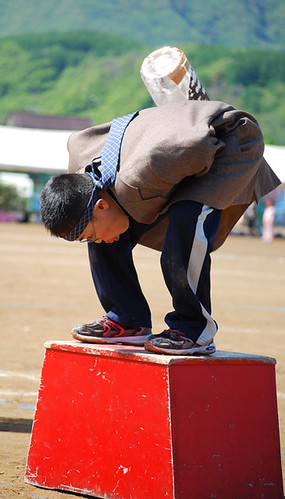
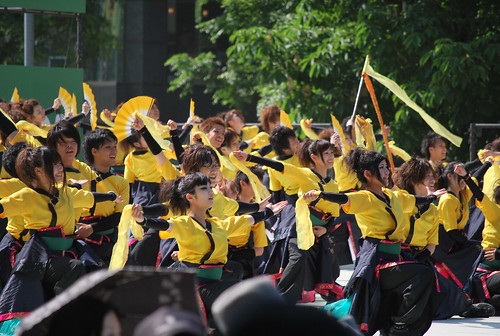
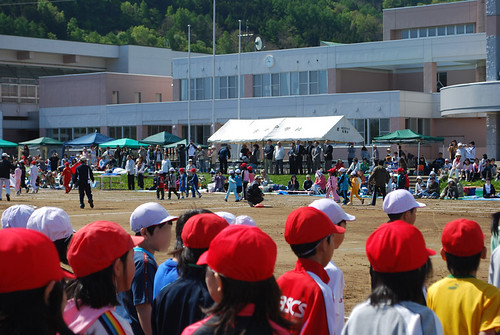
One such activity occurred on the weekend of May 29th at my elementary Undokai (school sports day), which saw the entire student population divided down the middle into two teams: Red and White. Each team had representatives from every grade, and when certain grades were competing, the remainder of the team would form the cheerleading squad: maniacally waving their team’s colours and following along in the pre-set, full-body, preset, foot-stomping, hat-waving red or white cheer routines.

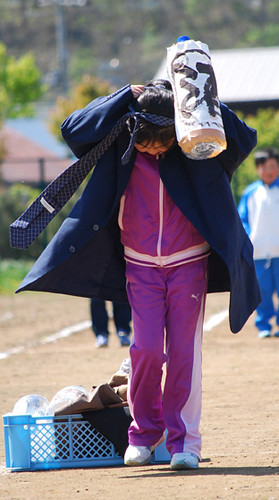
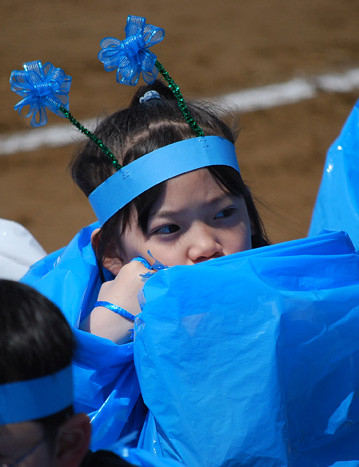
The closest approximation for an Undokai that we have in Canada is a Track & Field Day. And such a comparison would be apt when it comes to the Undokai’s X-meter-dash and relay events for the students. However, such a comparison fails to capture the importance of the Undokai as a community event that sees student’s entire extended families coming out to cheer them on (indeed it seems to be, in a way, mandatory for parents to show up for the Undokai, and they are encouraged to arrange vacation if they usually work weekends). The comparison to a normal Track and field day also fails to capture the rest of the Undokai events, which are best described as delightful madness. There are tug-of-wars, and piggy-back chicken fights, and yosakoi-like dance numbers. There are caveman races and weather races, family races and beer bottle races, koi races and ball races. And—my personal favourite—there were dress-up-like-a-sarariman-and-act-out-getting-sloshed races. It was that last that caused me to exclaimed, when I was finally able to get my laughter under control, “God DAMN, I love this country!”
But coming back to the Japanese binary of Red and White for a moment, I wonder if it might not be a purer binary than Black and White: if it might not be better able to illustrate the notion of a binary: of opposites.

I fear that our own western white and black has been too tainted by the associations with other binaries that we’ve muddied it in. White becomes associated with ideas like light and good and air and life. Black, in opposition, is associated with the conflicting notions of dark and evil and earth and death. Black and White, in western society in specific and, likely, in the English language in general, have become value judgments and no longer a simple chromatic binary. To assign either colour to someone or something is to risk contaminating it with these further binary associations or residual meanings.

In Japan, if you’re not white, you’re red. At the end of the day, those students at the Undokai are wearing white hats that are also red hats, and the others are wearing red hats that are also white hats. To change from one to the other is only a matter of inversion: of taking the hat off, changing it, and putting it back on. And, in the end, it’s just a hat.

To transition from Black to White in western society requires far more work. If you are black then you are the absence of white. You carry all of the negative, unclean associations with the black. Should you wish to change sides, to ascend into the white, so strong are our society’s peripheral associations with these two colours that, even if you succeed in changing, your previous colour will cling to you like a phantom miasma. It is like trying to mix white from black when dealing with pigments: no matter how much light you pour into the dark, all you will ever accomplish will be grey.

This is a theoretical discussion dealing with abstracts and is not meant to be a commentary on race. That being said, with the way that talking about someone being white or black aligns so easily with western notions of race, perhaps the race issue is the purest example of the implications of, and inherent dangers in, western society’s classification of the colours Black and White. Just as the Japanese arbitrary aesthetics decided that red and white would be opposites, so, too, did western arbitrary aesthetics draw race lines in Black and White.

Wednesday, June 16, 2010

Modern Myths: The Dragon

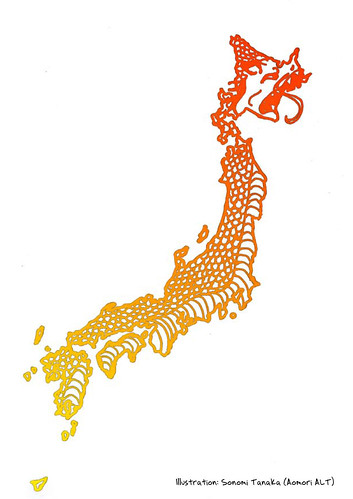
A dragon slumbers beneath the Japanese archipelago. If you were to look at the profile of the islands from space, you might be able to see the shape of it in them. Then again, you might see anything but a dragon and wonder what fit of creative madness spawned the legends of this beast.

Regardless, in Japan there is an old myth that the islands are actually perched on the back of a sleeping dragon. If you humour the idea, screw up your eyes, and look at a map of Japan from across a crowded room, maybe you’ll catch a glimpse of it. And, if you did, you might further conclude that, were these islands to be a dragon, the shape of the island of Hokkaido would be the best fit for a dragon’s head.

It’s not just the shape of the islands that lends credence to the myth. There is also the fire at the heart of Japan: the fact that our string of islands is just one more line of volcanoes in the pacific Ring of Fire. When you remember this, what better symbolic creature is there for an archipelago with magma boiling away at its core than a dragon?

Grandiose Japanese storytellers would dust off this old myth at parties to impress foreigners. They would say that the islands of Japan rested on the back of a sleeping dragon, or that a dragon slumbered under the islands, or that the islands themselves were a dragon. It was the Dragon that brought luck to the Japanese: the Dragon that would sustain them through their hardships, the storytellers would claim, hardly believing the thing themselves but reveling in the wonder it bred in the eyes of their audiences.

It was a fun little bit of myth and it never had any real consequences until back in the 1940s when someone had the idea of building a train tunnel from Aomori to Hakodate, joining the island of Honshu to the island of Hokkaido with a fixed, underwater rail link. Clever men bored beneath the Tsugaru Straight, holding nothing back. With their clever machines they dug three separate tunnels. When their clever machines couldn’t advance, they resorted to clever alchemies of channeled fire. And when even their powdered explosions failed to clear the way, they moved the stone by strength alone. They dug their tunnel deeper than anyone else ever had, they dug it longer than anyone else had ever imagined. They even built shrines to their own cleverness in the bowels of it: the only two train stations to ever be built beneath the ocean floor, each of them housing museums to safeguard the records of the men’s exploits.

All the while, it is doubtful that any of them thought twice about what they were doing. Their minds had grown sharp and quick over their years of schooling, grown to places where kappa and tanuki and obake were figments: unrealities meant to scare children straight. Those minds were so filled with cleverness that they had little room for story—for myth—and few among them remembered the tale they’d been told in their youth about the Dragon beneath Japan.

The Dragon, for its part, remembered.

And when those clever men completed their tunnel, linking the north and the south, and sent through the first trains on March 13, 1988, there were others who remembered, too. The people who used to tell the story of the Dragon to impress foreigners at parties, they wondered what if there really was a Dragon? What if Hokkaido was its head and Honshu its body? Wouldn’t this newly opened Seikan tunnel that bored so deeply through the rock beneath the islands be a slit across its throat? Would it not demand some sacrifice for the insult?

The Dragon’s ire was slow in building. It came gradually as Japan moved into the 1990s, and the nation found the luck it had been riding since the 1950s drying up. The bubble burst, and Japan descended into financial turmoil that lasted long into the new millennium. All the while those same men who would uproariously tell the tale of the Dragon to entertain the foreigners began whispering it to their Japanese friends, speaking suppositions about whether all this financial upheaval after so much gain might not be the Dragon finally turning on the Japanese people.

Now the sons and grandsons of those first clever men labour industriously to bring new wonders to the Seikan tunnel: the lightning miracle of Shinkansen. By 2015, they aim to traverse the tunnel ever more rapidly, ever more frequently. And the storytellers—now old and grey—begin to wonder what new ire the Dragon will manifest at this fresh insult—how the Japanese people may be made to understand the danger of sacrificing myth to the modern.

Sunday, June 13, 2010

Up on Shakotan Dake

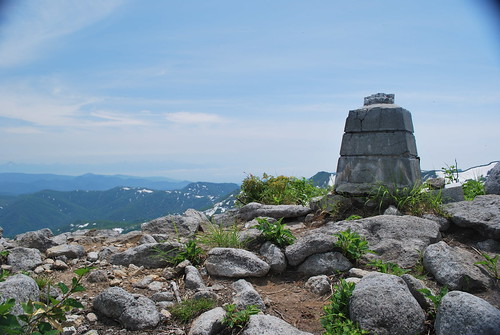
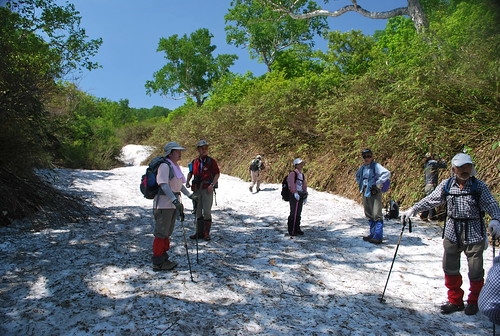
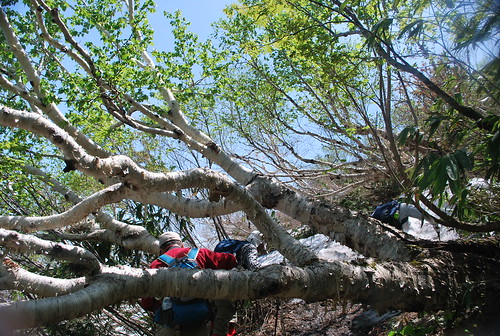
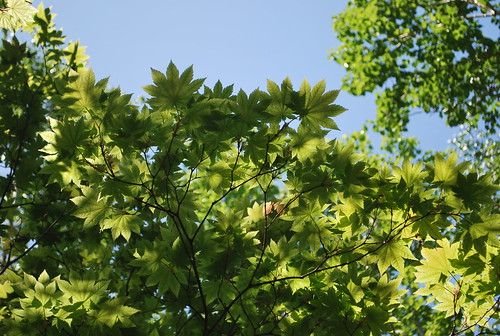
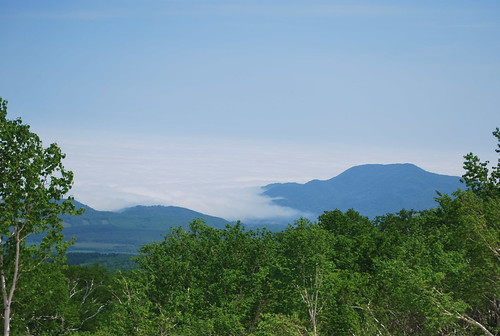
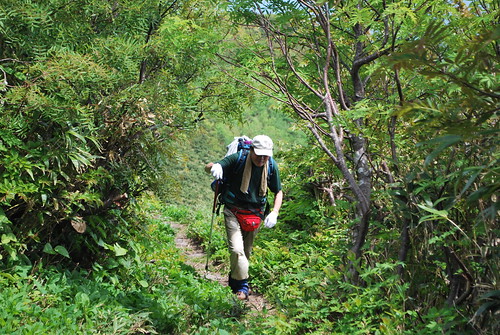
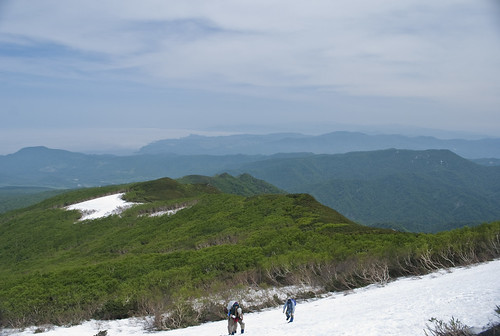
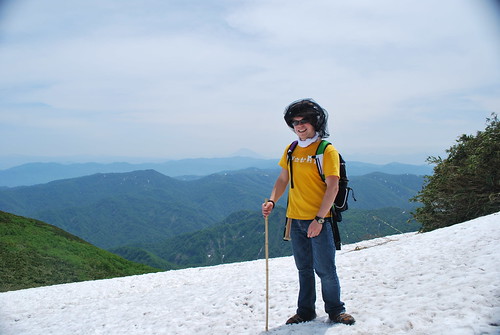
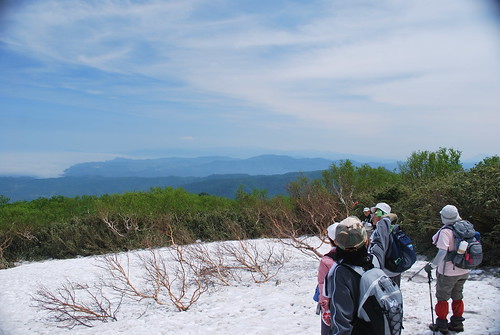
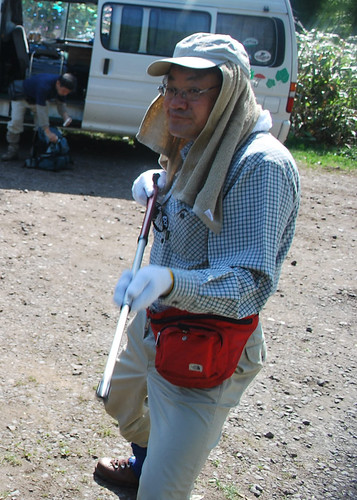
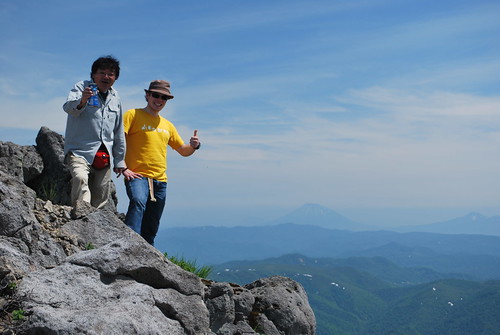
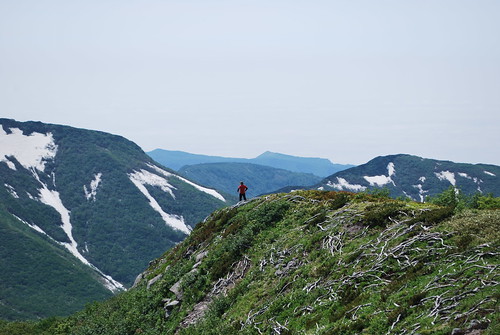
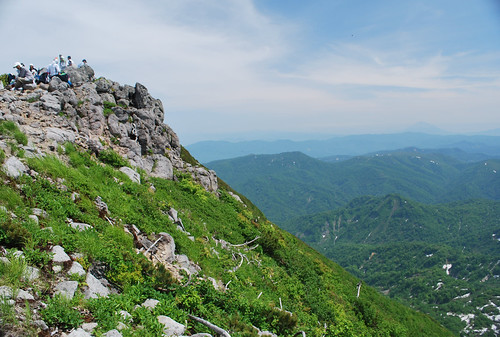
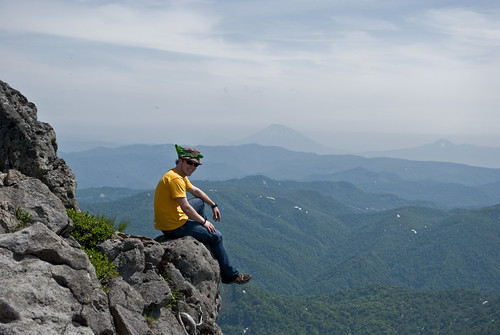
Today I climbed a mountain with my boss and a band of aging Japanese mountaineers. I'd been wanting to climb this particular mountain, which I can almost see from my house, since very soon after I arrived. In his continuing tradition of taking me on interesting adventures, my boss arranged the whole thing with a local climbing/hiking group, and we set out at 7:30 on Sunday morning. The weather couldn't have been better, and we were able to make it up in 4 hours, take about an hour for lunch at the top, then back down in 2 hours. Here's a cross section of the kinds of things you run into on a mountain:

Climbing Shakotan Dake with Jicho, I knock a staccato rhythm on the rocks with my bamboo cane as I cross. But it sounds a little more hollow than I’d hope: like there might be caves down there hiding Tanuki or Tengu.

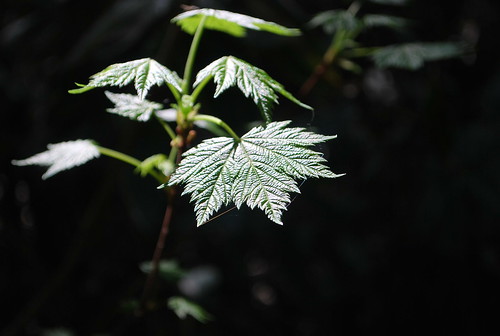
At altitude, birch trees grow low and twisty like mangroves, more horizontal sprawl than towering pillar. Looking down on the world from on high gives vertigo impressions of concavity, of the earth curling up beneath you, and you out over it, until you might just be able to glimpse the unders of rocks.

From up there, where we break for lunch on the peak, we glimpse the standard hallmarks: the now-old friends: Yotei, Niseko An’nupuri. The near-centenarians in our group prove hardier and more versatile than I: cracking beers and lighting tiny gas stoves to cook themselves sumptuous summit suppers. I gulp down water for the heat and onsetting headache, and I dine on the lembas bread of the Japanese: Onigiri. Rice balls wrapped in seaweed with protein-packed, fishy cores.

Up here: still snow, but there’s a change of scene in the green. The Hills of Hokkaido, more Amazon or Andes, and not the Japanese Northern Outpost. No longer the birthplace of winter.

From up on Shakotan Dake, Furubira behind us is barely visible. The elevated plain could be an island in the sky, for at its cliff edges the low-lying coast is overlaid with kiri: low-lying mist that sits like clouds. Throughout the day, it recedes slightly, and we can catch sight of our town, of neighbouring Bikuni. However, by the time we shamble back down the mountain, sweaty and spent, and drive back down to the coast, the kiri is as thick and grey as ever, and it shrouds us in on our way to the onsen.

Saturday, June 12, 2010

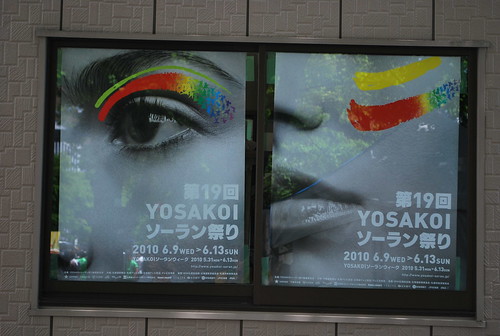
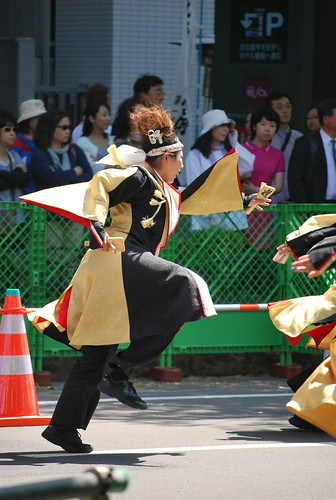
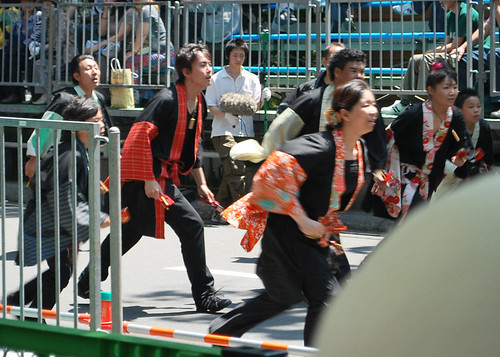
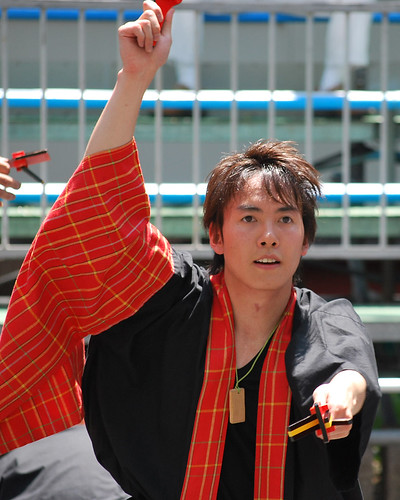
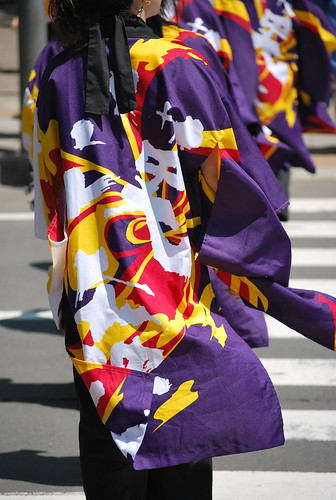
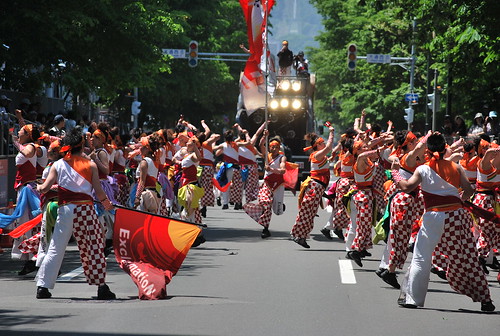
Yosakoi is


Yosakoi is madness.

Yosakoi is forward motion.

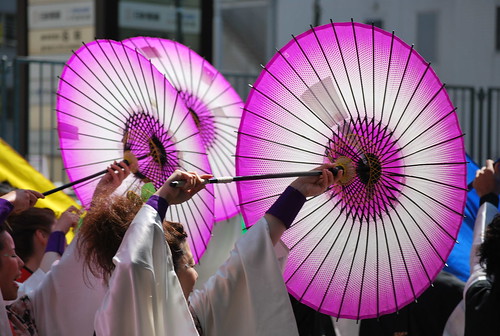
Yosakoi is colour and music and light.

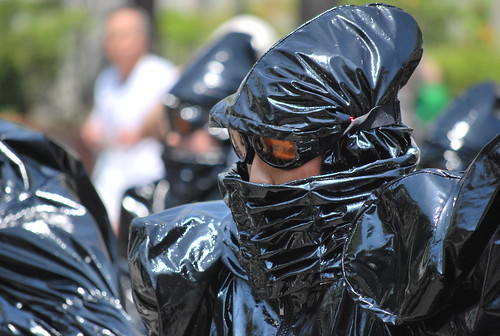
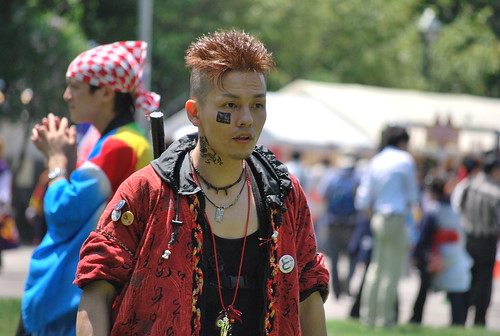
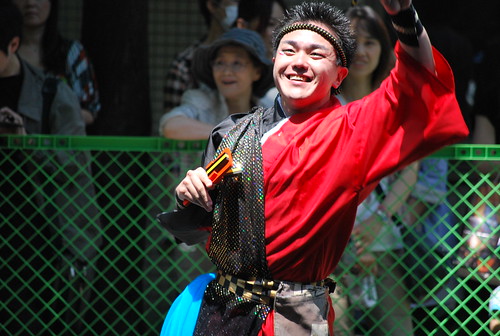
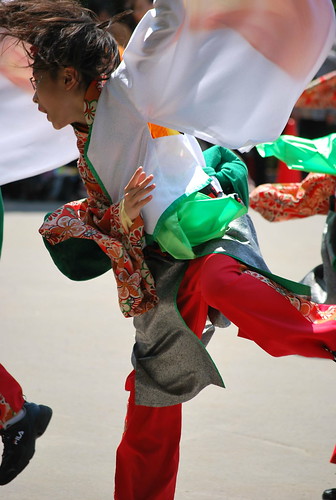
Yosakoi is a thing with a life of its own: a synergetic, Frankensteinian abomination of the fishing-inspired dance that birthed it. Yosakoi is the void that was filled by the surface-shy, but deep-down-explosive Japanese soul. Yosakoi is one voice expressing itself in a multitude of languages and dialects and idioms. Yosakoi is a rough framework for imaginations that express themselves best in rhythm. Yosakoi is the Will-To-Performance of a people.

Yosakoi is your visual definition for “genki.”

Yosakoi is energy uninhibited.

Yosakoi is fire.

Monday, June 07, 2010

Engaru and The Looking Glass

Last weekend Lindsay, Becca, Roz, myself, and the majority of the Hokkaido Association for Japanese Exchange Teachers (HAJET) Prefectural Council headed to President Simon Daly’s place in Engaru for our first, full, officially meeting. The Important Business Bits of the weekend went far better than I could have ever expected (not that I was expecting them to go particularly badly or anything). The Natural Beauty Bits of the weekend are better shown below (coming soon) than described here. The Childlike Wonder Bits of the weekend require a description, though, as the fact that one of Simon’s kiwi-born children only knows how to answer the question “how old are you?” with “Ni-sai!” is only the tip of the uniquely childminded iceberg.

While the Daly Children were up, we served as canvasses and mirrors for their imaginations: Grumpy Bears when we shut the doors of our side room to keep out their early risings; monsters and extraterrestrial ninjas constructing edible moons out of the intergalactic cheese of cosmic cows. We arranged names for ourselves from random strings of guttural noises.

When I told the eldest daughter that she looked like a princess in her dress, she replied that such an observation must make me a dragon, and I should do my dragon duty by chasing and trying to devour her. In my spontaneous dragon voice, scarce more than a gravelly whisper, I informed the child that I had been a dragon for longer than she could understand, that I was forced to take on my present, boy-shaped form centuries ago to escape the persecution of those like her who thought of my kind only as killers and savages.

I told her that dragons abducted princesses only so the princesses would be their friends: so the princesses would cook for them, and clean their caves, and deftly weave the kinds of little beauties that scaly dragon claws could never manage. The dragons would tell the loved ones of the princesses that they’d eaten their daughters because the dragons knew those people wanted to believe it, making it easier for the dragons to be left alone.

In becoming a mirror or a canvas for these children, all of us who still held on to our inner kinder saw the children as mirrors for us as well. While reflecting on how fluidly the telling of the dragon’s tale came to me, the two mirrors aligned, and I tumbled into their infinite regress. I started to wonder if it might not be true: if I might not have been a dragon this entire time and had forgotten, or if it might not have been a previous life.

Perhaps all of us little boys who fantasize about dragons and dinosaurs descended from them—perhaps we had always been them. And all the little girls: might they not have been the faeries and the unicorns and the birds? We, the Thunder Lizards, and them, the Airy Spirits?

What if I had previously been a tree and a dragon and a god?

Friday, June 04, 2010

Janken

Last night I won $200 (20,000円) playing Rock, Paper, Scissors.

Except that’s absurd, and there’s no way you could ever win $200 playing Rock, Paper, Scissors.

I won the money playing Janken, which on initial inspection looks like the Japanafication of Rock, Paper, Scissors. However, it differs on some fundamental level that makes it entirely feasible for someone to win money at it.

In Japan Janken is the great equalizer. The kids seem to play it from the time they learn to walk, freeing up their hands for all of the spasmodic, epic flailing about required by the game. And once they’re old enough to play it, they seem to immediately start using it to settle disputes, in much the same way that we’d flip a coin in Canada or have an arbiter choose a number between 1 and 10.

I most often see janken getting used to settle who gets the leftovers from school lunch. All the students who are interested in a given part of lunch stand up, and they all janken off furiously for it. And “furiously” is the best word for the way Japanese students go about janken. It’s a full body sport, from my first graders who flail their hands or hop up and down excitedly as they wind up, to my fifth graders who strike elaborate poses mid-janken, throwing their handsigns like punches.

These very fifth graders nearly tore down the classroom today as we had an English lesson mostly centered on janken, poorly disguised as a lesson on “how many?”. And the best way that question could have been phrased for the lesson would be “how many of your classmates did you destroy?”. The noise and action of 25 fifth graders throwing down janken in English, Canadian (Suu-Sum-See!), Chinese, Korean, and Chinese was like the wind up to Armageddon. In all the violent throwing of handsigns, energetic posturing mid-game, and ecstatic fist-pumping at victory, I’m surprised more kids didn’t get clocked or plowed through desks and chairs in all the action. The kids were out for blood, and I had to bellow over the discord to reign them in at the end of the janken portion of the lesson.

The reason the kids throw so much of themselves into the game is also one of the main reasons janken is so very different from the western Rock, Paper, Scissors:

It is indisputable.

Regardless of the outcome of a round of janken, the decisions holds and never seems to be questioned. There is no “he cheated!”; there is no “best two out of three?”. Once you have janken-ed over it, it is decided. I saw this most keenly when I stepped up to fight for leftovers with one of my elementay classes, only to win and be forbidden to share my spoils with the runner up: the teacher informing be that janken is “Japanese law.”

When you’re talking about janken, luck never enters into the discussion. When you win at janken, it is because you are strong. When you’re beaten at janken, it’s like being bested in an arm wrestle. The game holds a bearing on this society that is ridiculous, and I wouldn’t be surprised to see business men resorting to covert hand signs to overcome commercial impasses; hung juries throwing rock, paper, scissors around to sort out their differences, the judge never batting an eye when told that they came to the decision by janken.

It’s in this world that you can win $200 at Rock, Paper, Scissors; in this world that your boss will marvel at your ability for the achievement.

Wednesday, June 02, 2010

a year in The Life

Well, it’s been a year since I started this thing. I figured I’d commemorate it with some updates. This is the pretty straight forward, year-of-blog update. I've got something a little more linguistically interesting in the offing, but it will have to come a bit later.


First, I ain’t coming home

Despite thinking I was pretty clear on my decision in the Christmas cards I sent to most people, as well as in my six month post, it appears that there are some folks who are still getting surprised by my news that I recontracted with JET and will be hanging on in Furubira as the ALT until July 2011 at least. So here it is; one more time:

I’m not coming home in August 2010.

Right now I’m scheduled to be back in August of 2011, but there is always the possibility of extending my contract for a further year.


That being said, I’m coming home soon

Sorry to be contrary, but I’m coming home for a visit to Canada this July. The first bit will be in Vancouver for Amy’s birthday (that’s two years running, Thede. I hope you’re keeping track…) and Amanda’s wedding, and the second bit will be in Toronto to catch up with the family and all you mad city rats. However, for reasons of paid vacation limits and planning to work at Tokyo Orientation (even though they decided I wasn’t genki enough >:( ), it will be a very short visit. Therefore, I’m really hoping I can set up some kind of mass do so I can make sure to see everyone.


So where is Furubira, anyway?

I took a look back at those first posts and realized that I got the location of my town pretty wrong. So, though Amy’s likely the only one to care, here are some revised maps to show where I’m at in this mad archipelago.

Further, Furubira is a small fishing town of 3,800 souls—far less than the 14,000 it boasted at its prime, back when we had movie theaters and herring mansions, back before a change to off-shore fishing laws started a steady bleed of our fisherman population. I’d love to make a romantic comparison to the outports of Newfoundland, but the reality is that the fish processing our town is still engaged in seems to keep us running.


The Schools

The junior high school second graders who used to alternate between telling me to leave and telling me to die are now third graders who tell me I’m cool and that I should stay. They’re also entertaining themselves by yelling “hige!” at me from time to time and laughing as I stroke my beard in epic fashion. The junior high first graders who used to be the apple of my predecessor’s eye have slowly degraded into junior high second graders who are only now discovering the joys of telling me to die. Thankfully, my new junior high first graders became far less straight-jacket insane in their transfer over from sixth grade at the elementary school, and there are some among their number that completely blow me away with their level of English acumen.

The Elementary students are angels, like always. Well, the new fifth graders have inherrited the manic mantle from the old sixth graders, complete with the dubious honour of having their homeroom teacher leave on undisclosed, yet surely unrelated, indefinite leave. The new sixth graders are developing some attitude, but it can’t get the better of their genuine interest in learning. The new fourth graders continue to prove themselves to be wunderkind in the interest and ability they demonstrate in our twinning with my mother’s second grade class. The third graders are as fun as third graders should be, the second graders are suffering bit from a possible Sensei-Importance of English disconnect, and the first graders are the light of any day. God, that I could spend my every day trying to come up with new and creative ways to make them explode into those uninhibited peals of laughter. I’m convinced exposure to my first graders could cure cancer, those kids are so cute.

The High School is as a slowly closing High School should be, I guess. Since the year change in March-April, the third graders have graduated and moved on, the seconds have become thirds, the firsts have become seconds, and the first year class is no more. With only two classes to teach there now, I spend even less time at the school, and when we go through the whole process again next March, I’ll have only 50 minutes to teach at the high school, once every two weeks. It will be worth it, though, as the now-second-and-then-third graders at the high school have always been my very favourite students, and my Japanese Teacher of English (JTE) there is unquestionably my most manic, most entertaining teacher. He makes mad things like this on the regular.


The BOE

The other half of any ALT’s job: The Board of Education. Or, perhaps, the Bored of Education when we have to report to it on days when the schools are out and make work to do as our coworkers seem just as confused about what we’re doing there as we are. Thankfully, my BOE seems to be better than most: it is just the right mix of invested in my well-being while not being overbearing in my life. The people there are also as muppet-like as I am.


I’ve got hair

Didn’t say all these updates were going to be particularly interesting, but I’m thin on material, and this is the most hair I’ve had in a while, so deal.


And I’ve got a lady.

Which seems like a fundamentally impersonal way to talk about it, but just like with the recontracting thing, people still seem to be surprised by the news. I guess my less-than-subtle implications could have stood to be far less subtle. Her name’s Heather, and she’s from the UK. She showed up over here in the same JET group as I, and we’re placed not too far apart up here in Hokkaido, with Sapporo as a convenient meeting point between us. To quote the Barenaked Ladies, “she loves me, and her body keeps me warm…”


And since it's what started all this off, here is my own, snowier take on that photo by that Bassguitar guy on Flickr; the one that was my first image of Furubira. I'd been meaning to photograph these rocks for a while, and I finally got the chance in early April. Back then, I said that the picture had convinced me that Furubira was the kind of place I wanted to be. Now, twelve months later, I'm still thinking the same thing.