At the entrance ceremony today, the new elementary 1st graders are sandwiched between their new peers to the back and The Stage with The Flag to the front. They are drowned in the dreary droning of the haunting melody and words of the antiquated, imperialistic, controversial Japanese Anthem. It is a dirge that has always given me the eerie impression that it lingers in time: never starting or stopping, just existing. It fades in, gradually building to a see-sawing, moaning climax, before fading--or flowing--away, back to that place of shadow and light where it waits in time.
Don't get me wrong; there's beauty in it. It's just a beauty that harrows more than it inspires. I am relieved when it fades out, and the lost-looking new 1年生 are fished out of the dark by the nothing-but-sunshine-and rainbows Furubira Elementary school song: a song I'm so in love with that I not only want to learn it before I leave, but I kind of want to ask if I can sing it with the school--if I can bathe in their sometimes-screamy, midget-melodious light.

Showing posts with label school. Show all posts
Showing posts with label school. Show all posts
Wednesday, April 06, 2011

Friday, June 04, 2010
Janken
Last night I won $200 (20,000円) playing Rock, Paper, Scissors.
Except that’s absurd, and there’s no way you could ever win $200 playing Rock, Paper, Scissors.
I won the money playing Janken, which on initial inspection looks like the Japanafication of Rock, Paper, Scissors. However, it differs on some fundamental level that makes it entirely feasible for someone to win money at it.
In Japan Janken is the great equalizer. The kids seem to play it from the time they learn to walk, freeing up their hands for all of the spasmodic, epic flailing about required by the game. And once they’re old enough to play it, they seem to immediately start using it to settle disputes, in much the same way that we’d flip a coin in Canada or have an arbiter choose a number between 1 and 10.
I most often see janken getting used to settle who gets the leftovers from school lunch. All the students who are interested in a given part of lunch stand up, and they all janken off furiously for it. And “furiously” is the best word for the way Japanese students go about janken. It’s a full body sport, from my first graders who flail their hands or hop up and down excitedly as they wind up, to my fifth graders who strike elaborate poses mid-janken, throwing their handsigns like punches.
These very fifth graders nearly tore down the classroom today as we had an English lesson mostly centered on janken, poorly disguised as a lesson on “how many?”. And the best way that question could have been phrased for the lesson would be “how many of your classmates did you destroy?”. The noise and action of 25 fifth graders throwing down janken in English, Canadian (Suu-Sum-See!), Chinese, Korean, and Chinese was like the wind up to Armageddon. In all the violent throwing of handsigns, energetic posturing mid-game, and ecstatic fist-pumping at victory, I’m surprised more kids didn’t get clocked or plowed through desks and chairs in all the action. The kids were out for blood, and I had to bellow over the discord to reign them in at the end of the janken portion of the lesson.
The reason the kids throw so much of themselves into the game is also one of the main reasons janken is so very different from the western Rock, Paper, Scissors:
It is indisputable.
Regardless of the outcome of a round of janken, the decisions holds and never seems to be questioned. There is no “he cheated!”; there is no “best two out of three?”. Once you have janken-ed over it, it is decided. I saw this most keenly when I stepped up to fight for leftovers with one of my elementay classes, only to win and be forbidden to share my spoils with the runner up: the teacher informing be that janken is “Japanese law.”
When you’re talking about janken, luck never enters into the discussion. When you win at janken, it is because you are strong. When you’re beaten at janken, it’s like being bested in an arm wrestle. The game holds a bearing on this society that is ridiculous, and I wouldn’t be surprised to see business men resorting to covert hand signs to overcome commercial impasses; hung juries throwing rock, paper, scissors around to sort out their differences, the judge never batting an eye when told that they came to the decision by janken.
It’s in this world that you can win $200 at Rock, Paper, Scissors; in this world that your boss will marvel at your ability for the achievement.
Wednesday, June 02, 2010
a year in The Life
Well, it’s been a year since I started this thing. I figured I’d commemorate it with some updates. This is the pretty straight forward, year-of-blog update. I've got something a little more linguistically interesting in the offing, but it will have to come a bit later.
First, I ain’t coming home

Despite thinking I was pretty clear on my decision in the Christmas cards I sent to most people, as well as in my six month post, it appears that there are some folks who are still getting surprised by my news that I recontracted with JET and will be hanging on in Furubira as the ALT until July 2011 at least. So here it is; one more time:
I’m not coming home in August 2010.
Right now I’m scheduled to be back in August of 2011, but there is always the possibility of extending my contract for a further year.
That being said, I’m coming home soon

Sorry to be contrary, but I’m coming home for a visit to Canada this July. The first bit will be in Vancouver for Amy’s birthday (that’s two years running, Thede. I hope you’re keeping track…) and Amanda’s wedding, and the second bit will be in Toronto to catch up with the family and all you mad city rats. However, for reasons of paid vacation limits and planning to work at Tokyo Orientation (even though they decided I wasn’t genki enough >:( ), it will be a very short visit. Therefore, I’m really hoping I can set up some kind of mass do so I can make sure to see everyone.
So where is Furubira, anyway?

I took a look back at those first posts and realized that I got the location of my town pretty wrong. So, though Amy’s likely the only one to care, here are some revised maps to show where I’m at in this mad archipelago.


Further, Furubira is a small fishing town of 3,800 souls—far less than the 14,000 it boasted at its prime, back when we had movie theaters and herring mansions, back before a change to off-shore fishing laws started a steady bleed of our fisherman population. I’d love to make a romantic comparison to the outports of Newfoundland, but the reality is that the fish processing our town is still engaged in seems to keep us running.
The Schools

The junior high school second graders who used to alternate between telling me to leave and telling me to die are now third graders who tell me I’m cool and that I should stay. They’re also entertaining themselves by yelling “hige!” at me from time to time and laughing as I stroke my beard in epic fashion. The junior high first graders who used to be the apple of my predecessor’s eye have slowly degraded into junior high second graders who are only now discovering the joys of telling me to die. Thankfully, my new junior high first graders became far less straight-jacket insane in their transfer over from sixth grade at the elementary school, and there are some among their number that completely blow me away with their level of English acumen.
The Elementary students are angels, like always. Well, the new fifth graders have inherrited the manic mantle from the old sixth graders, complete with the dubious honour of having their homeroom teacher leave on undisclosed, yet surely unrelated, indefinite leave. The new sixth graders are developing some attitude, but it can’t get the better of their genuine interest in learning. The new fourth graders continue to prove themselves to be wunderkind in the interest and ability they demonstrate in our twinning with my mother’s second grade class. The third graders are as fun as third graders should be, the second graders are suffering bit from a possible Sensei-Importance of English disconnect, and the first graders are the light of any day. God, that I could spend my every day trying to come up with new and creative ways to make them explode into those uninhibited peals of laughter. I’m convinced exposure to my first graders could cure cancer, those kids are so cute.
The High School is as a slowly closing High School should be, I guess. Since the year change in March-April, the third graders have graduated and moved on, the seconds have become thirds, the firsts have become seconds, and the first year class is no more. With only two classes to teach there now, I spend even less time at the school, and when we go through the whole process again next March, I’ll have only 50 minutes to teach at the high school, once every two weeks. It will be worth it, though, as the now-second-and-then-third graders at the high school have always been my very favourite students, and my Japanese Teacher of English (JTE) there is unquestionably my most manic, most entertaining teacher. He makes mad things like this on the regular.

The BOE

The other half of any ALT’s job: The Board of Education. Or, perhaps, the Bored of Education when we have to report to it on days when the schools are out and make work to do as our coworkers seem just as confused about what we’re doing there as we are. Thankfully, my BOE seems to be better than most: it is just the right mix of invested in my well-being while not being overbearing in my life. The people there are also as muppet-like as I am.
I’ve got hair

Didn’t say all these updates were going to be particularly interesting, but I’m thin on material, and this is the most hair I’ve had in a while, so deal.
And I’ve got a lady.

Which seems like a fundamentally impersonal way to talk about it, but just like with the recontracting thing, people still seem to be surprised by the news. I guess my less-than-subtle implications could have stood to be far less subtle. Her name’s Heather, and she’s from the UK. She showed up over here in the same JET group as I, and we’re placed not too far apart up here in Hokkaido, with Sapporo as a convenient meeting point between us. To quote the Barenaked Ladies, “she loves me, and her body keeps me warm…”
And since it's what started all this off, here is my own, snowier take on that photo by that Bassguitar guy on Flickr; the one that was my first image of Furubira. I'd been meaning to photograph these rocks for a while, and I finally got the chance in early April. Back then, I said that the picture had convinced me that Furubira was the kind of place I wanted to be. Now, twelve months later, I'm still thinking the same thing.

Friday, May 21, 2010
Further Elementary Afternoons
Lunch with the San-Nensei today, dictated by the laws of NIKORASU TAIMU (二コラス タイム), the equitable sharing of my genki gaijin self in five minute chunks per table--all monitored by axeman Tsukada Sensei and his stopwatch. Arriving at the second group of the day, I pose the mandatory "How are you?"s, and a given student replies with "I am bisexual! I like boys and girls!"
When it comes time to janken for scraps and left-overs, I step up to duel with the eight year-olds at their urging, and, miraculously, come out on top of the confusing five-way exchange that follows. I try to play the diplomat, offering to share and feeling low for stealing food from the mouths of babes, but in a grammatical slip-up that is remarkably accurate, Tsukada informs me "no sharing. japanese law."
But I'm not long in my gluttonous guilt as the Yo-Nensei swoop in to save me from it. In an act completely contrary to the increasingly ravenous nature of the higher grades, the fourth graders gift their leftovers to the thirds. I pause in it, chalking up one more reason for why the fourth graders may just be my favourites.
And then it's back to the madness of ニコラス タイム, and the students clamour to tell me how they are, stringing together as many of the adjectives they know and, unwittingly, posing deep, metaphysical questions about whether someone can be at once hot and cold. One of them orders me to sit as she clambers onto my shoulders, braiding her fingers into my hair and reigning me towards the gym. There, Nojima Sensei and I are instructed that today teachers are Oni, as we always are, and the children put us through our paces as we're forced to chase them through the monstrous, echoing space.
Afterwards, sweaty and spent, I can hardly take a seat in the teacher's office before one of our Ichi-Nensei catches sight of me through the window, and her classmates' adorable calls of "HARO NIKORASU!" draw me outside to answer questions of "what is hana in English? what is boshi? what is sakura?". I comb the playground grass with them, searching intently for who knows what, and overcoming their shrieks to take my turn at braiding flowers into their hair.
Tuesday, April 13, 2010
Uniformity Check
They’re conducting uniformity checks at the junior high school today. Every student is getting measured and weighed. I feel like that kind of think never happened back in Canada when I was a kid, but maybe that’s my memory humoring me. Though these health tests have been long scheduled, I can’t help imagining them as crackdowns by the uniformity enforcers after the recent individualistic dissention among the student body.
You see, one of the single greatest hellraisers in my third year class (grade 9) dyed his hair the other day. Back in Canada, where we all have unique hair naturally, switching from one shade to another at will would hardly elicit a reaction from school officials. However, here in Japan, where hair colour is standard-issue, electing to change your mind about yours is a suspendable offence.
Honestly.
This student came to school with hair some shade of faux-blonde no different from the majority of the actors and j-pop stars and media personalities you come across on Japanese TV, but he was sent home for it. He was told that he could return to school when he had returned his hair to something better resembling its natural colour, and I picture one of the staff greeting him at the door upon his return, holding up a set of black hair swatches to his head, much like those used in the second world war to identify true Aryan blonde.
And this isn’t the first time it’s happened, either. A couple of my third year students last year were repeat hair offenders.
All of a sudden the kids freaking out about my blonde hair makes a little more sense. Because of how I was born, I get away with something they’d be sent home for.
The whole thing gives me a little more respect for this particular student. King hellraiser or not, he was looking to differentiate himself from the self-same, uniformed masses in one of the last ways left to him. When I was his age, I was coming to high school with snowcone vivid fuscia and aquamarine stripes across my scalp, and I was never subject to any kind of reprimand. He shows up with something similar to my hair colour, and he’s suspended. For an instant, I contemplate dying my hair black in a show of solidarity, but then maybe it would be I who was getting turned away at the door: sent home and told not to return until I looked a little more gaijin.
For all of my gaijin immunity, I’ve got a uniformity check of my own coming up in the next month or so. Every year Japanese teachers are subject to health testing, including blood testing. Many ALTs/JETs balk at such a practice, feeling that the medical tests are unwarranted to the point of being invasive. For my part, I didn’t much care, even going so far as to muse on the topic of what, exactly, the Japanese are doing with all of that gaijin blood they’re collecting (hybridizing the gaijin gene?). It was all one big laugh until I came in to my board of education on Monday and the office lady told me that my health test was coming up and I had the choice of either drinking barium and having the doctors X-ray my stomach, or drinking local anesthetic and having the doctors run a endoscope down my throat.
I asked her what this was all about, informing her that I felt fine.
“It’s preventative,” was her only response.
Craig tells me that they’re surely checking to see if I’m turning Japanese yet from all of the tasty Japanese food…that or they’re checking to see if they should extricate the alien they’ve implanted within me before it bursts out of my chest.
Tuesday, March 30, 2010
Board of Education Daze
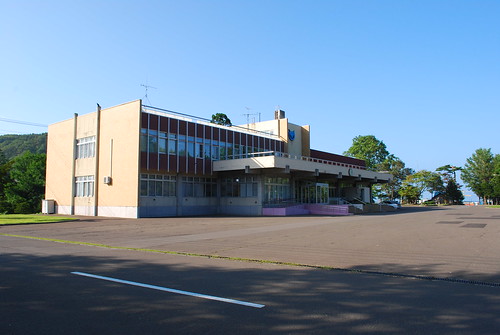
Right now in Japan we’re between school years. Just as a September to June school year seems like blasphemy to the Japanese, I’m sure you western kids will be surprised to hear that the school year in Japan starts in April and ends in March. It’s a weird thing until you wind up in Japan in March, and you see that it’s the perfect time for a year to end and April is the perfect time for a new year to commence. The days start to get longer and you remember what the sun was like as the snows of Hokkaido finally slow, allowing the massive drifts on the ground to begin to break up and melt. In other, more southerly parts of Japan, this is cherry blossom season, and those flowers become deeply woven into the graduation ceremonies of March.
And though schools close for about a week and a half between the ending of one school year and the starting of the next, all of us ALTs are still expected to be on the job.
In Japan, unlike in Canada, teachers and students don’t share the same holidays. When school is out for the students, the teachers and Board of Education staff are still expected to be sitting at their desks, dutifully working away at preparations for when classes resume. If teachers want to be off during these breaks, they need to schedule paid vacation days, or nenkyu. As the majority of us ALTs don’t get anywhere near as much nenkyu as the teachers do, we wind up with Board of Education Days: hours spent sitting in our Board of Education offices in town halls or cultural halls, trying to fend off boredom by studying Japanese or preparing materials for classes or obsessively checking our email. A lot of other ALTs seem to loathe these days, but I must say I don’t much mind them.
That’s because my town uncles come in to visit on Board of Education Days. There is Shinkai-Sensei, my kendo instructor, who sometimes rolls in to go over complicated branching hierarchies of kendo styles and strikes, and other times to discuss the finer points of a healthy Japanese diet. And there is Aami-San, who’s name, I must confess, I don’t actually know. I’ve taken to referring to him by the noun he first associated with himself: pointing to his nose in that Japanese way and saying the Japanification of “Army.” Between his militant English vocabulary and my anarchic Japanese, we have conversations about fishing and white water rafting and his years in the service. Or at least I think that’s what they’re about as my imagination tends to flow into the gaps in understanding, colouring the exchanges in ways that could be miles from their actual meaning.
Also, I get to go home for lunch on Board of Education Days. On my way in the door, I often find postcards from Tokyo or letters from Aomori or distinctive other treasures from all of you back home. For lunch, I do my best to be a good little Nihon-jin: supping on miso soup and flavoured rice and Japanese pickles. For all of the convenience of the provided school lunches (kyoshoku) I receive on other days, there is something simple and fulfilling in being able to make my own lunches on these days. And when I finish my very Japanese lunches, I jump onto skype and sometimes I talk to you at odd hours of the night where you are. When it comes time to return to work, it never seems like that much of a chore as the very short walk back to the bunka kaikan always seems to be particularly sunny and glorious.
Everything just seems to be light-hearted and chilled-out on Board of Education Days. People roll in and out of the office, and my wacky BOE coworkers joke with them, and they joke with me. When they use Japanese I can understand, we all laugh together. And when they use Japanese I can’t fathom I smile along, too, simply because these people would be just as entertaining in Urdu. We share tasty omiyage, and we share goofy photos, and ムんムんさん and むらかみさん tell me about how they’re going to be my chaperones with Heather because we can’t have any rabu rabu going on as that would be dame.
In the end, the days spent being Bored of Education wind up being just as welcome and necessary as the days spent having elementary students climb all over me, and I find myself not minding their slower rhythm in the least
Monday, March 08, 2010
Carnage/Creation
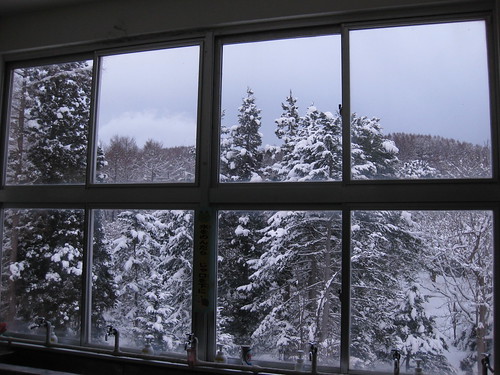
Today the town of Furubira started construction on the new elementary school. I had known this was coming down the pipe pretty soon, and I’d been told that the location for the new building would be right beside the current elementary. However, I hadn’t realized exactly where the new building was going up until today when I was on my way to class. Just outside the windows of the bathroom wash stations, two large pieces of construction equipment were laying waste to one of my favourite bits of forest (an area that is possibly one of the prettiest views from my elementary). From the windows above the wash stations, I was treated to a perfect, overhead view of the carnage/creation going on outside.

Some of the students who come to the wash station look out on the scene and see only carnage. The stand of evergreen that once served as a vertical canvas for the falling snow now lies in a dense tangle of the green of boughs, the brown of bark, and the raw yellow of living wood. All around it, the unspoiled white has been chewed up by the steel treads of the lumbering machines, leaving tracks vaguely reminiscent of rampaging buffalo or marauding Hollywood indjuns. One of the machines sweeps its mechanical claw out in front of it like an arm, brushing aside the deep snow until it reaches a lone remaining sapling. With a dexterity that might make one mistake it as an extension of his own arm, the operator reaches out with the mechanical claw and closes it around the small tree’s trunk, snapping the thing off instantly with a crack that can be heard from high above. The arm tosses the piece into the knot of fallen trees, and the claw digs in again at the base of the splintered trunk, pulling up the root ball like a dandelion stem. The black of its earth sprays across the snow white as the arm hefts it, too: cart wheeling through the air to land in the pile of slash.
Another student comes to the wash station and can hardly notice the carnage for all the creation going on around it. He sees the tracks of the machines making the land more and more level with each pass, their action on the trees removing the chaos from the soil and instating order. He draws vectors between the construction-capped workers rambling through the disorder. From the rough plans he saw in his parents’ copy of the town newsletter, he already begins constructing the new school in his mind’s creative eye. From out of the snow and dirt and twisted trees rise vertices of potential, and in the empty space in the forest outside he can already picture how he will run the circuit of the new building’s halls, counting the windows and the walls in its many rooms. He can already smell the fresh plastics and the drying wood glue, feel the light plaster dust in his hair.
While a third student stands at the wash station with her back to the windows. She can see only the ancient architecture in this place: this giant, rambling school that was built for a different age of this town—back when there were movieplexes and supermarkets and sprawling herring mansions. In this aging elementary, mere motion is a covert act as you’re more likely to be lost in it than found. In the scene outside, this student sees only the end of the old girl: this vast, often cold, sometimes lonely classroom castle that has been the birthplace of dreams ever since she wandered into it as an ichi nensei. It is a place so empty that it happily allows itself to be filled with anything you like; where past is so very present that it has to be kept in check least the yesterday should muscle out the today.
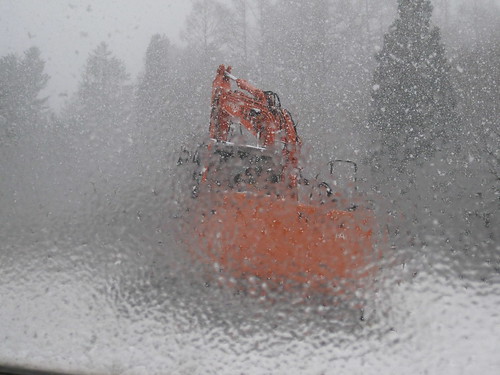
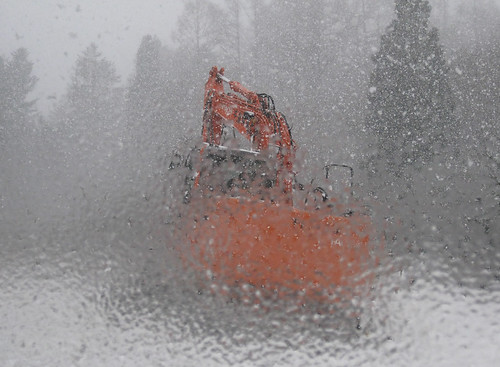
But on the lowest floor, the wash station windows are still boarded over. Ostensibly, it’s to protect the windows from the mountains of snow and ice that avalanche down from the rooves of buildings in this northern outpost; the vast loads of white piling up in glass-threatening quantities. However, with the melt now begun and winter on its last legs, I wonder if the boards might not have been left up to shield the eyes of our youngest students who make their homes on the first floor: their new minds still too impressionable to make much sense of the carnage or the creation just outside. Instead, they are treated to furtive glimpses through the cracks between two-by-fours, and their fertile imaginations attribute the grinding cries and flashes of orange beyond to dinosaurs just as often as to steam machines.
Friday, November 20, 2009
ITADAKIMASU!

In Japanese elementary and junior high schools, students receive a free prepared lunch every day, delivered to their classroom and served up by their peers. The teachers at the schools benefit from the same system, though they have to pay for their lunches. Regardless, not having to worry about packing a lunch is a fantastic experience. And, what’s more, the stuff that they serve up at the schools is often above par when compared to the cafeterias of Canadian schools. I mean, it could well be the Japanese equivalent of cafeteria crap in the eyes of native Japanese. However, if that’s the case, we thankfully set our bar far lower in Canada when it comes to deciding what’s fit to serve our young, growing, academic minds.
The culinary abominations of my own high school cafeteria have left me feeling like Japanese school lunches are meals fit for a king. They all tend to be at least “alright,” and at times they even nudge into “good” territory. The fact that I don’t have to make them myself and don’t have to pay for them up front also does wonders for the flavour. And, at the elementary school, the school lunch is further improved by the fact that I get to eat it in one of the classrooms with the actual students.
And when you sit and eat with the students, you can really catch glimpses of their growth. The younger grades at the elementary hardly ever clamour for seconds, electing instead to feed them to big fat gaijin sensei (that would be me). Up around grade 4, the students start developing an appetite, and by grade 6 they are screaming for the left over scraps and fighting furious janken1 wars for half a tempura shrimp. By the time the kids reach junior high, their bottomless teenage stomachs have them banging down the door of the teacher’s room on days when lunch is particularly good, looking for any scraps we happen to leave behind.
There's also the whole ceremony around lunch here. When you're eating in the classrooms with the kids, one of them will be assigned to the role of class leader for the day. This person usually prompts the rest of the class for greetings (every Japanese school period starts with students greeting their teacher, and every Japanese school period ends with students saying goodbye to their teacher), and I'm pretty sure this leader can be taken to task when the rest of the class is acting up.
When it comes to lunch, this leader is responsible for beginning and ending the meal. It begins with a raucous "ITADAKIMASU!", which is thunderously echoed by the rest of the students. It roughly translates to "thank you for this meal," but it is far more symbolic than that, referencing buddhist worship and the idea that an animal dying to feed you is one of the greatest sacrifices it could make. When you hear it every day, it starts to lose its meaning and becomes a bit of a joke as students bellow it at the top of their lungs, but as soon as you make the mistake of starting to eat before it has been said, you quickly realize how important this ceremonial element is (and that realization makes you feel like a big, stupid gaijin pretty quickly!). And, once the final student is done eating, the same class leader will clap their hands and yell "gochisosamadeshita!", which loosely translates to "it was a real feast!" and serves as the formal ending to the meal.
Just like with ever other pedestrian event in Japanese society, you've always gotta have an opening and closing ceremony.
In addition to sometimes being rather tasty, the lunches provide a degree of entertainment. Take today, for example, when I was served with a riddle, battered in a crunchy mystery coating, seasoned with some tasty enigma sauce. We got a 8-10” hotdog bun, a plate full of fried noodles, some of the awesome-fire-engine-red pickled ginger, and the meagerest scrap of Japanese bacon-cut pork you’ve ever seen. That last one, as we painfully discovered one hungover Sunday morning, is a clever ninja ploy that looks just like western bacon but tastes like a really skinny piece of pork. Yeah, it doesn’t sound so bad until you put it in your mouth expecting bacon, and you find out that it’s not.
That was my lunch, and just as I was about to set into it with the provided fork, I noticed the teacher across from me cramming the piece of faux bacon, ginger, and noodles into the big hotdog bun. I suspected this might be some clever ploy to make me look like the foolish gaijin barbarian everyone suspected me of being, but I looked around and saw everyone else was doing it. Apparently the carb-tastic meal was called yaki soba pan, which directly translates to “fried noodle bun” (duh). Why you’d eat fried noodles in a bun is beyond me, but that was the way of it.
1Janken is the Japanese version of rock-paper-scissors. But, when compared to the intensity and form of janken, rock-paper-scissors resembles a series of aimless, spasmodic flailings.
Friday, October 30, 2009
The Halloween that Wasn't
Well, despite the fact that the Japanese most definitely do not celebrate Halloween, I'd be damned if I wasn't going to hook it up for the kiddies over here.
I figured my greatest Halloween victory would occur at the Elementary School. They're usually the ones who have the least structure, meaning I have the most freedom of what particular Englishism I want to impart to the littleuns. I envisioned an all-day Halloweenfest, with the kiddies showing up in whatever costumes they could smack together. I didn't expect much since, as I already mentioned, the Japanese don't celebrate Halloween. And apparently my coordinator at the elementary thought the same for the same reason. She told me that there was no way we could have a Halloween extravaganza on the Friday before Halloween because A) all the students would be far too busy diligently preparing for their school festival on Sunday November 1st and B) there was no way any of them would have any costumes to wear to school.
I tried to negotiate a visit to all of the grades, rather than just the grade 5 and 6 visits I had scheduled for the day. I figured It'd be a pretty easy negotiation that would go something like this:
Me - "I want to teach every period of the day next friday, taking over each of the grades for a period and giving each of their homeroom teachers a break."
My Coordinator - "You want to work your ass off and you're not making any more work for any of the teachers? Sold. Go for it. Job's a good one."
Unfortunately, I'd clearly underestimated the importance of this ruddy festival, and the best I got out of her between bouts of teeth sucking (a patented Japanese form of "well...I don't know...") was something along the lines of an "I'll ask the other teachers, but they're all pretty busy...and the grade 5s and 6s have an established curriculum, so we can't deviate from it for something like a Halloween lesson."
So I went to my other schools from Monday to Thursday, expecting little form the Elementary on Friday. I wore my cowboy outfit to the High School on Monday as a bit of a dry run since my JTE (Japanese Teacher of English) at the High School is chill and is amenable to the bouts of English mayhem I try to create. The students at the High School are this wonderfully chill brand of kids. I mean, their English ain't so hot since their school isn't all that academic, but I swear the worst these kids could ever throw at me would be a half-hearted sneer. They seemed to rather enjoy my outfit.
For the Junior High School on Thursday, I dressed up like a matrix reject. Very shortly after I started at the Jr. High back in August, some of my third year students had told me that, if I slicked my hair back and wore my sunglasses, I would look like this character named Albert Wesker from the the Resident Evil/Biohazard series of survival horror games. Well, I say they told me that, but when you factor in their broken English and my rudimentary Nihongo, it was more like they were communicating by smoke signals, and I was responding in semaphore, but somewhere in the middle I got "Hair. All back. Uesuka!" from them. I googled the guy, and when I saw his picture I thought "well. That's easy."

Some black clothes and some bicycle gloves later, I had all the students who had played Biohazard thinking I was a cool dude, and all the rest of them thought I was some freak who liked the Terminator movies an awful lot. (In Japan, if you're a white male wearing sunglasses, and you're a bit brawnier than the standard Japanese build, everyone tells you that you look like Arnold Schwarzenegger) Either one was fine by me.

Then I headed to the Elementary this morning, expecting little of the day but planning for the worst. I figured that since I had offered to teach all the grades about Halloween I should at least be ready to do so if my coordinator had managed to swing it. Plus, I'd had previous experience with her telling me something might change, only to inform me that it had, infact changed ten to fifteen minutes before I needed to have a completely new lesson ready for a completely different class.
And today was no different. I rolled in this morning, and she informed me that I would be visiting all six grades today. Surprisingly, all of the homeroom teachers had happily agreed to let me take over each of their classes for a period, saving them the lesson planning and teaching time.
Imagine that.
So I was able to bring a bit of Halloween to all of the classes today, doing things like drawing paper pumpkins, teaching them to Trick or Treat, and showing them pictures of all my mad costumes over the years, and all the mad costumes my friends had donned. The following picture of Alex was a real hit with the kids. I don't think you can say you've lived properly until you've seen a first grader imitate that rocker face.

I also told a ghost story to the older grades. Despite having to tell it through a translator, the kids were genuinely freaked out, so I don't think it lost any of its creepiness. What's more, I got them going and they told some ghost stories of their own.
But, what made the whole day was the one particular class where, without any prompting from me, the teacher had helped the students to build makeshift costumes. When I showed up to their class, they were sitting orderly in their seats, and every last one of them was wearing a costume.
Shit, man.
When Halloween means as much to you as it does to me, and it seems you have to fight tooth and nail to convince some of your friends/coworkers that there's a unique joy in throwing on a costume, to show up in a classroom in a country that doesn't celebrate Halloween and to find every last one of your students wearing a costume that they made from scratch specifically for your 45-minute visit...
James Donald Jones captured it best when he said "well. That just makes me feel about ten feet tall."

Friday, October 16, 2009
Another Elementary Afternoon
There’s a cacophony loose in the elementary school today. The students are practicing for their school festival at the end of the month, which means that the separate grades are banging away on separate instruments, sequestered in separate classrooms, all over the building. And at certain points in the school’s hallways, different parts of the cacophony will harmonize, and the haphazard symphonies that emerge are endearing and a bit haunting as they echo away down the long corridors of this place.
_______
A third grader passed close to me and caught a whiff of cologne or deoderant or detergent from my shirt. She pressed her face into my shirt and held it there for a minute—for a second, I almost thought I could feel her breathing—before pulling away in a swoon, exclaiming iinoi! As if it were a call, that got the rest of her class to surround me, each of them planting their own faces in the fabric of my shirt and holding there, immobile for a moment, before withdrawing with iinois of agreement. I stood there, frozen, not knowing what to do and not wanting to interrupt them.
_______
A fifth grader burst into a giggling fit as she tried to get out the words “red sweater” in the middle of a game we were playing. There was no doubt that she could do it as she regularly trips over herself to bombard me with her most recent Englishisms at nervous, breakneck speed. But all she could squeeze out when she tried was giggles, and her giggles got me giggling, and it didn’t help the situation any to have a member of the opposite team blurting out “PANTS!” “GREEN!” emphatically, over and over, despite the fact that his card depicted “green shorts.”
Thursday, October 15, 2009
INFLU
Monday October 5, 2009.
Plague masks out, kids.
What was a humorous one-liner last week appears to have fully descended on the schools of Furubira this week. I realized it when I walked into the teacher’s office of the elementary school on Monday, and I had the normally laughy-jokey Kyoto Sensei (vice principal) pretty much forcefully apply one of those sick masks to my face before I could breathe too much of the air unprotected.
INFLU, as the Japanese call it, had finally gotten its pestilent little claws on the schools in my town.
This wasn’t the first I had heard of it as the teachers had been throwing the word around for about a month now, but I had written the whole thing off as media-boosted heebie-jeebies, akin to what was going on in Canada before I left around the whole Swine Flu threat. However, when I rolled in on Monday and was informed that my awesome third grade class had all been quarantined at home, and the teachers (every last one of them with a plague mask on) were planning to close the rest of the elementary for a week at the end of the day, it was clear how seriously the town was taking this whole thing.
And the reaction at my junior high school was no different on Tuesday. Fortunately, the first victims of the seemingly sympathetic superbug were three of my favourite {sic} students. It was also decided that the second year class would be closed and sent home for the week at the end of the day. The teachers at the Jr. high weren’t wearing masks yet, but they might as well have been as their speech was already infected and every second word out of their mouths was “infruenza.”
For me, the whole thing resulted in a kind of half-assed holiday as I still had to show up for work, but I had no students to teach.
For the town, though, it has had a broader impact than expected.
Another second or third year JET had once told me that my town was dying. There was some truth in the statement as my town once had roughly 14,000 inhabitants but has since shrunk to only some 3,800 people. The high school I visit will be closing in two years, and the public kindergarten has already closed. And having this other JET pronounce this death sentence got me down for a bit as I began to dread the idea of spending a year or more in a “dying” town.
Then I took an objective look at the situation and realized that the JET was wrong. There was still life in this place, and that life took the form of 3- to 5-foot munchkins that ran along its streets and through its parks. I saw that as long as Furubira had children, Furubira would be alive.
Strangely, this whole INFLU thing has served to prove my observation.
On my morning walk to the junior high school, I cross paths with the patchy stream of elementary school kids flowing in the opposite direction toward their school. Where we meet, they invariably greet me with a “HARRO NIKORASU!”, and I reciprocate with a “goodmorning!” or “hello!” in a tone that is probably a little loud for first thing in the morning. I also come across their crossing guard, the jack-of-all-trades Nakamura Sensei. He always greets me cheerfully, forces the children to greet me in English, and then he wishes me a good day. The best word to describe the whole exchange is “Genki.” (Japanese for “energetic,” but, as with most Things Japanese, it means a good deal more than that)
But on Tuesday morning, with the elementary closed for the rest of the week, there were no loud elementary students, and there was no genki Nakamura Crossing Guard Sensei. The walk to work was quiet, uneventful, and the furthest thing from lively.
It was the same case at Kendo on Tuesday night. On Tuesdays and Thursday nights, the kendo dojo at the sports centre is usually filled with the screams of the kendo kids. Climbing the stairs to the dojo, I can hear the kids before I can see them. The stairs resonate with their laughter and the explosive impacts of the balls they whip around in their indecipherable version of dodge ball. The game passes for a warm up activity as they wait for their kendo senseis to arrive. When I walk in, the kendo kids assign me to one of the two teams, and the other team gets to delight in firing balls at my head.
But that Tuesday night, I walked up the stairs to the dojo in complete silence. I entered the half-darkened, empty room, and there wasn’t another soul around. It appeared that the quarantine instated at the elementary school extended to all of the students’ extra curriculars as well. I warmed up on my own and even had the opportunity to attempt something like meditation in the quiet room before the senseis showed up. As it was just me there with the two teachers, we were able to get down to some pretty intense sword fighting action, but it wasn’t the same without a gaggle of 3rd to 5th graders running interference. The class was far more serious and far less alive.
So maybe I was right. Maybe it is the case that Furubira survives so long as it has children flowing like life through the arteries of its streets. And should the town ever lose those children, like it did last week, it would slowly start to fade to a cold, dead thing.
Friday, September 18, 2009
Elementary Afternoons
Here's another reason why I think everyone should spend their Fridays at an elementary school.
When I'm at my elementary school, the most randomness seems to transpire on Friday afternoons in the fifth and sixth periods when I'm not usually booked to teach class.
Today was no different. Just after lunch, the first grade teacher rolled in and asked me if I wanted to participate in some kind of outdoor activity with the first graders. As my Japanese ability is currently resting somewhere around that of a three-year-old, I had no idea what she was asking me to do. However, the first graders are, pretty much, cuteness distilled into a substance so pure that it could probably fuel jet fighters—a substance so intoxicating and contagious that it has even rubbed off on their teacher, making her the cutest thing going in the staff room.
So, when she asked me to spend a period with her and her class, I didn't particularly care what we were doing. She could have been asking me to watch grass grow with her class for the period, and it still would have been the cutest 45 minutes I spent all day.
As she escorted me outside, the English equivalent finally occured to her, and she errupted victoriously with "BUTTERFLY!" "CATCH!". And, sure enough, when I got outside, I was greeted by a whole bunch of midgets, wearing their standard reversible red/white hats, armed with bug nets on poles twice their height. Most of them also had bug cages hanging around their necks, and these whipped around violently as the first of them caught sight of me and errupted in cries of "NIKORASU SENSEI!"
( I don't think I'll ever get tired of that. )
With an ichi-nensei holding each of my hands, and one latched somewhere on my shirt, we wandered around the back of the school and up the old concrete steps to the playing field. This wide staircase was once made of concrete, but it has since fallen into a kind of decrepit equilibrium that makes you wonder if it hadn't been swiped from some south american temple.

Its broad sweep is surrounded by forest, punctuated by plants, and it is pretty much my favourite part of the school yard. The playing fields that the staircase leads up to are in no better shape. What was once an impressive set of tennis courts has been blanketed in creeping vines that make the courts look more like something abandonned by the Dharma Initiative, and what was once a baseball field has had its fences reclaimed by those same vines and its infield grow long with grasses and weeds.
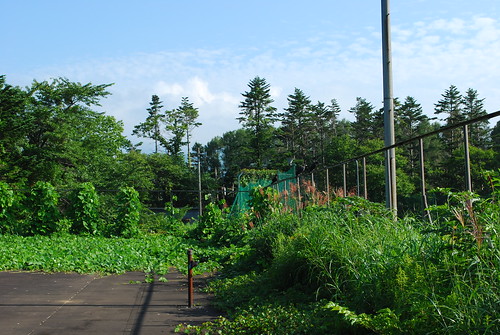
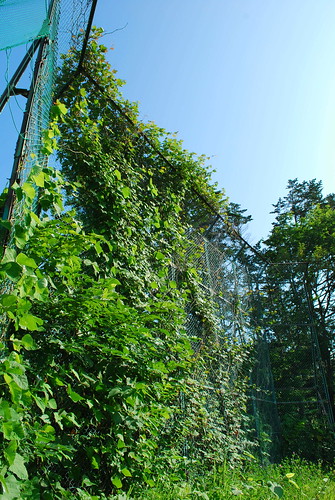
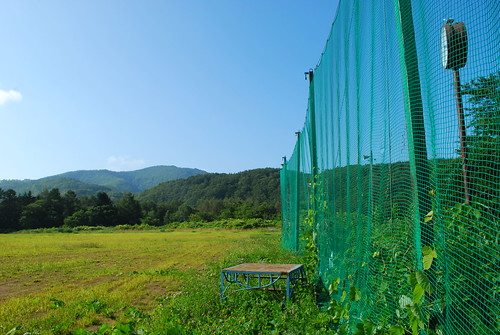
Though this overgrowth makes the fields fairly useless for their intended purposes, it also makes them the perfect place for tracking and trapping all manner of winged bug. In the light of the westerning sun and the shadows of the long grasses, I watched the ichi-nensei scatter, taking off after anything that shot by on the wing in a riot of gleeful giggles. I was dragged to and frow with cries of "SENSEI!" as the task of transfering bugs from net to cage without mashing them had fallen to my careful hands.
And the intrepid little hunters nabbed some real monsters. Aforementioned cute teacher netted one of the biggest grasshoppers I've ever seen, and one of her students managed to get four dragonflies into an impossibly small bug box without any help from me. Every successful catch seemed to egg them on all the more, and it wasn't long before the little bug boxes were abuzz with the sounds of dragonflies that had been forced to share quarters with butterflies and grasshoppers.
So this is where I spent my Friday afternoon: terrorizing bugs in Japanese with a band of first graders.
I still can't come up with something that could have been a more productive use for the time.
Tuesday, August 25, 2009
School Snippets
A number of people have been asking me how the whole teaching/school thing is going, and I realized I’ve mentioned very little about it on here. Mostly, that’s because I have only been visiting the schools for four days, and that doesn’t seem like enough experience to base any sweeping statements on. That being said, in those four days I have managed to happen upon some salient moments, so I can pass those on.
So, in chronological order…
Elementary / Shoogako
You haven’t properly lived until you’ve experienced the unmitigated wonder of a round little first grader in chef’s hat and apron serving lunch to you and his classmates—one concentrated ladleful at a time.
High School / Koko
One of the girls in my third-year class looks familiar, and, to make matters worse, she keeps looking at me and laughing behind her hand. Eventually, question and answer period roles around, and—through my JTE’s translation—she asks me if I remembered her from the Kombini in town—the ONLY Kombini in town.
And the only thing going through my mind is “oh crap. Did I buy beer from one of my students?”
Middle School / Chyugako (blogger ate the formatting, and I'm too lazy to try to fix it, so I apologize)
Junior High School kids
Playing badminton
with the ferocity of Tennis Pros.
Me, I thought it was a good idea to play with them.
And
Just like when I agreed to join an Ultimate Frisbee team,
back before I’d ever properly played the game
and I still wondered why Overly Athletic Ally was so into it,
when, already tired from running the length of the field,
direction of play switched on me,
and I had to run all the way back.
Just like then,
I realize I have severely underestimated
the potential intensity of this game—
nay
—this Sport
And all I have to look forward to today
is having my ass handed to me
by a fourteen-year-old
girl.
Subscribe to:
Posts (Atom)