Thursday, October 24, 2013
Reblog: My Japanese Name
Stumbled across the following on the Crackbookverse, and was utterly blown away at what an authentic representation it was of a certain facet of the Japan experience. Though my own Junior High was not this bad, I can empathize with a lot of this. My Elementary school, on the other hand, was DEFINITELY this good.
http://jasonporath.com/blog/2013/06/my-japanese-name/
Tuesday, April 13, 2010
Uniformity Check
They’re conducting uniformity checks at the junior high school today. Every student is getting measured and weighed. I feel like that kind of think never happened back in Canada when I was a kid, but maybe that’s my memory humoring me. Though these health tests have been long scheduled, I can’t help imagining them as crackdowns by the uniformity enforcers after the recent individualistic dissention among the student body.
You see, one of the single greatest hellraisers in my third year class (grade 9) dyed his hair the other day. Back in Canada, where we all have unique hair naturally, switching from one shade to another at will would hardly elicit a reaction from school officials. However, here in Japan, where hair colour is standard-issue, electing to change your mind about yours is a suspendable offence.
Honestly.
This student came to school with hair some shade of faux-blonde no different from the majority of the actors and j-pop stars and media personalities you come across on Japanese TV, but he was sent home for it. He was told that he could return to school when he had returned his hair to something better resembling its natural colour, and I picture one of the staff greeting him at the door upon his return, holding up a set of black hair swatches to his head, much like those used in the second world war to identify true Aryan blonde.
And this isn’t the first time it’s happened, either. A couple of my third year students last year were repeat hair offenders.
All of a sudden the kids freaking out about my blonde hair makes a little more sense. Because of how I was born, I get away with something they’d be sent home for.
The whole thing gives me a little more respect for this particular student. King hellraiser or not, he was looking to differentiate himself from the self-same, uniformed masses in one of the last ways left to him. When I was his age, I was coming to high school with snowcone vivid fuscia and aquamarine stripes across my scalp, and I was never subject to any kind of reprimand. He shows up with something similar to my hair colour, and he’s suspended. For an instant, I contemplate dying my hair black in a show of solidarity, but then maybe it would be I who was getting turned away at the door: sent home and told not to return until I looked a little more gaijin.
For all of my gaijin immunity, I’ve got a uniformity check of my own coming up in the next month or so. Every year Japanese teachers are subject to health testing, including blood testing. Many ALTs/JETs balk at such a practice, feeling that the medical tests are unwarranted to the point of being invasive. For my part, I didn’t much care, even going so far as to muse on the topic of what, exactly, the Japanese are doing with all of that gaijin blood they’re collecting (hybridizing the gaijin gene?). It was all one big laugh until I came in to my board of education on Monday and the office lady told me that my health test was coming up and I had the choice of either drinking barium and having the doctors X-ray my stomach, or drinking local anesthetic and having the doctors run a endoscope down my throat.
I asked her what this was all about, informing her that I felt fine.
“It’s preventative,” was her only response.
Craig tells me that they’re surely checking to see if I’m turning Japanese yet from all of the tasty Japanese food…that or they’re checking to see if they should extricate the alien they’ve implanted within me before it bursts out of my chest.
Tuesday, March 02, 2010
Why Japan Always Wins

With this being exam time for my junior high school students, the awesome school lunches that they and we teachers receive have been cancelled for the next few days. I was dutifully informed of this when I was given my schedule for this month, but as that was about two months ago, I promptly forgot and showed up with only an orange and an apple for lunch today.
Crap.
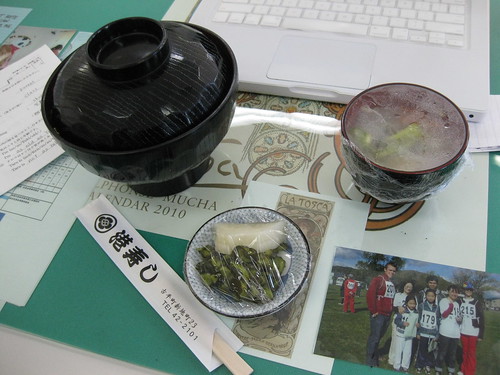
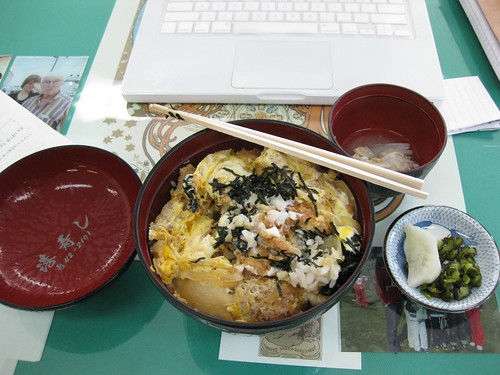
No matter, though, as apparently I wasn’t the only one, and a bunch of teachers lumped together and placed an order with the very delicious Minato Sushi in town.
When one of the proprietors showed up with our delivery, I don’t know what I was expecting, but it certainly wasn’t to have the orders bundled to serving trays with tied handkerchiefs, the food within still steaming in real, non-disposable bowls and plates from the restaurant. They delivered the food, took our cash, and left, only to return about an hour later to collect the flatware.
That they would bring the food in real dishes and leave them with us…It’s not a big thing, but it’s a nice thing. It’s a small-town-home-made thing; a fresh thing and a real thing.
It’s the kind of thing Canada just can’t compete with.
Wednesday, February 10, 2010
...and Grace, too
Today one of my students came to me and asked what “Grace” meant in Japanese.
I had to do a double take. I paused so long before asking him to repeat the word that it may well have been a triple take. You see, I’m used to the students in this class asking me to translate words like “masturbation.” And when I refuse, they take vengeance by screaming the word at the top of their lungs in class and in the hallways, knowing only that it’s something they probably shouldn’t be saying.
That this student, in the midst of such a hellish class, would come to me and ask me about a word as delicate and nuanced as “Grace” is evidence that he has not yet succumb to the cruelty, racism, or, possibly worst of all, indifference that the majority of his classmates currently espouse.
My own grasp of Japanese being only moderately more advanced than his grasp of English, I had no idea how “Grace” translated, so I tried to build it out of the words I did know: kireina, jyozu, yasashi, but for all my listing, they weren’t “Grace.” I tried to relate it to something I knew he was into: baseball. I told him that if he was all these things when he played, then he would know “Grace.”
The exchange really struck me, and I don’t know why. Maybe it’s the danger of asking a completist English major to translate a word for you. Maybe it’s my affection for this particular student, for his obvious brilliance beneath a defeatist attitude that has been built up around him by the real troglodytes in his class.
Or maybe it’s the words: the perspective created at the place between two languages, wherein the deep, attenuated meanings of a word can explode in your head like a box of kittens. And there’s you, surrounded by their magnificence, and utterly powerless to round them all up and push them through the door into the next language.
Friday, November 20, 2009
ITADAKIMASU!
In Japanese elementary and junior high schools, students receive a free prepared lunch every day, delivered to their classroom and served up by their peers. The teachers at the schools benefit from the same system, though they have to pay for their lunches. Regardless, not having to worry about packing a lunch is a fantastic experience. And, what’s more, the stuff that they serve up at the schools is often above par when compared to the cafeterias of Canadian schools. I mean, it could well be the Japanese equivalent of cafeteria crap in the eyes of native Japanese. However, if that’s the case, we thankfully set our bar far lower in Canada when it comes to deciding what’s fit to serve our young, growing, academic minds.
The culinary abominations of my own high school cafeteria have left me feeling like Japanese school lunches are meals fit for a king. They all tend to be at least “alright,” and at times they even nudge into “good” territory. The fact that I don’t have to make them myself and don’t have to pay for them up front also does wonders for the flavour. And, at the elementary school, the school lunch is further improved by the fact that I get to eat it in one of the classrooms with the actual students.
And when you sit and eat with the students, you can really catch glimpses of their growth. The younger grades at the elementary hardly ever clamour for seconds, electing instead to feed them to big fat gaijin sensei (that would be me). Up around grade 4, the students start developing an appetite, and by grade 6 they are screaming for the left over scraps and fighting furious janken1 wars for half a tempura shrimp. By the time the kids reach junior high, their bottomless teenage stomachs have them banging down the door of the teacher’s room on days when lunch is particularly good, looking for any scraps we happen to leave behind.
There's also the whole ceremony around lunch here. When you're eating in the classrooms with the kids, one of them will be assigned to the role of class leader for the day. This person usually prompts the rest of the class for greetings (every Japanese school period starts with students greeting their teacher, and every Japanese school period ends with students saying goodbye to their teacher), and I'm pretty sure this leader can be taken to task when the rest of the class is acting up.
When it comes to lunch, this leader is responsible for beginning and ending the meal. It begins with a raucous "ITADAKIMASU!", which is thunderously echoed by the rest of the students. It roughly translates to "thank you for this meal," but it is far more symbolic than that, referencing buddhist worship and the idea that an animal dying to feed you is one of the greatest sacrifices it could make. When you hear it every day, it starts to lose its meaning and becomes a bit of a joke as students bellow it at the top of their lungs, but as soon as you make the mistake of starting to eat before it has been said, you quickly realize how important this ceremonial element is (and that realization makes you feel like a big, stupid gaijin pretty quickly!). And, once the final student is done eating, the same class leader will clap their hands and yell "gochisosamadeshita!", which loosely translates to "it was a real feast!" and serves as the formal ending to the meal.
Just like with ever other pedestrian event in Japanese society, you've always gotta have an opening and closing ceremony.
In addition to sometimes being rather tasty, the lunches provide a degree of entertainment. Take today, for example, when I was served with a riddle, battered in a crunchy mystery coating, seasoned with some tasty enigma sauce. We got a 8-10” hotdog bun, a plate full of fried noodles, some of the awesome-fire-engine-red pickled ginger, and the meagerest scrap of Japanese bacon-cut pork you’ve ever seen. That last one, as we painfully discovered one hungover Sunday morning, is a clever ninja ploy that looks just like western bacon but tastes like a really skinny piece of pork. Yeah, it doesn’t sound so bad until you put it in your mouth expecting bacon, and you find out that it’s not.
That was my lunch, and just as I was about to set into it with the provided fork, I noticed the teacher across from me cramming the piece of faux bacon, ginger, and noodles into the big hotdog bun. I suspected this might be some clever ploy to make me look like the foolish gaijin barbarian everyone suspected me of being, but I looked around and saw everyone else was doing it. Apparently the carb-tastic meal was called yaki soba pan, which directly translates to “fried noodle bun” (duh). Why you’d eat fried noodles in a bun is beyond me, but that was the way of it.
1Janken is the Japanese version of rock-paper-scissors. But, when compared to the intensity and form of janken, rock-paper-scissors resembles a series of aimless, spasmodic flailings.
Friday, October 30, 2009
The Halloween that Wasn't


Thursday, October 15, 2009
INFLU
Monday October 5, 2009.
Plague masks out, kids.
What was a humorous one-liner last week appears to have fully descended on the schools of Furubira this week. I realized it when I walked into the teacher’s office of the elementary school on Monday, and I had the normally laughy-jokey Kyoto Sensei (vice principal) pretty much forcefully apply one of those sick masks to my face before I could breathe too much of the air unprotected.
INFLU, as the Japanese call it, had finally gotten its pestilent little claws on the schools in my town.
This wasn’t the first I had heard of it as the teachers had been throwing the word around for about a month now, but I had written the whole thing off as media-boosted heebie-jeebies, akin to what was going on in Canada before I left around the whole Swine Flu threat. However, when I rolled in on Monday and was informed that my awesome third grade class had all been quarantined at home, and the teachers (every last one of them with a plague mask on) were planning to close the rest of the elementary for a week at the end of the day, it was clear how seriously the town was taking this whole thing.
And the reaction at my junior high school was no different on Tuesday. Fortunately, the first victims of the seemingly sympathetic superbug were three of my favourite {sic} students. It was also decided that the second year class would be closed and sent home for the week at the end of the day. The teachers at the Jr. high weren’t wearing masks yet, but they might as well have been as their speech was already infected and every second word out of their mouths was “infruenza.”
For me, the whole thing resulted in a kind of half-assed holiday as I still had to show up for work, but I had no students to teach.
For the town, though, it has had a broader impact than expected.
Another second or third year JET had once told me that my town was dying. There was some truth in the statement as my town once had roughly 14,000 inhabitants but has since shrunk to only some 3,800 people. The high school I visit will be closing in two years, and the public kindergarten has already closed. And having this other JET pronounce this death sentence got me down for a bit as I began to dread the idea of spending a year or more in a “dying” town.
Then I took an objective look at the situation and realized that the JET was wrong. There was still life in this place, and that life took the form of 3- to 5-foot munchkins that ran along its streets and through its parks. I saw that as long as Furubira had children, Furubira would be alive.
Strangely, this whole INFLU thing has served to prove my observation.
On my morning walk to the junior high school, I cross paths with the patchy stream of elementary school kids flowing in the opposite direction toward their school. Where we meet, they invariably greet me with a “HARRO NIKORASU!”, and I reciprocate with a “goodmorning!” or “hello!” in a tone that is probably a little loud for first thing in the morning. I also come across their crossing guard, the jack-of-all-trades Nakamura Sensei. He always greets me cheerfully, forces the children to greet me in English, and then he wishes me a good day. The best word to describe the whole exchange is “Genki.” (Japanese for “energetic,” but, as with most Things Japanese, it means a good deal more than that)
But on Tuesday morning, with the elementary closed for the rest of the week, there were no loud elementary students, and there was no genki Nakamura Crossing Guard Sensei. The walk to work was quiet, uneventful, and the furthest thing from lively.
It was the same case at Kendo on Tuesday night. On Tuesdays and Thursday nights, the kendo dojo at the sports centre is usually filled with the screams of the kendo kids. Climbing the stairs to the dojo, I can hear the kids before I can see them. The stairs resonate with their laughter and the explosive impacts of the balls they whip around in their indecipherable version of dodge ball. The game passes for a warm up activity as they wait for their kendo senseis to arrive. When I walk in, the kendo kids assign me to one of the two teams, and the other team gets to delight in firing balls at my head.
But that Tuesday night, I walked up the stairs to the dojo in complete silence. I entered the half-darkened, empty room, and there wasn’t another soul around. It appeared that the quarantine instated at the elementary school extended to all of the students’ extra curriculars as well. I warmed up on my own and even had the opportunity to attempt something like meditation in the quiet room before the senseis showed up. As it was just me there with the two teachers, we were able to get down to some pretty intense sword fighting action, but it wasn’t the same without a gaggle of 3rd to 5th graders running interference. The class was far more serious and far less alive.
So maybe I was right. Maybe it is the case that Furubira survives so long as it has children flowing like life through the arteries of its streets. And should the town ever lose those children, like it did last week, it would slowly start to fade to a cold, dead thing.
Tuesday, August 25, 2009
School Snippets
A number of people have been asking me how the whole teaching/school thing is going, and I realized I’ve mentioned very little about it on here. Mostly, that’s because I have only been visiting the schools for four days, and that doesn’t seem like enough experience to base any sweeping statements on. That being said, in those four days I have managed to happen upon some salient moments, so I can pass those on.
So, in chronological order…
Elementary / Shoogako
You haven’t properly lived until you’ve experienced the unmitigated wonder of a round little first grader in chef’s hat and apron serving lunch to you and his classmates—one concentrated ladleful at a time.
High School / Koko
One of the girls in my third-year class looks familiar, and, to make matters worse, she keeps looking at me and laughing behind her hand. Eventually, question and answer period roles around, and—through my JTE’s translation—she asks me if I remembered her from the Kombini in town—the ONLY Kombini in town.
And the only thing going through my mind is “oh crap. Did I buy beer from one of my students?”
Middle School / Chyugako (blogger ate the formatting, and I'm too lazy to try to fix it, so I apologize)
Junior High School kids
Playing badminton
with the ferocity of Tennis Pros.
Me, I thought it was a good idea to play with them.
And
Just like when I agreed to join an Ultimate Frisbee team,
back before I’d ever properly played the game
and I still wondered why Overly Athletic Ally was so into it,
when, already tired from running the length of the field,
direction of play switched on me,
and I had to run all the way back.
Just like then,
I realize I have severely underestimated
the potential intensity of this game—
nay
—this Sport
And all I have to look forward to today
is having my ass handed to me
by a fourteen-year-old
girl.