For all my anxiety about making sure this trip went off without a hitch and my brother and father were rested, fed, and happy, it's only gotten better since leaving Hokkaido. For all my adamantly proclaimed love of snow and winter, as we flew in over the geometrically perfect, man-made island of Kansai airport, and the sun glinted in the window off the waves of the inland sea, I started to yield to the idea of a temperate winter. And then on the train from Kansai in to Shin Osaka, as the Kansai craddle from which all of Japan was born whipped by outside the window, I marvelled that the trees still had leaves. Coming out of the grey-white dark of Hokkaido, the prospct of warmth and sun and growth seemed so distant as to be fantasy.
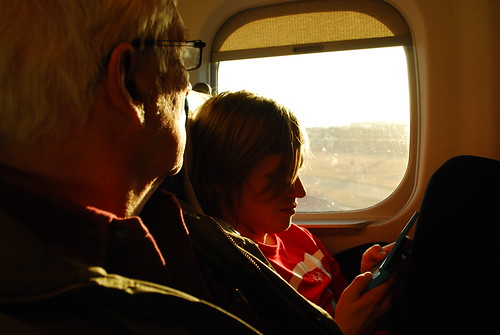 But here it is, and it warmed me. On that train, I was hit by sentimental waves of Greece and Scandinavia and Estonia and London, and in the midst of being buffeted by them I realized this adventure of ours had really begun.
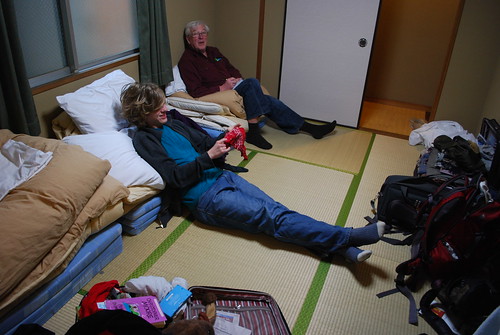 Our hostel in Hiroshima was bare bones in that livably Japanese way, with our own toilet, sink, and futons, but little else that wasn't shared. It provided dad with coffee and Craig with facilities for pursuing his ongoing mochi addiction.
_____________
Hiroshima itself has been two worlds:
Yesterday: sunny Miyajima.
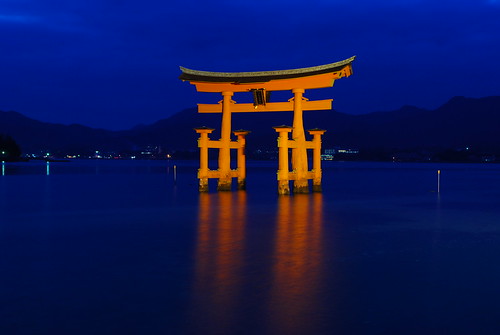
The sacred island that man couldn't set foot on until he built a colossal, vermillion Torii gate in the water off its shore through which boats could approach in deference.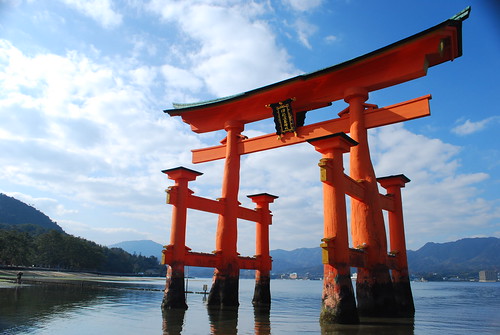
A knot of hills and temples, possessed by its island spirits embodied in the curious yet indifferent deer that stalk the crowds of visitors, searching expectantly for their offerings.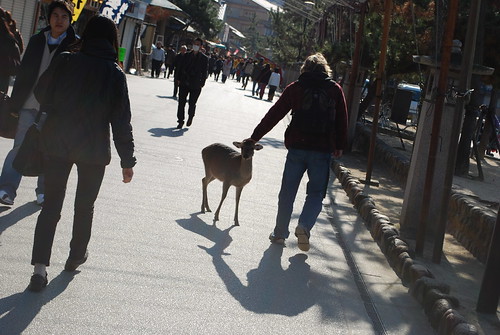
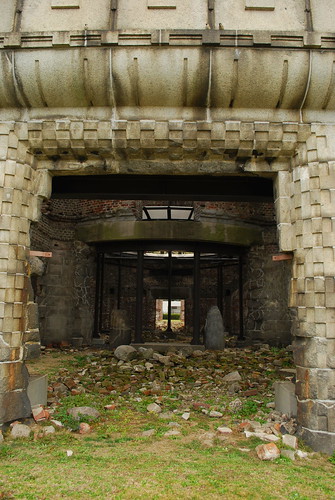
Today: The A-Bomb Dome and Peace Park of Hiroshima city proper: grey before the coming rain.
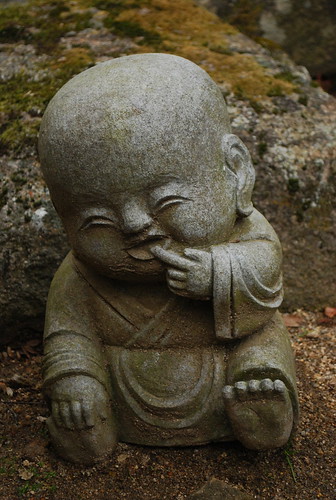
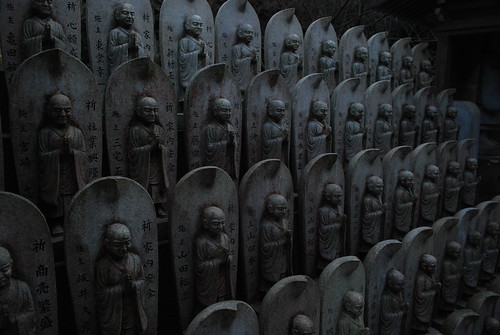
And the mountainside sprawling complex of Holy that is Daishou-in temple. A place of Buddhist worship infested by lawn-gnome-like Chibi Buddhas: oriental leprechauns that have studied the stoney disguises of the tanuki. When you look upon them, they are statues frozen in comedic, almost mocking poses.
And when you turn your back, they gambole off between the rocks and plants of this massive zen garden. They play hide and seek with monuments and shrines many times their size: springing them upon you as you turn corners and hiding them away as you try to capture the wonders with your camera.
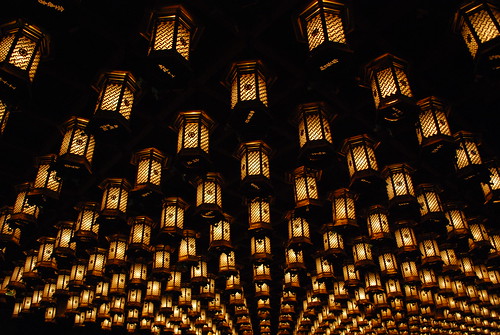
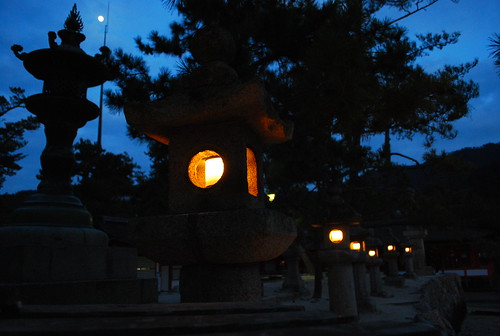
As the night falls on Miyajima, these diminuative Buddhas descend from their mountain home to light the stone lanterns along the shore and to shoo the deer back into the forests.
Lastly they spark the great bulbs that set fire to the Floating Torii, assuring that its reflection glows in the rising tide and burns itself into the minds of the footsore and windblown visitors as they leave Miyajima on the last of the ferry boats.
Today: The A-Bomb Dome and Peace Park of Hiroshima city proper: grey before the coming rain.
The last sun of yesterday disappears behing a slate of cloud as we descend from the tram, the irradiated remains of the former prefectural office full before us without any build up or any reveal. You don't wander down a path to find the A-Bomb Dome. There is no coy game of cat and mouse where the path approaching it gives you fleeting glimpses before revealing the full of it. It's just there. Vivid and whole and undeniable. The ruins, mere meters from what was once the epicenter of man's greatest folly of curiosity, they seem almost a sculpture of destruction, an image carefully fashioned to embody the archetype of a ruin.
Every protruding, twisted girder; every heaping of rubbled masonry, a flourish of a brushstroke intending to make the meaning of this oeuvre explicit.
It is more monument than any amorphous blob of modern art could ever be. And in my mind it brings down an avalanche of images:
The shockwave hurtling down from a height of 580 meters to strip away the majority of the prefectural office like rags or flesh, leaving only the current skeleton of steel and rock; the firey ball of plasma boiling down in the shockwave's wake--a vivid visual of fire passing through the metal remains of the dome, like smoke through a latticework.
The birds that now roost among the ruins of the A-Bomb Dome; pidgeons still picking hopefully through the rubble; something like starlings perching on the metal work of the actual dome and flitting to and frow among the standing remains in a flock.
Thousands of people being reduced to atoms, the trauma and absolute nature of their destruction going so far as to undo the very boudaries of their spirits so that both the molecules of their DNA and the shadows of their souls begin to overlap. And in the heat and the dark, as everything that once composed them is forced upwards into the azure sky, they fuse. Thousands of souls all rising together; a vast, sentient thing that rides the winds away from the inferno. The one, eclipsing soul of Hiroshima's dead.
Enola Gay, learning of that daft son of hers' last attempt to do something to make her proud. She, rolling her eyes and shaking her head with a morbid laugh, wondering if that ol fool will ever learn.
The shockwave hurtling down from a height of 580 meters to strip away the majority of the prefectural office like rags or flesh, leaving only the current skeleton of steel and rock; the firey ball of plasma boiling down in the shockwave's wake--a vivid visual of fire passing through the metal remains of the dome, like smoke through a latticework.
The birds that now roost among the ruins of the A-Bomb Dome; pidgeons still picking hopefully through the rubble; something like starlings perching on the metal work of the actual dome and flitting to and frow among the standing remains in a flock.
Thousands of people being reduced to atoms, the trauma and absolute nature of their destruction going so far as to undo the very boudaries of their spirits so that both the molecules of their DNA and the shadows of their souls begin to overlap. And in the heat and the dark, as everything that once composed them is forced upwards into the azure sky, they fuse. Thousands of souls all rising together; a vast, sentient thing that rides the winds away from the inferno. The one, eclipsing soul of Hiroshima's dead.
Enola Gay, learning of that daft son of hers' last attempt to do something to make her proud. She, rolling her eyes and shaking her head with a morbid laugh, wondering if that ol fool will ever learn.