Thursday, October 24, 2013
Reblog: My Japanese Name
Stumbled across the following on the Crackbookverse, and was utterly blown away at what an authentic representation it was of a certain facet of the Japan experience. Though my own Junior High was not this bad, I can empathize with a lot of this. My Elementary school, on the other hand, was DEFINITELY this good.
http://jasonporath.com/blog/2013/06/my-japanese-name/
Saturday, June 18, 2011
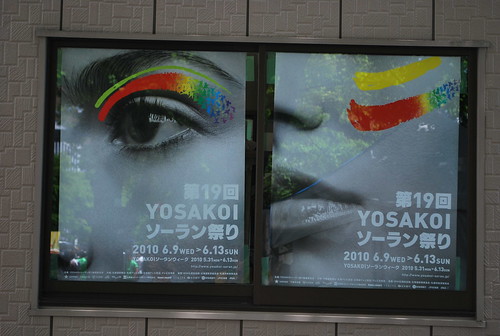
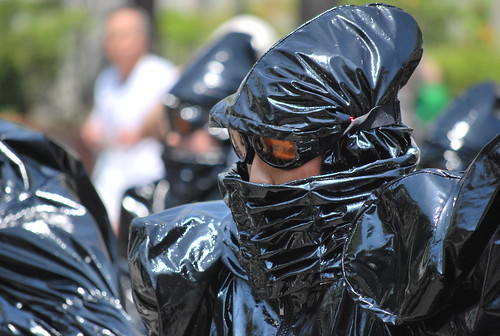
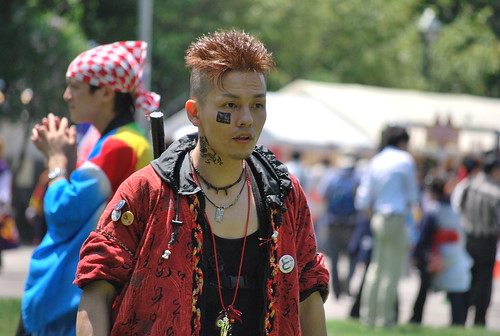
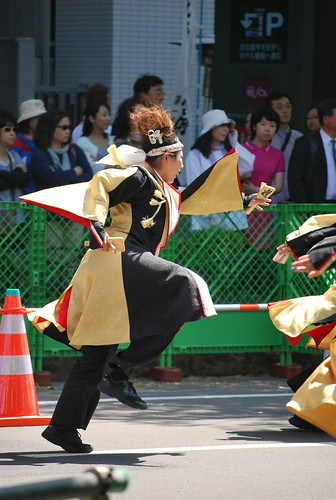
Soran! Soran!

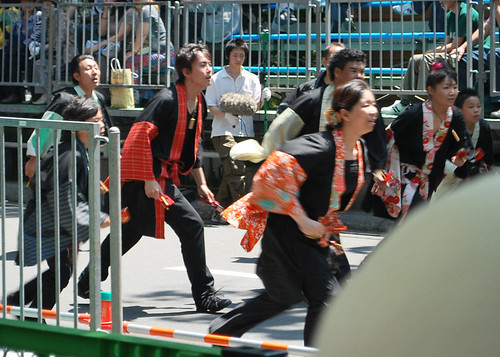
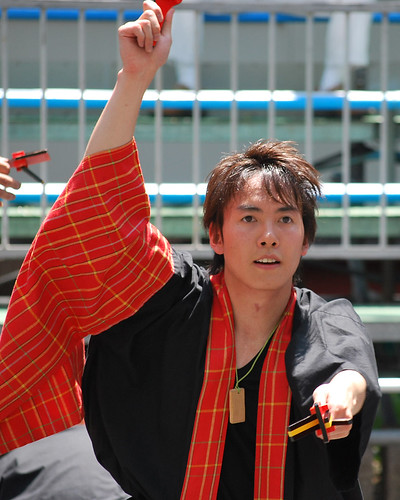
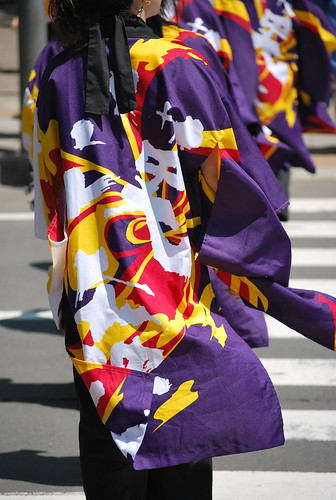
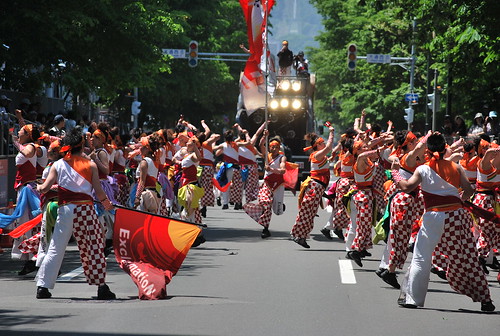
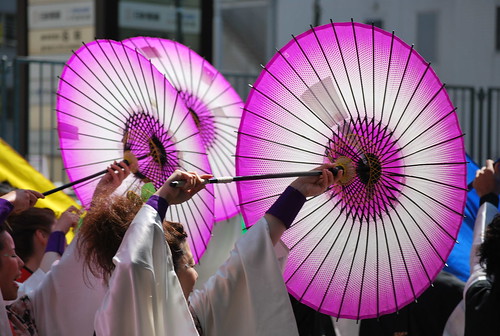
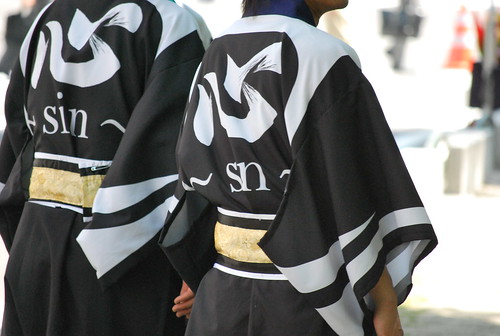
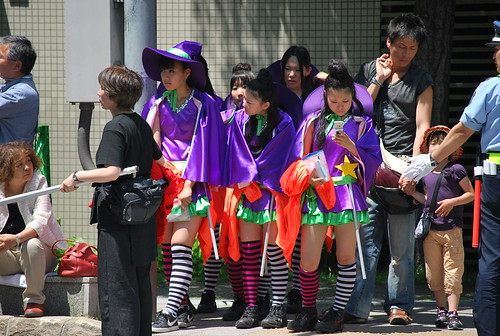
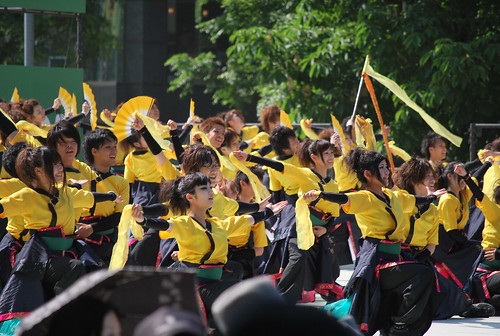
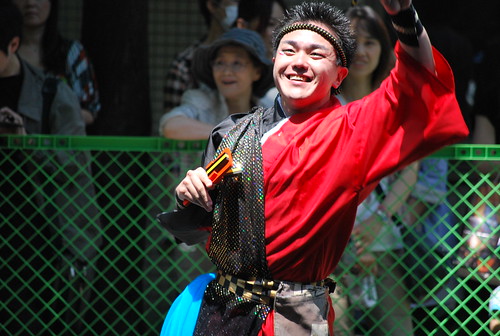
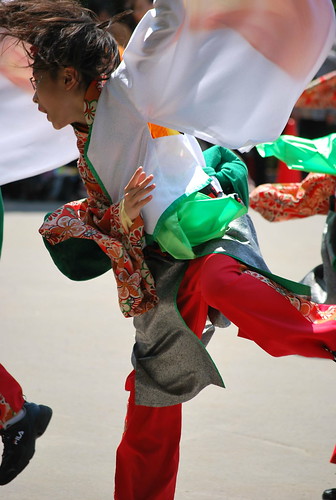
Last week at this time, half the ALT population of Hokkaido was descending on Sapporo to take in the Yosakoi/Soran Matsuri(festival). The whole thing started out with a dance: Yosakoi...or was it Soran? Regardless, it was a dance developed down south in Japan meant to draw from the motions of fishermen hauling in nets and the chants that they used to keep time. But that's a bit like saying that Glee was developed from Christmas carollers. Yosakoi/Soran has grown so far beyond its beginnings that it is now little more than a vague musical/gesticular pattern within which the Japanese LOSE THEIR SHIT.
Friday, June 17, 2011
This is where I live on video (No Reservations: Hokkaido)
Randomly, though he'd already been to Japan for an episode of his fantastic Travel/Food documentary series, Anthony Bourdain came back this past February to do an episode focusing solely on Hokkaido. Well, it's mostly Sapporo as he didn't rove further than about a 20km radius from the city. However, he heads to places I've told you about before, like Niseko and Noboribetsu, and when he talks about "Uni" and "Tarako," those are two things that my town is famous for catching. The video is a little wintery compared to the weather here today, but I figure it's still a great way to get a video glimpse into the part of Japan where I live. What's more, this is the full episode, so you don't need to go hunting for other parts.
Hope you like it. As it is making miss this place even when I am still here, I can attest to its accuracy.
Tuesday, June 14, 2011
Asano and the Arab Spring
This is Kamakura

Kamakura and Kita Kamakura make up a collection of shrines and temples a short train ride out of Tokyo. When she lived in Tokyo three years ago, Heather used to come out to Kamakura all the time. She thought I'd like the place, and with the combination of old-school Japanese architecture and TREES, she was absolutely right.
Wednesday, April 06, 2011
Ananthema
Don't get me wrong; there's beauty in it. It's just a beauty that harrows more than it inspires. I am relieved when it fades out, and the lost-looking new 1年生 are fished out of the dark by the nothing-but-sunshine-and rainbows Furubira Elementary school song: a song I'm so in love with that I not only want to learn it before I leave, but I kind of want to ask if I can sing it with the school--if I can bathe in their sometimes-screamy, midget-melodious light.
Monday, February 07, 2011
なっとう

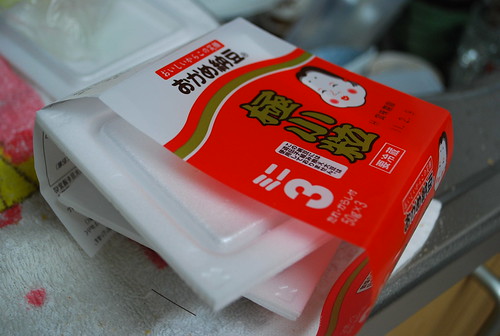
Natto.
A solid cornerstone of any foreigner's Japanese experience.
It is also the Japanese kryptonite to invincible Gaijin everywhere. All of their blonde-haired, blue-eyed, booming-voiced sexy might reduced to nothing in the face of four words:
“Can you eat natto?”
Posed by a Japanese national who you’d previously considered your friend; posed with a vague smile on his face and a mischievous twinkle in his eye.
While you, the uninformed foreigner, still try to hang on to your exotic power, ignorant to what’s about to be sprung on you.
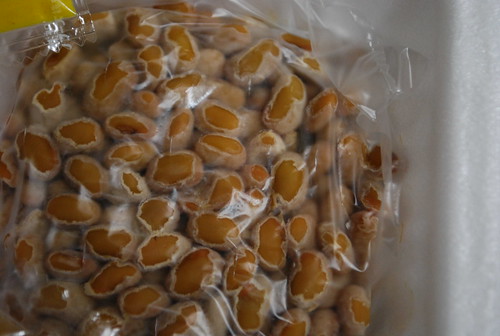
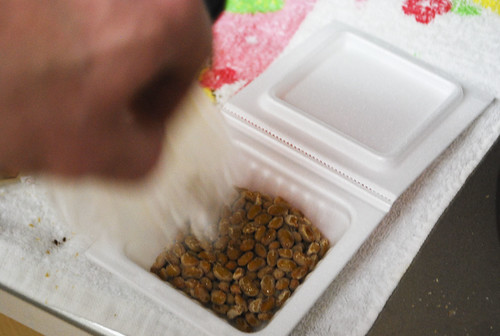
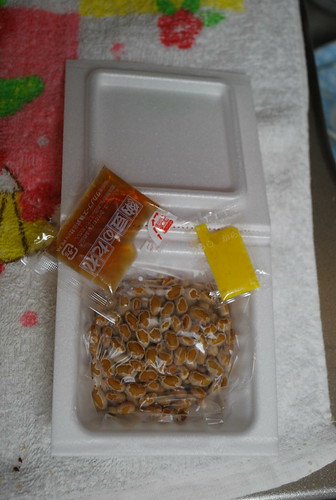
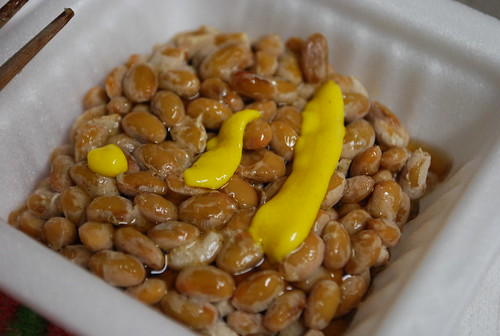
Fermented soy beans.
Sickly beige and chilled into a solid mass.
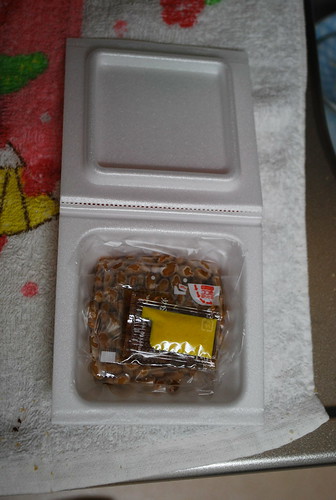
The Japanese’ll serve it to you with hot sauce or mustard or soy sauce or kimchi.
If you’re truly unlucky, they’ll serve it to you with raw egg.
The pungent odor of gym socks will waft over you, and you’ll have to hold back the urge to gag. You’ll gird your loins and tell yourself that there’s no way that anything could actually taste that bad.
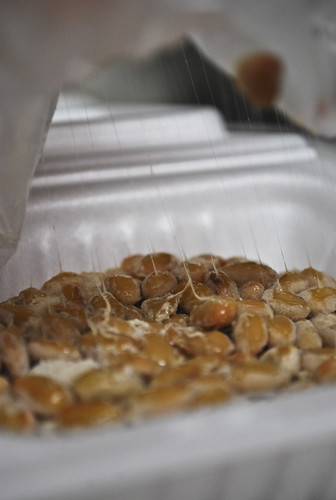
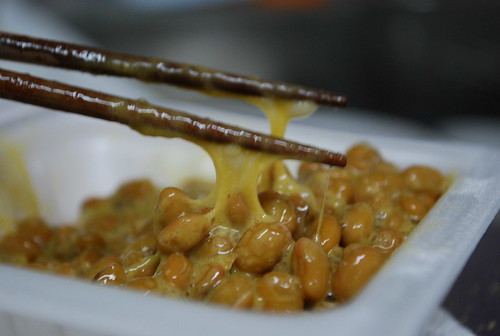
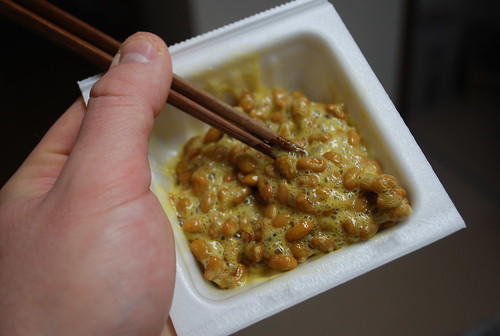
And you’ll be right. The danger of natto is not in the taste. The danger of natto is in the smell and the look of it; the slip-slimy consistency of the mucous-like liquid that holds it all together and trails out streamers like feathery silly putty as you stretch your first mouthful away from the mass of it.

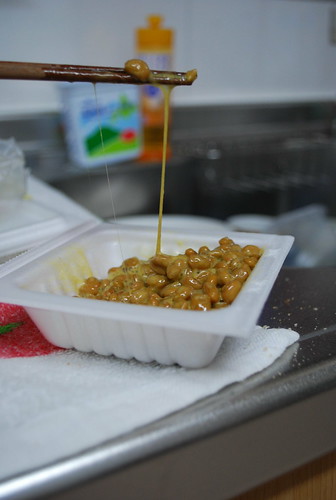
And that is only if you can get the slide-y natto to stay on your hashi, which is as much of a challenge as overcoming the smell of it. Woe betide those who had the misfortune of being served natto mixed with raw egg and the consistencies of the two seem to synergize when combined, creating something so much slimier than the sum of its parts: a slippery slurry that you can only ever hope to eat with hashi if you combine it with rice to lend it a bit more substance.
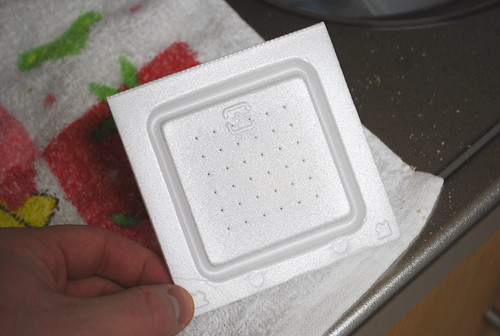
But if you’re lucky to be eating it straight, or with some of the stink of it masked with mustard or hot sauce, as you celebrate your victory over consistency and triumphantly bring the tenuous hashi-full of it to your mouth, you feel streamers of slime settle sickly across your chin. Looking down, you realize that they’re not only resting wetly on your chin but are running like long life lines back down into the styrofoam package of natto on the table before you.
ネーバ ネーバ
neba-neba. The unique Japanese expression for describing the slime-y, wet-web-like consistency of natto and one of my favourite random Japanese terms.
Those same slime-y strands are also now linking your hashi in your outstretched hand back to your mouth, and out of necessity you learn the action that all Japanese practice from birth: the fervent tornado spinning of your hashi hand through the natto strands to wind them up and free your face and your hand from the hair-thin umbilicals hanging down from them.
neba-neba.
Whatever you do when eating natto, it should never be eaten with anything else. The slime that comes off the fermented beans in natto is an parasitic, virulent thing that may just possess the vaguest inklings of sentience. Should you introduce natto-slime-covered hashi to any other sauce or liquid, the slime will spawn and multiply, and perfectly fluid sauces will quickly begin to manifest the same viscous, mucous trailers that natto has. And each further food you introduce this contaminated sample to will take them on, too. No matter how far the slime moves from its parent beans, it never seems to dissipate—seeming instead to only grow more powerful by the introduction of fresh liquid.
In the end, I’m convinced that eating natto comes down to a determination to succeed in a war of wills rather than a gastronomical motivation towards deliciousness. The only foreigners who eat natto are those with something to prove: the ones who, when that gleam comes into a Japanese friend’s eyes, and a sly grin creeps across his face, relish the ensuing crestfallen slump when they are able to proclaim “はい!なとがだいすきです!”
And then there’s folks like me, who got told once that natto was good for you, and in a draconian adherence to hearsay and folk wisdom that might just border on the alchemical, have decided to eat the stuff for breakfast every day.
But not with raw egg.
That would be just weird.

Wednesday, September 15, 2010
Modern Myths: The Tengu
The Tengu: braggart. goblin.
Elsewhere in Japan: a once-winged demon that would carry you off in the woods.
Here, In Furubira, a beneficent (if irritable) spirit who brings catches and harvests aplenty.
That red skin, white hair, and suggestive nose: all so clearly constructed, so impossibly implausible…
…yet.
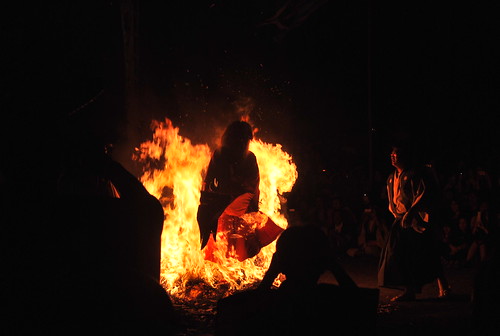
Something in his movements gives the impression this is more than costume: that this might, more accurately, be a man possessed.
Even the lions that attend him—the ones I can clearly see my high school students puppetting—the clack of their wooden jaws gives me shivers, and they seem to flow too smoothly around the Tengu in the fire light.
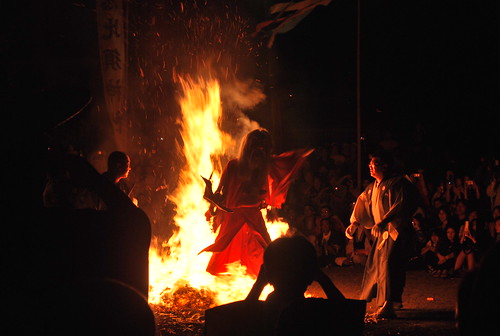
In the town of Furubira, the people honour a mythical Japanese creature known as the Tengu. In days long-passed, Tengu were bird-men or dog-men, best equated with our ideas of goblins or demons. Today the people of Furubira worship a beneficent incarnation of the Tengu; summoning him bi-annually to bless their catches and their harvests. The sons of town officials or the relatives of important business men are asked to don the red robes of the Tengu: to study the wild, dance-like gait of the character, and to practice the controlled teeter that goes along with its stilt-like geta.
But, despite the red wooden mask and the white, horse-hair wig; despite the vermilion robes and the alabaster gloves, the Tengu is not a man in a costume.
The Tengu is a man possessed.
Sure, the tradition started as a dramatic attempt to only emulate long-gone mythical creatures. The man behind the mask became the player, and the whole town, his stage. However, emulation is a dangerous practice. One can only emulate something so closely before one’s identity outside the emulation begins to shift and give, losing more of the original self and taking on more of that which you emulate.
The process is even more perilous when that which you try to emulate was once a god.
To better emulate its movements, the man behind the Tengu mask puts himself in the place of the Tengu, lending it not only his body but also his mind. It is a willing possession: a man of flesh and blood inviting a creature of the ether—a creature of Myth—to inhabit him for the length of the festival. I can’t help believing that such a process must leave something behind; that the thing which walks out of the great bonfire at the culmination of the festival might, somehow, be cardinally different from the man who walked in. The town officials change the man behind the mask regularly, as if to spread around the honour. But could they, instead, be doing so to keep that man from taking on too much of the Tengu?
Though some may take the term “mythical creature” to be synonymous with “non-existent creature,” the reality is that the term indicates a creature that exists in myth—making its home in story and sustaining itself on belief. In our modern, empirical world, where all that can exist is that which you can touch, hold, and trade, mythical existence is relegated to a lower level of being—far removed from the things that we allow to bare consequence on our lives.
But that which lives can also die, and that which is material will crumble and fade.
All the while, myth and memory and story live on.
If things like the Tengu only ever existed in imagination and belief, is it not the case that they exist still—that as soon as one remembers them, these entities live again? By paying tithe to the Tengu twice every year; by giving it physical form in the act of lending it a body; do the people of Furubira not make the creature more alive than the once-real-and-now-very-much-dead former emperors of this land?
©Photo Copyright Ross Cole-Hunter/Pekoism
Monday, August 09, 2010
Modern Myths: ロボト (Robots)
It’s a fact that scarcely gets mentioned outside of Japan: that all the museums in this place are stocked with robots.
Where in other countries there should be historical dress and obsolescent bits of the industrial age, in Japan there are robots. Sculptures of robots, and paintings of robots, and miniatures of robots, and man-sized, geometric-armour-puzzles of robots bristling with potent, needle-like projections that can only be weapons from the future.
There are bulbous, iron, fallout-suit robots for man and dog, complete with photosynthetic modules holding actual plants, made to carry the fire of life through black times. There are textbook, cardboard-box-and-stovepipe robots, with broad, television-like faces that are only so many generations removed from their furniture ancestors. There are actual furniture robots—chair and record-player, sound-system robots—things that look like husks that were captured and had their guts ripped out to house our much-less-clever technologies. There are steampunk, post-carrier robots with incandescent eyes, and there are shinning, crowned robots who are little more than industrial-age collections of cogs and levers. There are girl robots with long green hair, and boy robots that look like distended, extraterestrial cyborg impressions of man. There are little baby robots with polyester dresses, white plastic skin, and blank, black, staring eyes.
There are pictures of robots you remember from when you were small.
There are prototypes of robots who will render you obsolete.
In the children’s wing, in the community gallery, there is a broad circle of wooden stools, and on each stands a testament to one of the many robots who have already colonized our minds through anime: who’ve been garrisoning off small parts of the Japanese souls since those souls were young. In the community gallery, young people are encouraged to familiarize themselves with practical robots, helping them to navigate mazes and further build their artificial intelligences. In the community gallery, broad sheets of paper cover the walls, and the children are encouraged to draw their own robots. With the ingeniousness of the young, they attack the blanks with pencil crayons, filling the spaces with diabolical creation.
And when the lights in the gallery dim at the end of the day, and all of the children are ushered out into the sweaty Aomori night, the technicians and the engineers take down those doodles from the walls. They study the pencil-crayon schematics and scan them into their complex computers. They birth the next generations of robots from the dreams of babes.
Friday, July 23, 2010
The Return
I wrote this on Tuesday July 13th, but timing is complicated in the blogosphere—particularly when it's rocking back and forth between Eastern Standard and Japan Mystery Time. It's mostly about going home...or maybe it's about staying here.
On the bus from Haneda to Narita on my long way home to Canada, I sit behind a group of what must be high school students from the States. Their chaperone is asking them in a southern drawl about what they intend to eat when they get back home—their Welcome Return after all of this Japanese fare.
I think about my planned trip to Golden Star up at Yonge and Steeles with my former MHS colleagues when I get back to Toronto. I think of piping up, uninvited, to contribute “CHEESEBURGER!” and “MILKSHAKE!” to the conversation.
However, they move on to talking about how they'll be relieved not to have to eat with chopsticks anymore, and I recall how I’ve been telling the Japanese that I’m going to start calling them “Hashi” in English as chopstick is such a hideous word for such a graceful implement: one that makes food taste so much better by forcing you to savour it. I think about how I’d very much like to go on using Hashi to eat with long after I leave this place.
And it’s just one more piece of a growing realization: that it’s a damn good thing I recontracted for another year of JET because I’m certainly not ready to go home yet—not permanently, at least. I’m not ready to give up being surrounded by the constant hushed puzzle of Japanese conversation for the loud clarity of English. I’m not ready to give up the joy and wonder of my students, who I’m already starting to miss.
In the end, I wind up moving to the back of the bus, away from the unabashed, booming Americans and into a cloud of whispered Japanese.
Thursday, July 22, 2010
Modern Myths: Genkan
An ant scuttles across the rounded river stones set in the concrete floor of the elementary genkan (entrance way). The movement catches the corner of my eye, and for a moment I move to act.
But I hesitate.
I think of the magic of the genkan—an unquestionable threshold in Japanese society between soto and naka—out and in. The Japanese remove their outdoor shoes in the genkan and step up into their houses and schools in stocking feet. Often they’ll pull on indoor shoes or slippers, but in that instant before they do, they pay tribute to the separating enchantment that exists in the genkan: the one that reinforces the boundary between soto and naka. By observing the in/out binary of this place, they give it power over them—they invest it with the alchemical energy of belief.
Each belief act is simple, small; and the transference of energy is just as miniscule. However, over years and years it can build, and so does it do in the elementary school’s genkan—so has it been doing for more than a hundred and thirty years in this building’s various incarnations. It will continue to do so, simply, until a day comes when it is needed, and then the energy will act just as simply: like key magnetism or sympathetic gravity.
A man will come to harm the children. He will refuse to remove his shoes before stepping up into the school, and when he does so, the genkan will deny him entry. The polar ice caps will melt, and the Sea of Japan to the north will rise. However, its waters will only ever lap at those rounded river stones in the concrete floor, never to cross the low threshold up into the school.
Just as it was believed, that the genkan separates the out and the in, so shall it be as the simple magic vested in the genkan holds back the outside.
It is for this reason that I cannot follow through on my instinct to kill the ant. As he crawls among those enchanted river rocks, he is still without—just where he should be—despite being, bodily, within the doors of the elementary. Should I kill him while without, imposing the clean, organized dominion of within upon him in the genkan, I risk robbing the genkan of some of its magic. To do so would be to risk imbalancing that delicate, sympathetic formula with this one act.
Saturday, June 12, 2010
Yosakoi is
Yosakoi is madness.
Yosakoi is forward motion.
Yosakoi is colour and music and light.
Yosakoi is a thing with a life of its own: a synergetic, Frankensteinian abomination of the fishing-inspired dance that birthed it. Yosakoi is the void that was filled by the surface-shy, but deep-down-explosive Japanese soul. Yosakoi is one voice expressing itself in a multitude of languages and dialects and idioms. Yosakoi is a rough framework for imaginations that express themselves best in rhythm. Yosakoi is the Will-To-Performance of a people.
Yosakoi is your visual definition for “genki.”
Yosakoi is energy uninhibited.
Yosakoi is fire.