
Showing posts with label Food. Show all posts
Showing posts with label Food. Show all posts
Friday, June 17, 2011
This is where I live on video (No Reservations: Hokkaido)
Randomly, though he'd already been to Japan for an episode of his fantastic Travel/Food documentary series, Anthony Bourdain came back this past February to do an episode focusing solely on Hokkaido. Well, it's mostly Sapporo as he didn't rove further than about a 20km radius from the city. However, he heads to places I've told you about before, like Niseko and Noboribetsu, and when he talks about "Uni" and "Tarako," those are two things that my town is famous for catching. The video is a little wintery compared to the weather here today, but I figure it's still a great way to get a video glimpse into the part of Japan where I live. What's more, this is the full episode, so you don't need to go hunting for other parts.
Hope you like it. As it is making miss this place even when I am still here, I can attest to its accuracy.

Sunday, April 17, 2011
A Goodbye to Winter

This past weekend Heather and I headed to Niseko for our last runs of this season, and likely the last runs in Hokkaido for a little while. The island was clearly as sad as I was about the end to the long, glorious, deeply snowy winter as it was raining, off-and-on, pretty much all day.
Monday, February 14, 2011
Ai Ryori II
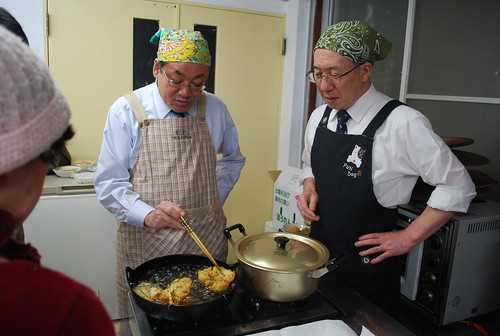
My new supervisor (left) cooking with my old supervisor (right)
Another Valentine's Day, another RABURABU Man's cooking class with the Furubira townies. Last year we made Gomaae, one of my favourites, and this year we made Bibimbap, which isn't, strictly-speaking, Japanese, but it is FREAKING DELICIOUS, so I didn't mind.
Monday, February 07, 2011
なっとう
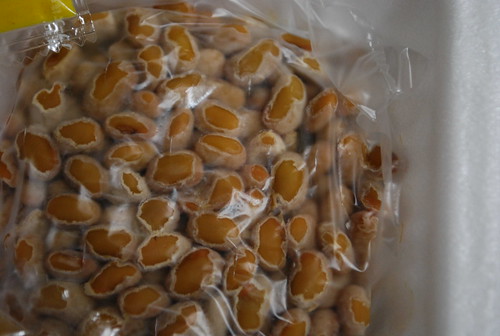
Natto.
A solid cornerstone of any foreigner's Japanese experience.
It is also the Japanese kryptonite to invincible Gaijin everywhere. All of their blonde-haired, blue-eyed, booming-voiced sexy might reduced to nothing in the face of four words:
“Can you eat natto?”
Posed by a Japanese national who you’d previously considered your friend; posed with a vague smile on his face and a mischievous twinkle in his eye.
While you, the uninformed foreigner, still try to hang on to your exotic power, ignorant to what’s about to be sprung on you.
Fermented soy beans.
Sickly beige and chilled into a solid mass.
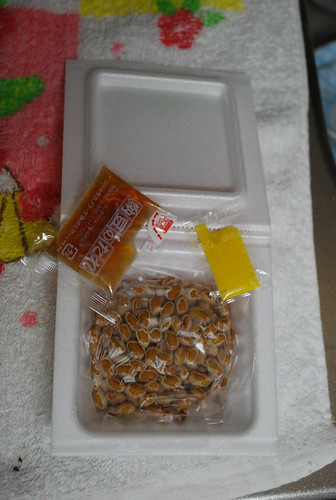
The Japanese’ll serve it to you with hot sauce or mustard or soy sauce or kimchi.
If you’re truly unlucky, they’ll serve it to you with raw egg.
The pungent odor of gym socks will waft over you, and you’ll have to hold back the urge to gag. You’ll gird your loins and tell yourself that there’s no way that anything could actually taste that bad.
And you’ll be right. The danger of natto is not in the taste. The danger of natto is in the smell and the look of it; the slip-slimy consistency of the mucous-like liquid that holds it all together and trails out streamers like feathery silly putty as you stretch your first mouthful away from the mass of it.
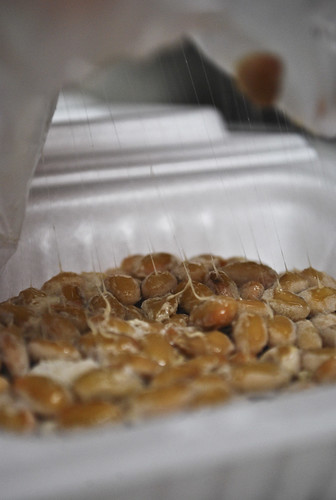
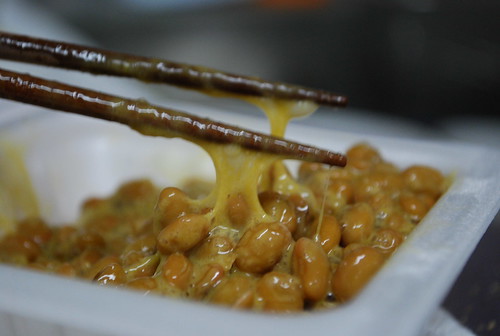
And that is only if you can get the slide-y natto to stay on your hashi, which is as much of a challenge as overcoming the smell of it. Woe betide those who had the misfortune of being served natto mixed with raw egg and the consistencies of the two seem to synergize when combined, creating something so much slimier than the sum of its parts: a slippery slurry that you can only ever hope to eat with hashi if you combine it with rice to lend it a bit more substance.
But if you’re lucky to be eating it straight, or with some of the stink of it masked with mustard or hot sauce, as you celebrate your victory over consistency and triumphantly bring the tenuous hashi-full of it to your mouth, you feel streamers of slime settle sickly across your chin. Looking down, you realize that they’re not only resting wetly on your chin but are running like long life lines back down into the styrofoam package of natto on the table before you.
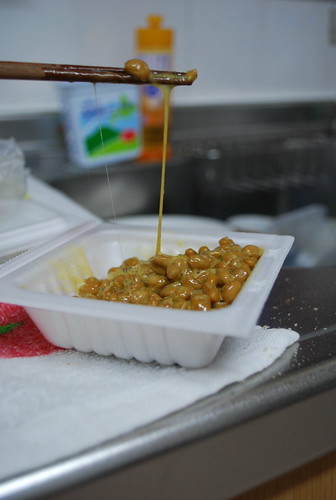
ネーバ ネーバ
neba-neba. The unique Japanese expression for describing the slime-y, wet-web-like consistency of natto and one of my favourite random Japanese terms.
Those same slime-y strands are also now linking your hashi in your outstretched hand back to your mouth, and out of necessity you learn the action that all Japanese practice from birth: the fervent tornado spinning of your hashi hand through the natto strands to wind them up and free your face and your hand from the hair-thin umbilicals hanging down from them.
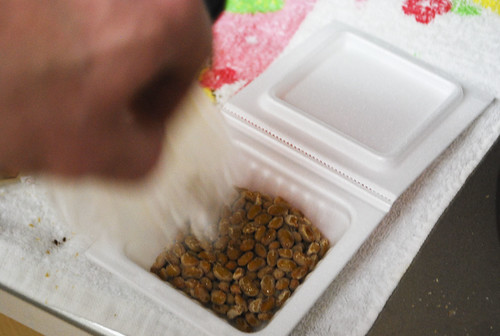
neba-neba.
Whatever you do when eating natto, it should never be eaten with anything else. The slime that comes off the fermented beans in natto is an parasitic, virulent thing that may just possess the vaguest inklings of sentience. Should you introduce natto-slime-covered hashi to any other sauce or liquid, the slime will spawn and multiply, and perfectly fluid sauces will quickly begin to manifest the same viscous, mucous trailers that natto has. And each further food you introduce this contaminated sample to will take them on, too. No matter how far the slime moves from its parent beans, it never seems to dissipate—seeming instead to only grow more powerful by the introduction of fresh liquid.
In the end, I’m convinced that eating natto comes down to a determination to succeed in a war of wills rather than a gastronomical motivation towards deliciousness. The only foreigners who eat natto are those with something to prove: the ones who, when that gleam comes into a Japanese friend’s eyes, and a sly grin creeps across his face, relish the ensuing crestfallen slump when they are able to proclaim “はい!なとがだいすきです!”
And then there’s folks like me, who got told once that natto was good for you, and in a draconian adherence to hearsay and folk wisdom that might just border on the alchemical, have decided to eat the stuff for breakfast every day.
But not with raw egg.
That would be just weird.
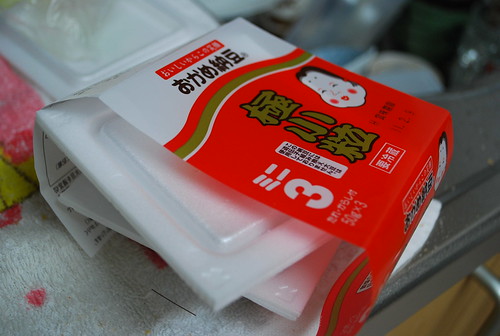
I call this 'Bachan Brand natto. It's the best I've found, and it's all I eat.
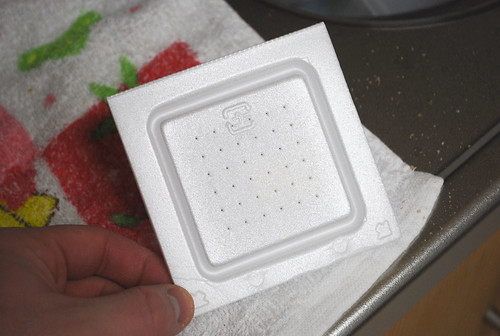
Air holes in the top of the individual styrofoam packages so that the sentient slime doesn't suffocate.
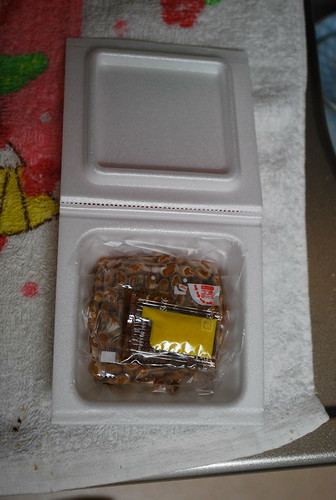
What natto looks like in the package.
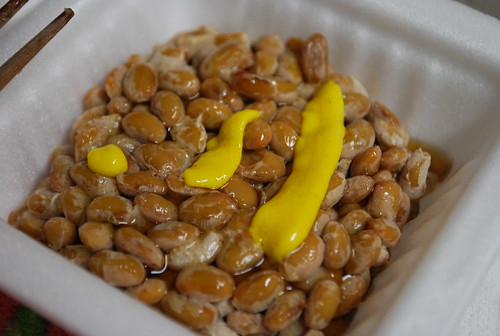
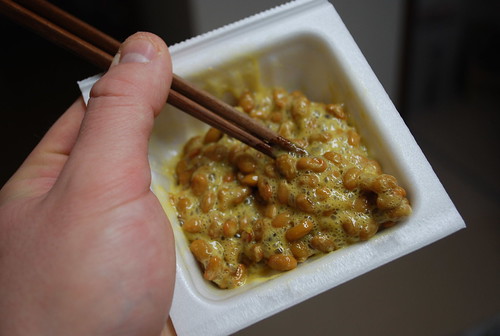
Whipped up to the desired frothy consistency. I'm not sure why Japanese folks do this, but it seems to make it easier to catch larger blobs of natto with your hashi, and it does a little something to control the neba-neba. That being said, even when it's frothed up, you've still got to slurp the stuff like ramen noodles!
Tuesday, March 30, 2010
Board of Education Daze
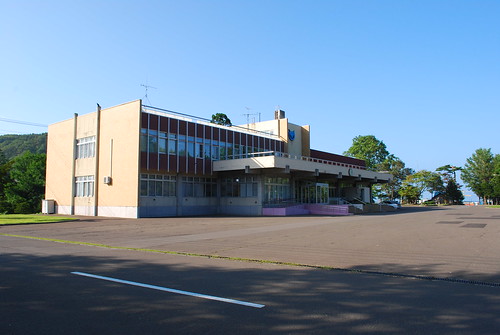
Right now in Japan we’re between school years. Just as a September to June school year seems like blasphemy to the Japanese, I’m sure you western kids will be surprised to hear that the school year in Japan starts in April and ends in March. It’s a weird thing until you wind up in Japan in March, and you see that it’s the perfect time for a year to end and April is the perfect time for a new year to commence. The days start to get longer and you remember what the sun was like as the snows of Hokkaido finally slow, allowing the massive drifts on the ground to begin to break up and melt. In other, more southerly parts of Japan, this is cherry blossom season, and those flowers become deeply woven into the graduation ceremonies of March.
And though schools close for about a week and a half between the ending of one school year and the starting of the next, all of us ALTs are still expected to be on the job.
In Japan, unlike in Canada, teachers and students don’t share the same holidays. When school is out for the students, the teachers and Board of Education staff are still expected to be sitting at their desks, dutifully working away at preparations for when classes resume. If teachers want to be off during these breaks, they need to schedule paid vacation days, or nenkyu. As the majority of us ALTs don’t get anywhere near as much nenkyu as the teachers do, we wind up with Board of Education Days: hours spent sitting in our Board of Education offices in town halls or cultural halls, trying to fend off boredom by studying Japanese or preparing materials for classes or obsessively checking our email. A lot of other ALTs seem to loathe these days, but I must say I don’t much mind them.
That’s because my town uncles come in to visit on Board of Education Days. There is Shinkai-Sensei, my kendo instructor, who sometimes rolls in to go over complicated branching hierarchies of kendo styles and strikes, and other times to discuss the finer points of a healthy Japanese diet. And there is Aami-San, who’s name, I must confess, I don’t actually know. I’ve taken to referring to him by the noun he first associated with himself: pointing to his nose in that Japanese way and saying the Japanification of “Army.” Between his militant English vocabulary and my anarchic Japanese, we have conversations about fishing and white water rafting and his years in the service. Or at least I think that’s what they’re about as my imagination tends to flow into the gaps in understanding, colouring the exchanges in ways that could be miles from their actual meaning.
Also, I get to go home for lunch on Board of Education Days. On my way in the door, I often find postcards from Tokyo or letters from Aomori or distinctive other treasures from all of you back home. For lunch, I do my best to be a good little Nihon-jin: supping on miso soup and flavoured rice and Japanese pickles. For all of the convenience of the provided school lunches (kyoshoku) I receive on other days, there is something simple and fulfilling in being able to make my own lunches on these days. And when I finish my very Japanese lunches, I jump onto skype and sometimes I talk to you at odd hours of the night where you are. When it comes time to return to work, it never seems like that much of a chore as the very short walk back to the bunka kaikan always seems to be particularly sunny and glorious.
Everything just seems to be light-hearted and chilled-out on Board of Education Days. People roll in and out of the office, and my wacky BOE coworkers joke with them, and they joke with me. When they use Japanese I can understand, we all laugh together. And when they use Japanese I can’t fathom I smile along, too, simply because these people would be just as entertaining in Urdu. We share tasty omiyage, and we share goofy photos, and ムんムんさん and むらかみさん tell me about how they’re going to be my chaperones with Heather because we can’t have any rabu rabu going on as that would be dame.
In the end, the days spent being Bored of Education wind up being just as welcome and necessary as the days spent having elementary students climb all over me, and I find myself not minding their slower rhythm in the least
Tuesday, March 02, 2010
Why Japan Always Wins
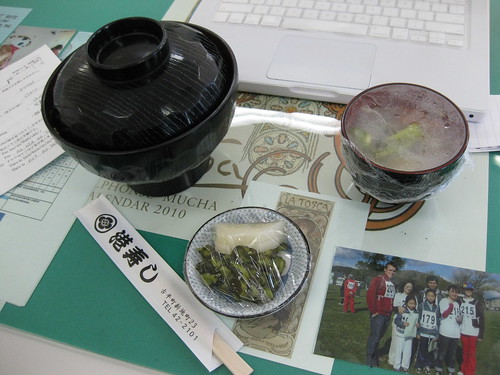
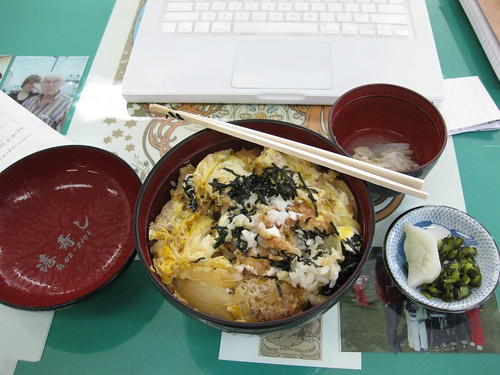
With this being exam time for my junior high school students, the awesome school lunches that they and we teachers receive have been cancelled for the next few days. I was dutifully informed of this when I was given my schedule for this month, but as that was about two months ago, I promptly forgot and showed up with only an orange and an apple for lunch today.
Crap.
No matter, though, as apparently I wasn’t the only one, and a bunch of teachers lumped together and placed an order with the very delicious Minato Sushi in town.
When one of the proprietors showed up with our delivery, I don’t know what I was expecting, but it certainly wasn’t to have the orders bundled to serving trays with tied handkerchiefs, the food within still steaming in real, non-disposable bowls and plates from the restaurant. They delivered the food, took our cash, and left, only to return about an hour later to collect the flatware.
That they would bring the food in real dishes and leave them with us…It’s not a big thing, but it’s a nice thing. It’s a small-town-home-made thing; a fresh thing and a real thing.
It’s the kind of thing Canada just can’t compete with.
Sunday, February 14, 2010
Ai Ryori
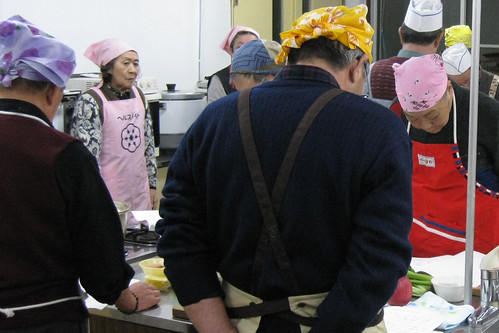
I started writing this immediately following Valentine's Day, but it got lost in all the excitement of the Busiest Month Ever. It was inspired by the Man Cooking lesson that me and a bunch of townies received from some culinarily experienced 'bachans. It was, in part, a Valentine's gift, I think. In Japan, Valentine's Day is a one-way thing: women use this day to honour their men by buying/making sweets for them.
And before any feminists cry foul, it should be noted that Valentines Day in Japan is followed by White Day a month later, and on White Day it is the men's turn to reward their ladies, and they are meant to pay back everything they received with interest. I don't know how exactly they calculate it, but the return gift from the man to his lady is meant to be of three times greater in value than what he received from her on Valentine's Day. Fortunately, as my lady hadn't yet accepted the position back on Valentine's Day, I'm free to reward her with three times bupkiss. However, I'm sure I'll find some way to honour her this weekend.
Four diminutive Japanese ladies in pink kerchiefs and aprons take the reins, sporting crests that are half hana half shuriken. In this men's cooking lesson, they are the senseis, and indeed it would seem that most of the men can't go too far without needing one of our matrons to bring us back in line.

Token foreigner boy is placed with the heads of board of education and vice principals, all the power they wield laid low before a tiny Japanese woman, as is often the way. Still, my 次長(Jicho) performs masterfully, seemingly better suited or more adapted to domestics. I spin it out into a harmonious, balanced relationship with his wife, while I picture the rest of the men calling for dinner from their armchairs.

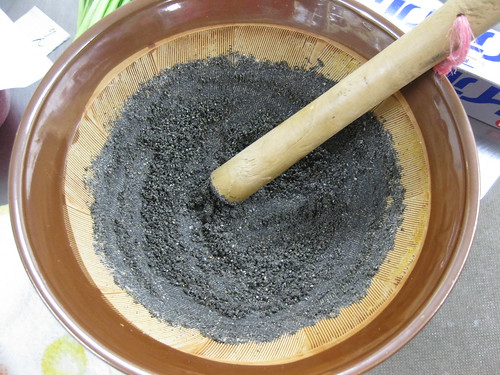
I "soo-ka, soo-ka, soo-ka" at our printed recipes in jest, the hiragana I can read not forming up into much of anything. From between hieroglyphics of kanji, I piece together "go-ma--a-e" in readable kana, and demand to be put in charge of this one thing I've made before. Murakami-san boils the spinach for me, and Jicho fires the sesame, pouring the toasted grains into a vast mortar. I take to pestle, and the dark seeds are ground together into something that looks like smoke and tastes like sin. Taken straight, the paste is an anaphalactic shock to your tongue. I reflect that if the devil eats peanut butter, it's surely made from this. With sugar and with shoyu, the paste comes to look almost purple when mixed in with the limp spinach, giving the small dish a flavour that is at once arresting and alluring.
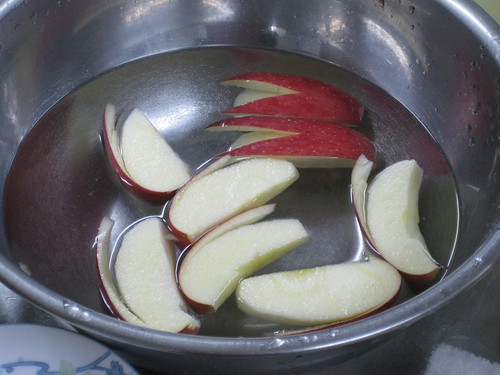
With the proper direction of diminutive Japanese ladies, we work all kinds of alchemy. Sauces from scratch, and rabbits from apples.
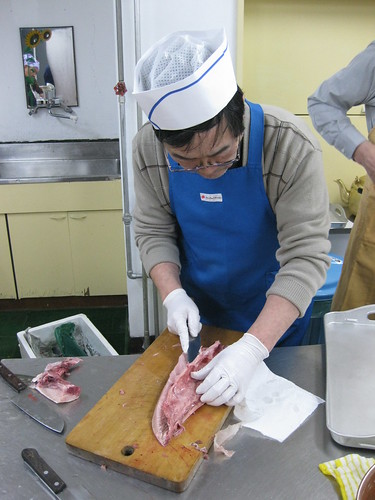 As they separate food from corpse, the buri lacks the near-display quality of sashimi. It is pink and grey and brown and marbled with fat. Were it to be served to you on a platter alongside other fish, it would surely be the last you chose. As we sit down to eat with our lady sensei, the buri hits my tongue and it's slippery and soft, and it tastes thick and wet.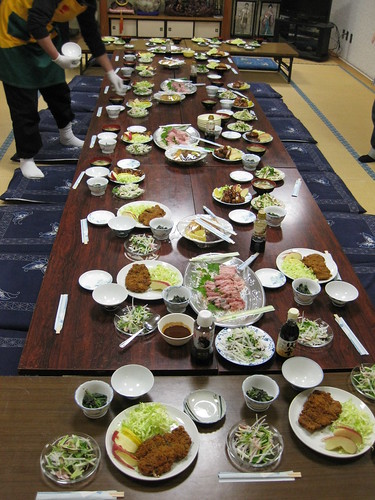
Friday, January 29, 2010
Mochi Mashing
Last Sunday the Furubira International Society put on their annual Omochi Suki party. The fact that my town of 3,800 people actually has an international society is a bit of a laugh, but it is a testament to my very internationalized Japanese Mom/Patron Saint of Furubira JETs: Asano Sensei.
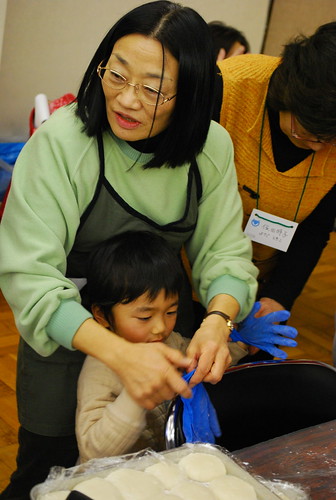
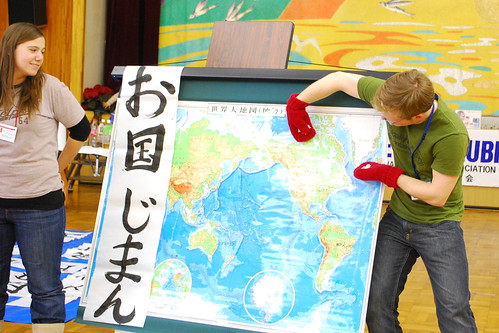
She’s the one who graciously invites me into her home every Monday for elaborate, Japanese dinners, and she’s one of the loudest cheerleaders behind our International Society. With good reason, too, as she’s traveled to/lived in something ridiculous like 25 countries. In Canada, such a feat would be impressive. In a sleepy fishing village in Japan, such a feat is pretty much unheard of. So, every time one of these international events rolls around (and that’s more often than you might think), she makes sure I’m going to be there, and she goes out of her way to invite international students in from the Universities of Sapporo. She hooks them up with homestays and Japanese meal, and she encourages them to present their particular corners of the globe in front of gathered townsfolk.
And last Sunday she had the students in for the Mochi Party. It’s not really any surprise that the students decided to show up, though, as a mochi party involves hefting a wooden mallet high over your head before bringing it down with gusto on cooked rice in massive stone mortar. Who wouldn’t want in on something like that?
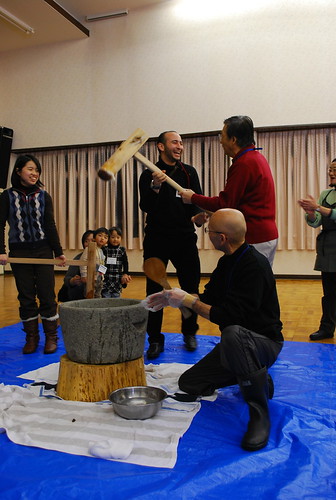
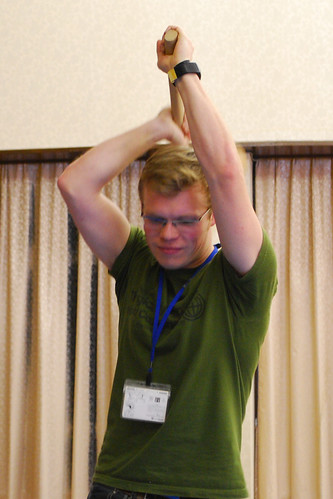
Again and again you pound the rice in an action the Japanese euphemistically refer to as “whacking the rabbit,” all the while trying deftly to avoid the hands of the person who’s kneading the ever-stickier rice paste for you.
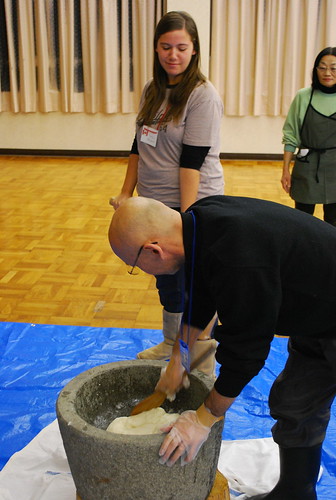
Don’t be confused by that last bit. You’re not supposed to break your whacking rhythm to wait for the Kneader to get his hands out of the way. In fact, you’re pretty much supposed to aim for the hands and hope they’re not there when your mallet connects with that sticky THUD. So artful is the rhythm of this perilous dance that professional Mochers (mochi-ers? moochers?) heft the hammer blindfolded, without any concern for the frantic kneaders below.
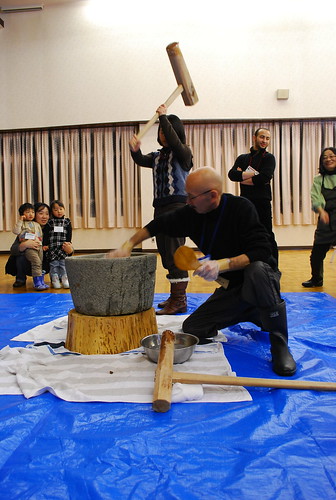
To make the whole thing even more fun, after all this whacking you actually get to eat the fruits of your surprisingly-intensive labour, one round, dense, choke-tastic mochi ball at a time.
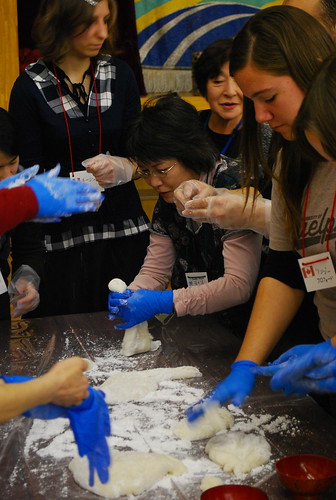
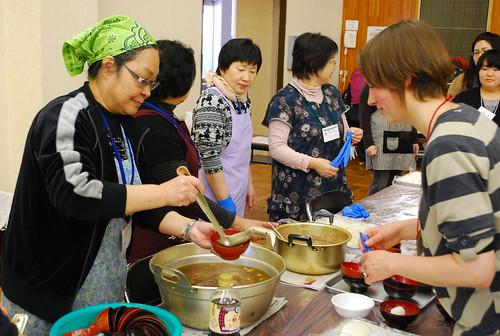
Just as it was no surprise that the international students wanted to get in on this edible form of whack-a-mole, it should have been obvious that some of my JET buddies would want to be part of the action. Lindsay, Roz, and Heather showed up for the event, further bolstering Asano-Sensei’s contingent of gaijin-on-display. They all performed wonderfully in the whacking, shaping, and eating parts of the day’s events. Here’s proof of that.
Here’s a look at the fruits of their labour, more for Craig than anyone as he’s shown himself to have an unnatural love for this particular Japanese food item.
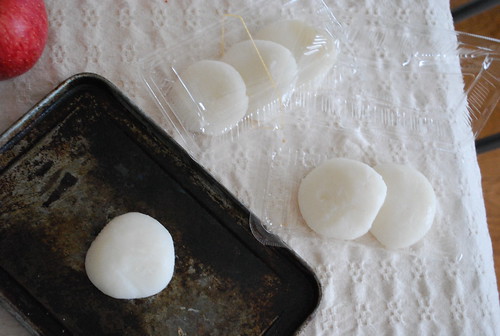
And this one's for me.
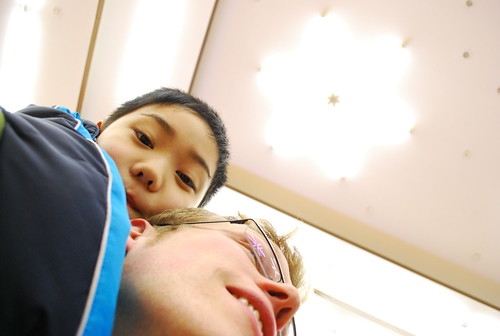
Tuesday, January 19, 2010
Omiyage
Omiyage is one of those Japanese words for which there is no equivalent in English.
The uninitiated would tell you that it translates as “souvenir.” But that equivalency will start to fail you the first time your Japanese mom tells you that she’s brought you a souvenir from Shikoku and it’s made of sweet potato. If omiyage is souvenir in Japanese, then la souvenir (to remember) in Japan is to forget. It is to share a place by returning from it with pieces of it to cannibalize. It is to experience a place by devouring it. La souvenir lasts for only as long as it lingers on your tongue, and the memorable places visited become those that ensconce themselves in the flavour centres of your mind.
Omiyage is something different.
Omiyage is a transferable flavour memory. Despite its stick-thin, rice-reverent surface, deep down Japan is a nation ruled by its gut. From metropolises to fishing towns, every place in this country seems to have a signature food item. When the Japanese travel, the consumption of these regional dishes seems to be as important as visiting a region’s physical attractions. And, just as the Japanese take pictures of these attractions, preserving them and carrying a part of them home, so, too, do they aim to capture the flavour of a region by returning with its omiyage.
Omiyage is a food act. It is thoughtfulness made manifest. When the Japanese travel for business or pleasure, they return to their offices with boxes of omiyage from wherever they’ve been. To give omiyage is to prove that you were thinking of your coworkers; to prove that you care about them. To neglect omiyage is to be heartless and indifferent.
Omiyage is a self-perpetuating cycle. Though undoubtedly once founded in something profound, the notion of giving omiyage today seems to exist only to create demand for the production of more omiyage. So ingrained is it in the culture that you are judged if you are not generous with your omiyage, but the background justification for this judgment has been long lost. Omiyage shops thrive like mushrooms at attractions all across this country: a massive industry sustained by a point of Japanese etiquette.
Omiyage cannot be the Japanese equivalent of a souvenir because a souvenir is permanent. It is a bauble or a trinket or a chotchkie. It is a material piece of something likely destined for the bin. You hang onto a souvenir for a time, you may put it on display in a place of honour, but, eventually, all but the very best souvenirs degrade into clutter. Omiyage is temporary. It is given with emotion and it is consumed while that emotion is still fresh in it. As it is meant to be eaten, it does not sit around; it is—by definition—incapable of collecting dust.
What it comes down to is the cultural weight behind the words. When you give someone a souvenir, you are being thoughtful, and they’ll likely appreciate it. It will hang around on their desk, and they’ll think of you fondly when they look at it, but, eventually, the wonder will go out of it, and it will become just one more thing. In Japan, however, when you bring omiyage, you insert yourself as an observant member in an existing cultural framework. You become part of a web of significances, and it serves to magnify a simple sweet beyond the realm of thoughtfulness.
I’d do a better job explaining it, but I must admit that it’s something I can more feel than truly understand. I’ve just learned that, when you go somewhere, you bring back omiyage for the teachers back in the office. I’m told that they don’t really expect it from foreigners such as myself, but when I see how very grateful the teachers are to receive it, their reactions seem to far outweigh any difficulty in buying and transporting the stuff home.
EDIT: Leave it to Sarfaraz to pick up on the French in something. Actually, I was kind of hoping he would and am now glad that he has done so.
Also, thanks for the proofread ;)
Wednesday, August 19, 2009
Modern Myths: Maguro
I just got back from Sapporo orientation (which was awesome, and I think Sapporo may just be in the running to become Japanese Toronto), and I'm freaking out about preparing for my first day with the students tomorrow. Thus, to fill the void and lighten it up after that whole uniform thing, here are some daylight photos of my town, and below you'll find something a little wackier. It's what happens when the little seeds of ideas are allowed to grow rank and gross in nature within the confines of my mind.

RISE, tuna. RISE!
While learning about Japanese cuisine from Sonomi and her mother Didi, we got on the topic of how the growing global fascination with Japanese sushi is causing world stocks of bluefin tuna (maguro) to dwindle dangerously. Sonomi mentioned that, despite being aware of the declining population, major Japanese corporations in the fishery business have tried remarkably little to reenergize the population. Quite the opposite, actually, as she claimed that these companies are aiming to capitalize on this increasing scarcity.
She tells of Japanese fish corporations that have researched and developed space-aged cryogenic technology for the sole purpose of amassing huge reserves of bluefin tuna. Like oil tycoons, they seem to be hoarding these stock piles in vast, subterranean, subzero vaults for the days when the price-per-kilo of tuna swings and skyrockets as wildly as the price of oil is currently doing on world markets.
I picture massive, underground caverns, carved out to house machinery and storage vaults. With all the frost across the surfaces and dry-ice-fog gliding along the ground, they look like nothing so much as Mr. Freeze’s lair from Adam-West-era Batman. Walking the narrow aisles between storeys-tall vaults is the CEO-cum-Fish-Baron of TRANSWORLD SAKANAKORP Ltd.
Around him, state of the art robots are abuzz, preparing, storing, and monitoring his icy hoard. At the top of the cavernous hall, he sits down at a luxurious table that overlooks all the serenely-humming freezers, and his RoboButlers bring him martini glasses brimming with tuna roe and plates piled high with bluefin sashimi. He adjusts his monocle and runs his hand over a patchy, swarthy beard before falling to the feast, pouring the slippery roe down his throat with his left hand while cramming the sashimi into his mouth with his right. Mouth full, looking out over his creation, he cackles in triumph.
And then one of the half-chewed pieces of fish catches, and he chokes. He claws at his throat with frantic hands, eyes bulging as he gesticulates to the RoboButlers. The RoboButlers, for their part, do nothing but stare on with cold, blue, LED eyes. Eventually, face purple and eyes bloodshot, he collapses, and the last of his life flows from him.
But the RoboButlers keep butling, with silicone minds and cold fusion hearts, and the secret subterranean vaults remain secret and remain subterranean through an age of the world. The tuna stocks dwindle, as predicted, and the oil stocks dwindle along side them, and, before long, the remains of the race of man make plans to leave their depleted planet. They amass a fleet of ships, glittering and advanced, but a bug in a defense protocol interprets the first launches as a nuclear first strike. Following its hardcoded subroutines, the protocol empties the salvoes of three continents, triggering automated retaliatory strikes from the salvoes of two more.
The resulting nuclear firestorm triggers the volcanoes of the nation once known as Japan, and the heat and seismic activity crack open the long-buried and forgotten bluefin tuna vaults. And, bathed in the combination of blistering heat and inescapable radiation, the tuna were resurrected and they were changed. As they stumbled out of those vaults to claim their world—walking on webbed, scaled feet, with bulging eyes blinking at the tang-orange sky—none that had known these creatures in their original form would have recognized the upright, reanimated monstrosities that they now were:
Zombie Tuna inheriting the Earth!

Illustration contributed by Sonomi Tanaka.
Tuesday, July 21, 2009
Modern Myths: Unagi

One of the seemingly least appealing dishes in Japanese cuisine to a western palette is Unagi—or, in layman’s terms: eel.
Of all the Things Japanese that show up on menus over here in Canada, I seem to get the best squeamish reactions by proposing Unagi to people. I’m not sure what it is that is so unappetizing about the idea of eating something that is half snake and half fish, but westerners seem to want no part of it. And this has worked out great for me since, fairly early on, I discovered that the stuff is delicious, and the negative western associations with eel seem to assure that I get any Unagi I order entirely to myself.
However, I’m screwed once I get to Japan. They know better, and over there Unagi is a full-on delicacy. The reverence that the Japanese have for the stuff makes it expensive at Japanese restaurants here, and I shudder to think what kind of delicacy markup eel is subject to in Japan.
Foolishly, I never stopped to wonder why Unagi was so expensive. I must have subconsciously decided that the tastiness somehow validated the price point. However, the reality is that, just like in any other supply-demand equation, Unagi is expensive due to its scarcity.
Didi—Sonomi’s mother—was the one who turned me on to the scarcity of eel in Japan, and something about the way she spun the tale struck a chord with me.
She told of how eel has to be caught in the wild, rather than bred in fish farms like some other popular seafood. She claimd that, despite numerous attempts to mate the creatures, the Japanese fishery has been unable to breed eel in captivity and unable to explain their failures. This means that the market must rely on caught eel and must pay for the labour and luck involved in catching it.
This rarity, combined with the inability of humans to essentially domesticate eel by breeding it gets me going. The Shinto in me always seems to resonate when it comes to stories of nature staying wild in spite of man and his conquering tendencies.
The story of the Unagi, in particular, harkens to a remarkably vivid dream I once had that featured these majestic sea creatures that were unlike anything I’d seen before. The best word I have for them is “mythical,” and the best approximation I can come up with was that they were part lionfish, part eel, and part dragon. They were the kind of thing that could only ever exist in dream, complete with smoky, glasslike, trailing fins, and unnaturally vivid reds, golds, and greens in their scales. But, despite being impossible creatures, they had this inexplicable air of reality about them. It was as if we could find them if we delved deep enough—as if they were the rare creatures that were once glimpsed off the prow of a ship and from which the idea of sea monsters descended. In the dream, it felt as if they existed somewhere in our world, but it was a place we could never hope to reach.
When I hear about the rarity of the Unagi; when I hear about how we are wholly unable to breed them—unable to make them adhere to our dictates of supply and demand—I wonder if they might not be the distant descendants of those majestic creatures from the dream. The Unagi: bred in the oppressive heat of undersea vents by the closest thing this planet ever came to dragons; left to swim up into the cold seas above, where man plucks them from the water and scratches his head, wondering where eels come from and how they are made.
Subscribe to:
Posts (Atom)