Showing posts with label cities. Show all posts

Wednesday, December 15, 2010

Modern Myths: The Tanuki

Here's something I've been meaning to write for a while. one section of it came to me rather vividly month back, and I wrote it down, but I'd been procrastinating on fleshing out the greater story it was meant to sit in. I think this is a good start, and due to concerns of time and of preventing it from lying idle for so long that it dies, here it is in its current state. It's not perfect yet, though, and I have a lot of love for what it could be, so I hope I can expand upon it some day. The fantastic illustrations have been provided by my buddy Nicholas Small over in Teine. I'll include his original Tanuki sketch as well for I think it says things on its own that are very different from what my photoshoppery hath wrought.
When you lived in a fishing town of scarce more than three thousand souls, it was common for young women to just up and leave in the night, eloping with secret lovers or turning to the city, which held the promise of work and a life with a forward momentum. Thus, when Yume disappeared that year, the event was barely a blip on the town’s social radar. The gossips would suck their teeth and whisper about how selfish it was to leave your family and your furosato for the city, but other than their excited and snide comments, the event went undiscussed.

If pressed, her mother would have told you that she blamed her own mother, Yume’s grandmother, for filling the child’s head with wild stories in her youth—tales of adventure and secrets and fantastic creatures that were far beyond the concerns of an honest family in a small town.

While Yume’s parents worked, she would often be sent to stay with her ‘bachan and ‘jichan on their farm just outside of town during the languid summer holidays. Her ‘jichan would be out working the hot fields, while Yume and her ‘bachan would sit in the shaded cool of the house, with the screens slid wide to let the wind breathe through, bringing with it some relief from the humid Hokkaido summers. Together they would prepare onigiri and miso for her ‘jichan’s lunch, and her ‘bachan would tell her fables of the wondrous creatures that hid in the woods on the surrounding hills: of the Tengu and the Kappa and the Tanuki.

Her ‘bachan would tell of how their island was the last home of a great many mystical beings who had once lived all along the sweep of their archipelago nation. However, like the Ainu, they had all been displaced: pushed further and further north by the modern minds who built the great cities and were so clever as to dream that these beings of story had never been. The creatures had been forced into the dark mountain forests at the heart of Hokkaido as the river spirits had their beds paved, and the mountain giants were pierced through by tunnel after tunnel.

She would tell Yume of the Tanuki: wise old cousins of the common raccoon dogs that people came across in the mountain forests. However, unlike their smaller brothers, the Tanuki could walk upright, and they were clever enough to speak the languages of men. They could hide from their foes by turning themselves into statues, and in the silent hours of the night, they would steal into towns from the woods under the cover of darkness to lure away virgins, carrying them off into their mountain forest homes. The only way to dissuade the Tanuki was to bribe them with sake and rice cakes, and so did her ‘bachan put out offerings to the Tanuki on nights when the moon was full.

When Yume had been a child, her ‘bachan’s stories of the Tanuki had frightened her. When the full moon would shine brightly through her curtains and keep her from sleep, she would summon up all the courage she had and crawl to the window. She’d peek only her eyes over the sill, parting the curtains only slightly, and staring out into the night, watching for the Tanuki with a mix of terror and delight.

As she grew into her teenage years, she’d soon forget her ‘bachans stories as her mind filled with concern for school and boys. However, as she neared the end of her schooling, and her wild ambitions for her life were more and more boxed in by the depressing realities of life in a tiny coastal town, there were nights when those stories from her childhood would come back to her, unbidden. She’d dream of being carried off by the Tanuki as even that fantasy escape from the dull, long days in her town seemed more and more welcome.

When she finally graduated from her town’s tiny high school, she had been pressed into service at her mother and father’s tiny shop that sat along the main road that ran through the town and onwards to more interesting, omiyage-worthy locales. It was expected that, like her sisters, she would work at the shop for her parents until she found herself a suitable husband and she could switch careers to that of a full-time mother.

And in the drudgery of that day-to-day, her ‘bachans stories would come back ever stronger, causing her to spend the long days with no customers only half conscious of the world around her. She’d wander through ancient dreamscapes from the country’s feudal past, consorting with dragons and ogres and goblins alike. When she was dismissed at the end of her fruitless days, she would visit her town’s tiny, rickety jinja, and she would drop coin after coin into the strangely angled wooden collection box, hearing them clatter emptily inside. She would perform the actions by rote: clapping her hands, jangling the tinny bell, and praying for only one thing with all her heart: that she be granted an escape from this slowly dying town.

The Tanuki came to her in the night, not long after her twentieth birthday. She’d been spending so much of her time in her daydreams of late that she wasn’t surprised to see him, out at the edge of the treed hill behind her parents’ house. She fell into the rhythm of the dream and did not question it, but a part of her that was burning low held out faint hopes for those half-remembered stories from childhood.

She went to him across the slightly damp grass, under the full moon. And, without her having to say a word in greeting, he spoke.

His name was Inazuma, and it meant lightning. He spoke to her of how he would be the Tanuki and she would be the Fox, and they would run free under the stars. Her eyes shimmered like morning snow, he said, and the white of her skin could cause the moon to blush red with envy. Together they would fashion thunder on the mountaintops and channel the steams of the hotsprings into clouds and rain. He knew of vast networks of tunnels that glowed with the low light of algae and were heated by multi-coloured natural onsen. He’d show her how to bottle the sweet, heady nihonshu that flowed freely from secret rocky streams, and he’d teach her the rhythm of the seasons by playing it for her across his taught belly. In the dark depths of the valley forests, back where the peaks of the Shakotan range kept out all but the wildest of men, they would make love on carpets of evergreen boughs, and their children would be thought and memory and dream.

Under the full moon, in the dark of the yard, his grey fur shone silver, a bright contrast to the dark pools in which his eyes sat.

She could feel his eyes stare out at her from those dark pools more than she could see them. He asked her “will you come with me?”
The man came to her only a few days later, in her parents’ shop. As it sat along the main road through their town, every so often people from the city would wander in, look around distractedly, before wandering back out to their cars. When he came in, she scarcely moved her eyes to look at him, assuming that he would soon be back upon his way. She nearly slipped from her stool when he addressed her in the empty shop.

His name was Kaneko, and it meant Child of Wealth. He spoke to her of how he would be the proprietor and she would be the chief hostess of his private izakaiya just outside of Susukino. Her curves were that of an idol, he said, and her wit could hoodwink the cleverest of Sararimen. Together, they would make hundreds of thousands a night. He knew the business well, and he could show her fleeting glances that would have patrons following her all night long, looking only to buy more drinks for the pleasure of her company. He’d show her tricks to make those patrons pay twice for one drink, and he’d teach her how to read the needs of wanton men in their veiled eyes. In the low light of their izakaiya, any man she wanted would be hers, and any woman she loathed would envy her.

In the late afternoon heat, he had to remove his black suit jacket in her family’s tiny oven of a shop. Under the translucent white of his shirt, she swore she caught a glimpse of livid black lines snaking on his skin.

From under a standing mane of sharp hair, he starred at her with sharp, dark eyes. He asked her “will you come with me?”
She was just one more woman to disappear in the night, more resented than in any way mourned by her mother and her sisters, who’d assumed she had run to the city like so many others. Her ‘bachan, however, thought differently. On the night after Yume’s disappearance, she bent down slowly and carefully placed a bowl of nihoshu and a rice cake at the top of the back steps that faced her family’s fields and the mountain forests beyond. She looked out over the fields and then up at the slightly waning moon, smiling vaguely before turning back inside and putting out the light.

Sunday, June 27, 2010

Two Sundays: The Souls of Cities

or “Two Sundays: Sunday The Second”

This should likely be retconned back to here to go with the other Sunday, and I'll do that eventually, but I figured I'd post it today as I likely won't be posting much while I'm off in Van, and some of the Torontonians might be interested. Also, it's not Japan-related, but it is meant to contrast with that other Sunday. Though I took my sweet ass time agonizing over this, all of these thoughts materialized concurrently with all of that sweetness from the Sunday spent camping.

In Canada, or Toronto, specifically, Sunday was spent in tense anticipation of the kind of madness that had gone down the day before under the cover of the G20 protest. The kind of stuff I came home to find out about my city couldn’t have been a starker contrast to the leisurely, amicable weekend I had just spent in Japan. Witnessing the coverage of everything that went down in Toronto, I find the whole thing depressing and perhaps even a little sickening. It’s been kind of haunting me since, like a nebulous storm cloud over my head, and the first time I tried to sort through what I was feeling and thinking was in an email to Saff.

Sorry, sir. Was away all weekend when all the G20 stuff/messages from you dropped. I looked at all your tweets and a bunch of the pictures you took, and it only served to depress me, so much so that I've been completely unmotivated to read any of your blog posts.

You see, I'm a pretty passionate guy, and I can set myself on fire when it comes to ideas or certain beliefs, but...I don't know. I can't get behind either side on this G20 thing. I'm angry with the security force for making my city something it's not, but I'm angry with that black block bullshit for doing the same. If it's true that the cops were baiting the black block to legitimize themselves, then I'm pissed at the black block for being stupid enough and juvenile enough to take the bait and revel in the opportunity for destruction. They ruined everything, and they single handedly damaged the image of all of the other peaceful, legitimate protestors. The conflict seekers and the drama queens baited the police and cast their shadow over all the people behind them with real things to protest about.

I think it comes down to the fact that these people described themselves as Anarchists, and I don't think I can ever get behind Anarchists. I don't care what end they're trying to justify with their means: in my eyes they are devoid of beliefs. Their only god is chaos: their only moral, destruction. Anarchy is a cop-out masquerading as beliefs. To have beliefs, you have to be accountable to something.

If you’ll permit me a tangent, it reminds me of a university course I took in the Rhetoric of Dissent. As a group project, we were asked to start our own resistance movement. There were anti-smoking groups and anti-cell-phone groups and anti-meat groups, but the one I’m remembering now was the “X” group. It was populated by the hipsters and the counter-culture kids in the class, and it was…well I don’t really know what it was. It was anti-anti, I guess, and thinking themselves clever the group did little in their presentation other than sit at the front of the class, doing little, delighting in how much more clever and ironic they were than all the rest of us with our predictable, so-very-yesterday causes. They were the black block of our class, and they were a cop-out. They took advantage of their freedom, and they worked towards nothing. They claimed the nothing to be their cause, to be their end goal, but all they succeeded in accomplishing was a void. They insulted everyone who had come to that class with a purpose, and they mocked the authority of our professor.

The black block anarchists are as unwelcome in my city as the riot cop darth vaders that clashed with them. The only way I can adequately express my distaste for both sides is by saying I want them both to not exist; I want them all teleported to Mars where they will never again trouble Toronto the Beautiful.

At the same time, I don't want to dwell on this. It has affected me more deeply and more inexplicably than I would have thought it had any right to. I'm not someone who comes to depression naturally, but this has depressed me. Even if the Toronto police/the security force were unconstitutional and truly cruel, and even if there is some way they can be held accountable for their actions, I don't care.

I don't give a flying fuck.

The damage has been done to the soul of a city, and to drag it out with investigations and finger pointing and attempts to justify the violence and the cruelty will do nothing to heal that bleeding gash in what our city is.

A lot of people fucked up in all of this, and the Free City, as you call it, was the only one that paid the price for those fuck ups. No matter what either side tries now, after the fact, to validate their actions, it will never make it up to the city.

The main point that came out of all this, though, for me was the idea of the Soul of the City. Maybe that can be the kind of thing worth posting up here; the kind of thing worth sustaining with the madness of Toronto as an illustration. The notion of the Soul of the City if something I’d touched on before, with dutiful thanks to Italo Calvino’s Invisible Cities (Read this book. Why haven’t you read this book yet?) and Neil Gaiman’s Worlds’ End.

If cities were to have souls, they’d likely be mostly people-based. There is the city’s architecture and its infrastructure and its ecology, but I’d like to think these constants compose a body, and it is the people who breathe the life into that body. That being said, without the body of architecture and infrastructure and ecology, those people would be other than what they are within the body of the city.

Just as the souls of cities can become hot, running fevers that infect their bodies, they can become protective. Even if they’re composed of thousands if not millions of individuals, the souls function as one. The many, fractured views of what the city should be that are held by those millions of individuals average out and harmonize into an overarching identity just below the surface of the city. Its soul lives in their beliefs, in their impressions of what the city is.

And when the city is threatened, this collected soul reacts.

In Berlin, Germany, a hundred or so German Nationalists (Neo Nazis) need a cordon of officers to protect their freedom of speech as a crowd of thousands of ordinary Berliners gathers around them to silence them. They are the soul of the city, demanding that the same mistakes should not be made again.

In Tallinn, during the Soviet occupation of Estonia, the Estonian people in the capital created their own, non-soviet radio station and would broadcast from the former legislature building. A group of hundreds of Russians, possibly organized by Soviet authorities arrived to ring the building, attempting to force their way through the gates to silence the Estonian voice within. The radio station sent out a call to the city, telling it that their freedom was under siege. And it was the soul of the city that responded. Thousands of Tallinn residents of Estonian descent peacefully descended on the legislature building, ringing in the Russian protestors with a force dozens deep. In the end, Estonian police had to escort the Russians away through the gathered mass.

In each case, the city defended itself through its latent soul: through the tiny magic that it holds in the minds of its residents—a guarding enchantment disguised as municipal patriotism and an investiture in the clear notion of “home.”

However, when a violent darkness descended on Toronto, and it needed its soul to protect it, that soul was drained away. The foolhardiness of the few was favoured over the averaged wisdom of the many. Ahead of the G20, great walls were erected through the heart of the city, obstructing its natural flows and pushing the residents that made up its soul out of the city’s heart. Soldiers were fashioned out of peace keepers: they were armed, they were encased in armour.

I think John Cruickshank, Publisher of the Toronto Star, said it best in his article immediately following the madness over the weekend in Toronto. I think it was the following statement from him that set me off down this contemplative path about cities and their souls. I think it was the following statement that was the only sanity I’d heard in all of this:

“The only force that can prevent vandalism and mayhem in a city is the presence of its population.”

The soul of the city responds.

When the city is in peril, its citizens move to protect it.

When the nihilistic black block infiltrated our city, we didn’t need riot cops: we needed civilians, living in the city and making it alive as they do every Saturday and Sunday. In the presence of civilians—in the presence of the soul of the city—violence and anarchy will not be tolerated.

And let it not be the case that people think the black block as the only threat to this city—the only force that the soul of the city would have rejected. Though the authorities would tell you that they emptied the core to protect the civilians, I don’t doubt that they made this decision to protect their force of Darth Vaders as well. Just as the Soul of the City would not have tolerated the black block, I very much believe that it would not have tolerated the gas-masked and plexiglassed black cops, either.

Gah. I’m not sure what this was meant to be, and I know it has little to do with Japan, but I’ve agonized over it for long enough, so here it is as it is. Here’s hoping something in it speaks to you, even if it isn’t as artfully wrought as it could have been.

Thursday, January 07, 2010

東京 (Of Tokyo)

Tokyo isn't big.
It isn't huge or giant.
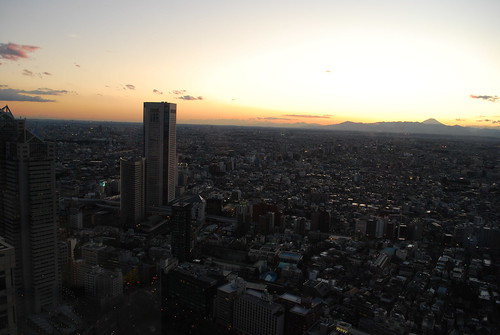
It is monstrously massive. It is a vast, grey smudge that can be seen from space on the surface of otherwise green-ish Japan.

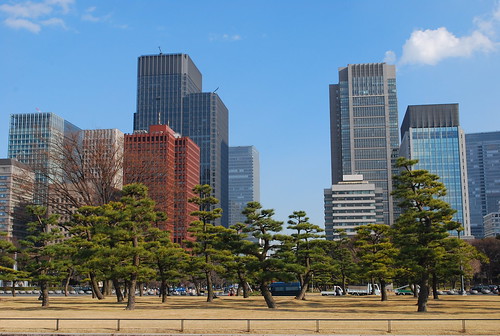
The distant boundaries of the city are ringed by mountains, and the broad plain between them is almost completely choked with urban development. If you're looking at a satellite photo of the city up close, you're hard pressed to locate any particular area to orient yourself. You're forced to pull back until you can catch where the dense grey of concrete eventually starts to peter out and let in some green. And only by interpolating from this green periphery can you begin to guess at the location of the heart of the metropolis.

So dense and vast is Tokyo that it is easy to think of the thing as some relentless virus of progress: infesting and repurposing the land. Had it not been kept in check by the geographic realities of mountains and ocean, it might have succeeded in sprawling further, eventually transforming the whole of Japan into a single cybernetic network of commuter trains, concrete, and power lines.

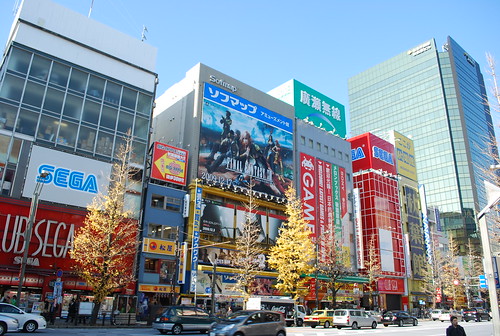
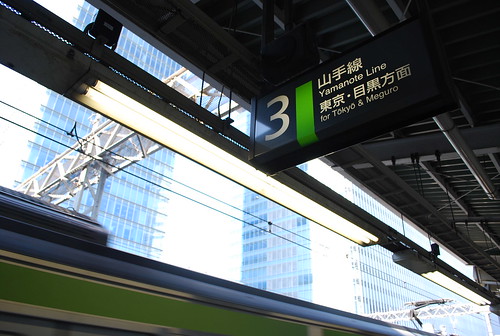
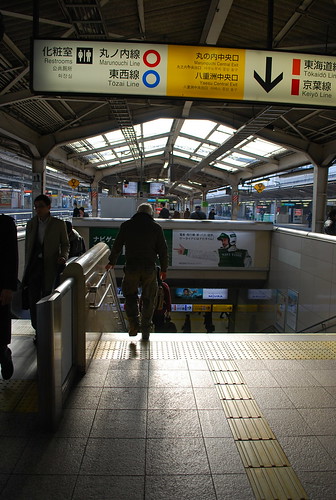
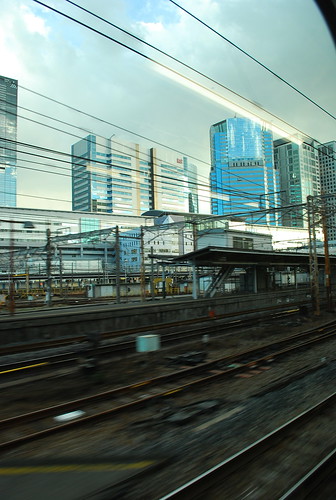
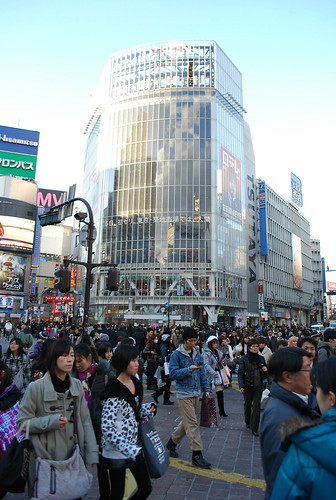
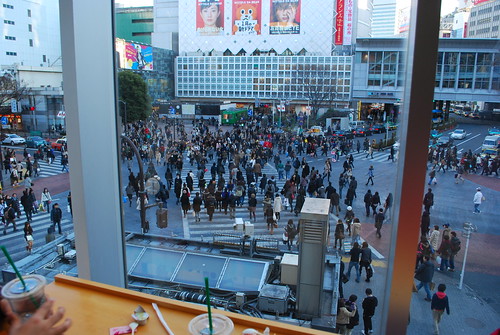
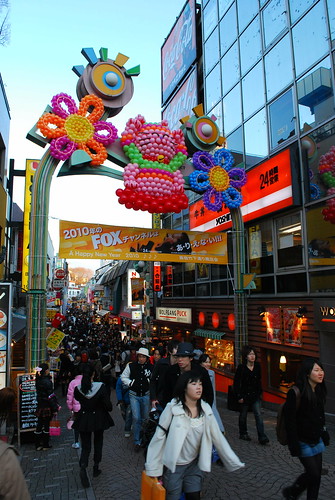
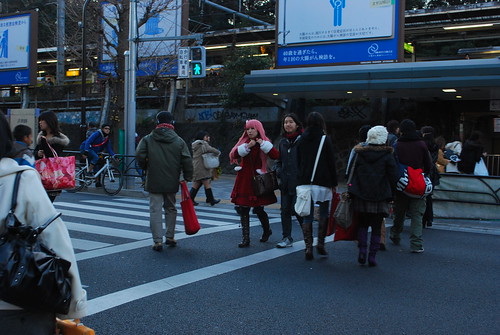
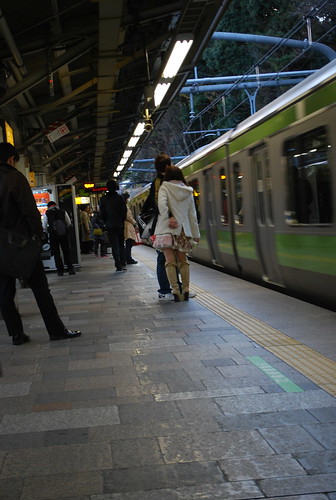
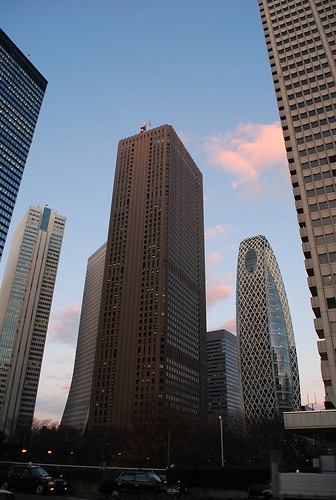
If Tokyo is a living thing, then its arteries are the JR and Metro lines that move commuter trains on its surface and beneath its skin. And in these arteries flows blood made up of millions of the black-suited Japanese Sarariman. To try to see something of Tokyo, we piled into the flow of Sararimen and took the circulatory Yamanote line around the city's heart. The names of stations might as well be the names of the metropolis' organs: Shinjuku and Shibuya, Harajuku and Akihabara, Tokyo and Shinagawa. We jumped off and on the train, wandering around these centres, trying to get a feel for what this place was, but our every stop was one more densely developed downtown vista for all of the 30+km of the line.

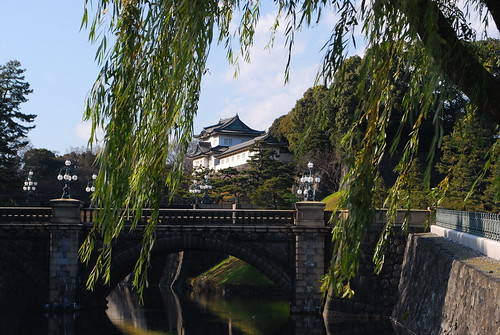
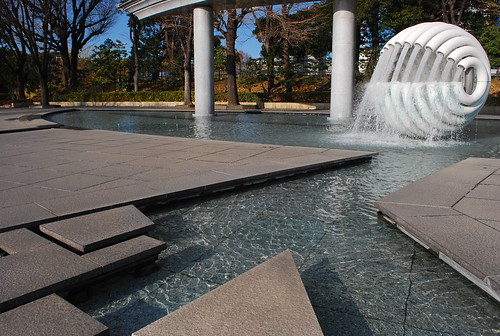
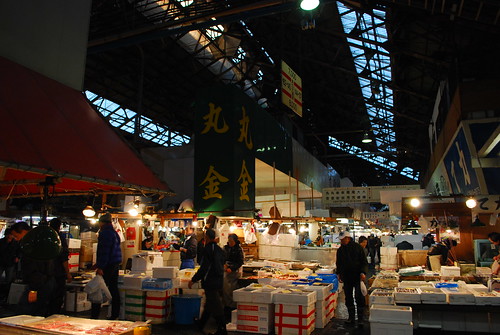
...and I think that's all I can really say about Tokyo. In our two and a half days in town, we saw barely a fraction of it. I tried to capture some of it on film, mostly to satisfy Sarfaraz's obsession with the lives of cities. Oddly, I took fewer pictures than expected. Here's hoping that I caught something with them.