Showing posts with label keeping up with the Joneses. Show all posts

Friday, January 08, 2010

Of Bonding

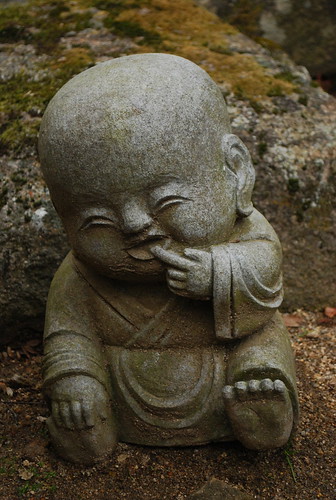
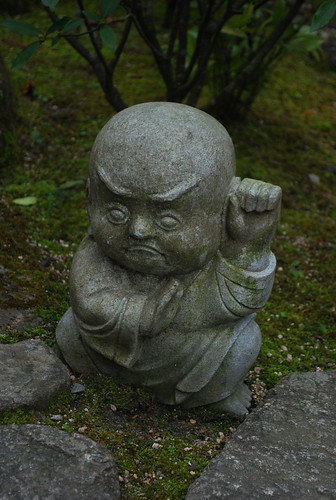
Angry Chibi Buddha

The subtitle for this one should probably be "(A Rant for Saff)" since he's, likely, one of the only people who will be motivated to follow this through.

I think it's appropriate to go here as it's about my trip with my brother and my Dad, and it's about New Years Resolutions, and it's about being repressed (as the Japanese sometimes are), and it's about the ways that our society approaches certain things--approaches that really piss me off.

What's more, it's about something I believe in very passionately.

So, without further screwing around, here she be:

You have to realize something:

The majority of our Supercalafragilisticexpialidotion Father-Sons Miracle Bonding Vacation was spent in silence. We'd walk around, we'd look at stuff, and, if pressed, Dad would reveal how amazed he was about the construction of the stuff we saw. We didn't sit around, crying and giving each other hugs. It's not how we do things. Not ever. It's not who we are.

You go on and on and on about how we need to have this epic, father-son bonding vacation together. What you have to realize is that we don't need it because we're beyond it. We don't need to have two weeks together in a foreign land to tell each other how much we mean to one another because we do it every time we have dinner together. I don't need some big bonding adventure with Dad because a long time ago I realized I needed to see him and talk to him more, so I made a point of going over there every week for dinner, and we'd talk for hours thereafter. Every time Craig, Dad, and I sit down together around Dad's table, we're bonding. We've been doing it for years.

People who don't talk about their feelings and don't tell their loved ones that they love them often enough need big, epic, bonding experience adventures. They need a new setting to share their feelings because they are, for some reason, too afraid to do so in their standard settings. It's like the Japanese when they drink to let go: relying on a change of state--whether it be a mental one from inebriation or a physical one from travel--to break down the barriers you've set up around yourself.

People who talk about "Bonding" need an excuse to do it. They give intimacy and sharing a name, set it on a shelf, and they keep telling themselves they need to get to it some day. And, in so doing, they never get to it. It's like making a New Year's Resolution: you realize you're not doing enough of something, and you set that something on a shelf as a lofty goal and one of two things happen:

1) You achieve your goal by forcing yourself to do it. You don't do it because it's natural or right or it moves you. You do it because you have to, and you're motivating yourself with guilt.

OR

2) You never achieve your goal precisely because you've set it on a shelf. By making it your Resolution--your Goal--you endow it with an extra bearing...you make it bigger than it ought to be by making it something that's so hard to do that you need to make a resolution to do it. It carries all the guilt of you not having done it before, and that guilt makes it seem all the more insurmountable.

People who never mention the word bonding are, in all likelihood, the people who are already doing it. Instead of attaching a name to it, putting it down on their list of things to do, and saying they need to get to it one day, they do it naturally--organically: just like breathing, just like circulation. They go to the people they need to go to, they say the things they need to say. I'm not saying it's easy to do. I'm saying that when you do it, you have to do it naturally.

If you slot in "bonding experience" on your calendar, and you schedule a defined amount of time for it, you are destined to fail. The exchange will be stilted, synthetic, defined. At 11:00 am The Bonding will commence, and at 1:00 pm The Bonding will be completed. You cannot bond with someone on a schedule. It's not a matter of gaining bonding points through scheduled interactions until you gather enough to trade in for a bonding level.

I guess what I'm trying to get down to is a cliché:
Talk is cheap.

Don't talk about bonding. Don't talk about New Year's Resolutions.
Just do it.

I don't like talking about bonding; I just try to do it.

So, on our Jones Family Trip, what we did was spend time together and see stuff together. There was nothing overtly deep and meaningful about it in the instant; that kind of stuff comes with time. The kind of Hallmark, saccharine sentimentality that you seem to be hoping for never transpired, and I'm glad it didn't as it would have been false--for all of us. Any bonding or life changing that occurred occurred silently, inside our heads, and it's the kind of bonding and life changing that Daddio will seldom if ever talk about, but it's the thing that will occur to him with a smile when he's sitting on his own somewhere.

We are what we are, and this trip will be what it will be. To try to force it to be anything else--to try to force it to be meaningful in a loud, showy, let's-talk-about-it way would be to counterfeit the experience. The meaning exists inside our heads. It's as real in there as our names and our passions. To try to make broad, sweeping, heart-warming statements about it is to cheapen it.

In short, I don't think I can give you the answer you're looking for because that answer would be a lie. Just know that this was good. I enjoyed it, and I think Craig and Dad enjoyed it, too.


Thursday, January 07, 2010

東京 (Of Tokyo)

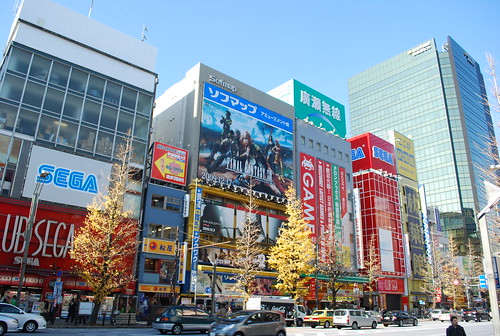
Tokyo isn't big.
It isn't huge or giant.
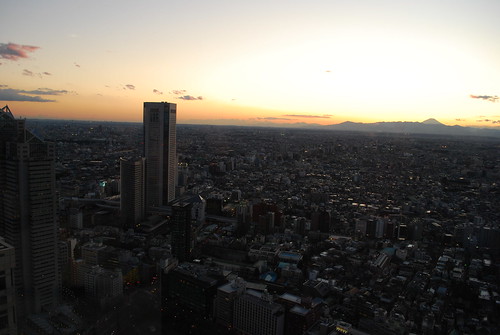
It is monstrously massive. It is a vast, grey smudge that can be seen from space on the surface of otherwise green-ish Japan.

The distant boundaries of the city are ringed by mountains, and the broad plain between them is almost completely choked with urban development. If you're looking at a satellite photo of the city up close, you're hard pressed to locate any particular area to orient yourself. You're forced to pull back until you can catch where the dense grey of concrete eventually starts to peter out and let in some green. And only by interpolating from this green periphery can you begin to guess at the location of the heart of the metropolis.

So dense and vast is Tokyo that it is easy to think of the thing as some relentless virus of progress: infesting and repurposing the land. Had it not been kept in check by the geographic realities of mountains and ocean, it might have succeeded in sprawling further, eventually transforming the whole of Japan into a single cybernetic network of commuter trains, concrete, and power lines.

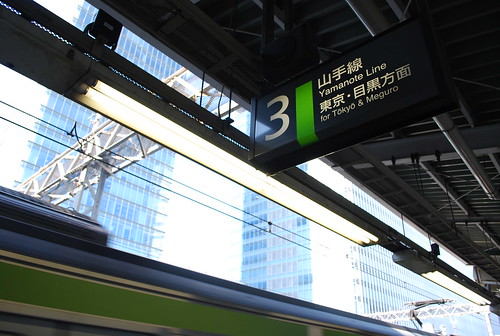
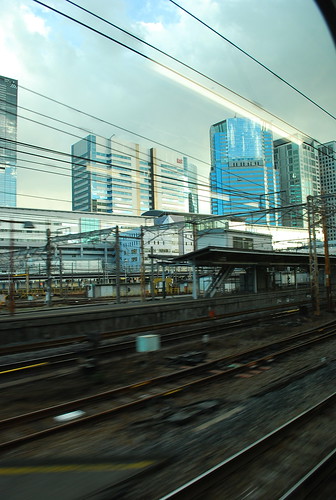
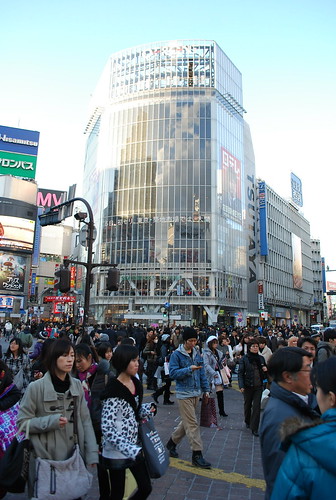
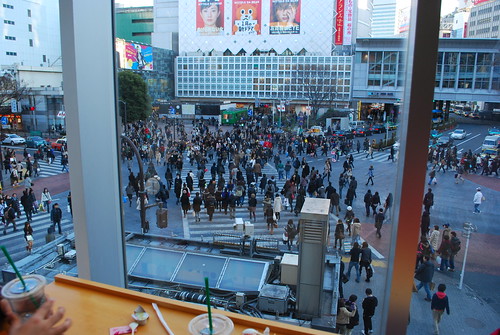
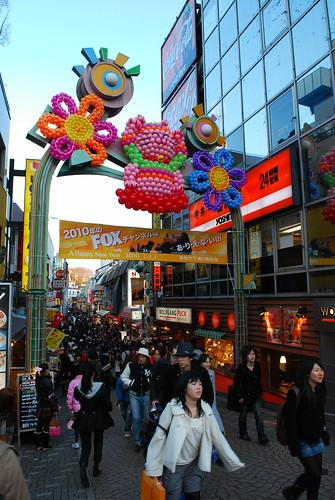
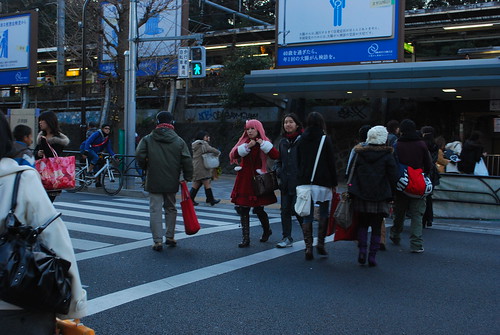
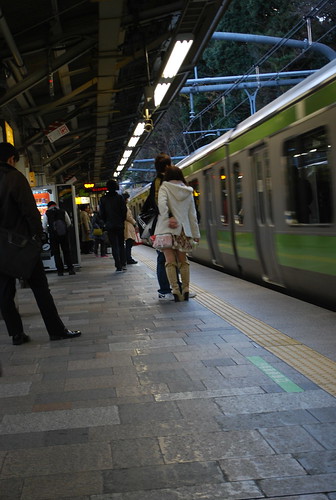
If Tokyo is a living thing, then its arteries are the JR and Metro lines that move commuter trains on its surface and beneath its skin. And in these arteries flows blood made up of millions of the black-suited Japanese Sarariman. To try to see something of Tokyo, we piled into the flow of Sararimen and took the circulatory Yamanote line around the city's heart. The names of stations might as well be the names of the metropolis' organs: Shinjuku and Shibuya, Harajuku and Akihabara, Tokyo and Shinagawa. We jumped off and on the train, wandering around these centres, trying to get a feel for what this place was, but our every stop was one more densely developed downtown vista for all of the 30+km of the line.

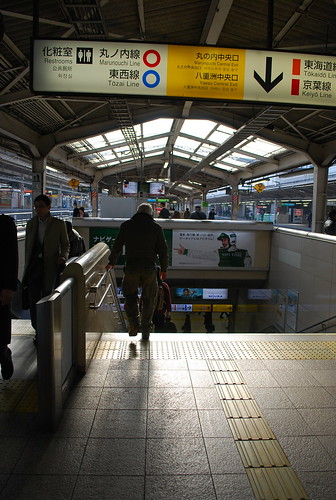
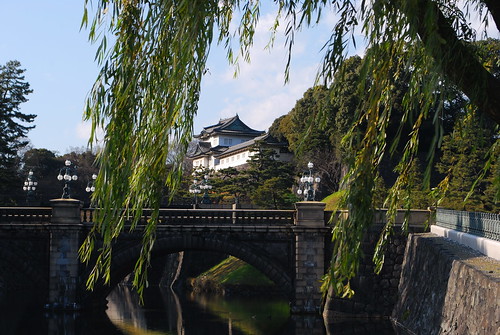
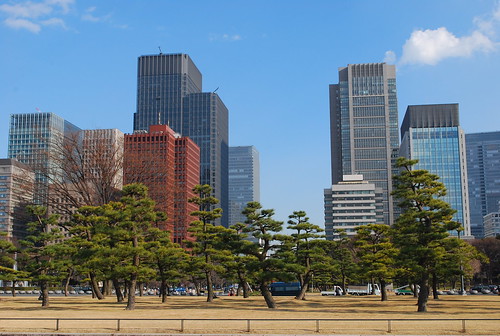
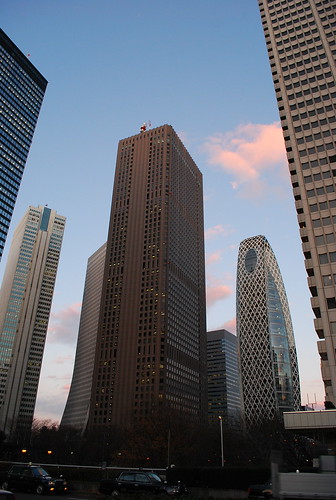
...and I think that's all I can really say about Tokyo. In our two and a half days in town, we saw barely a fraction of it. I tried to capture some of it on film, mostly to satisfy Sarfaraz's obsession with the lives of cities. Oddly, I took fewer pictures than expected. Here's hoping that I caught something with them.
Sunday, January 03, 2010

京都 (Of Kyoto)

Our five days in Kyoto have been idylic.

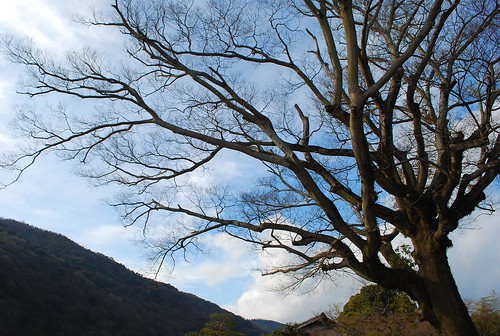
I can't imagine manufacturing better weather than this. The forecast had been all rain and snow for the week, but the reality has been one of windblown sun and cloud skies.

In fact the only thing down here to remind you that it's winter in other parts of the world is the icy wind down out of the mountains, a wind that doesn't seem to have any right being that cold.

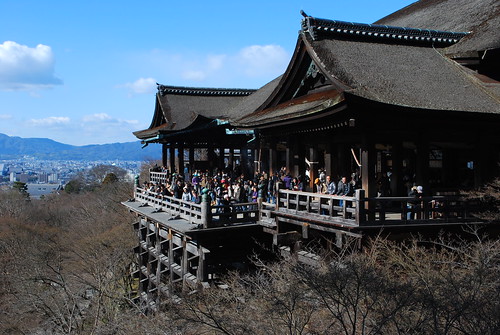
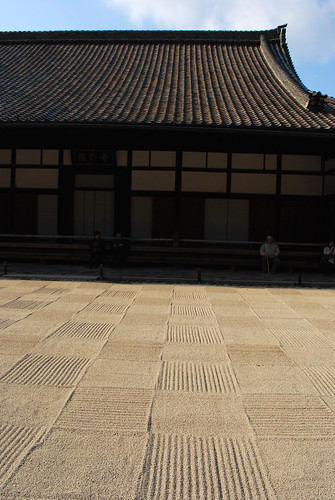
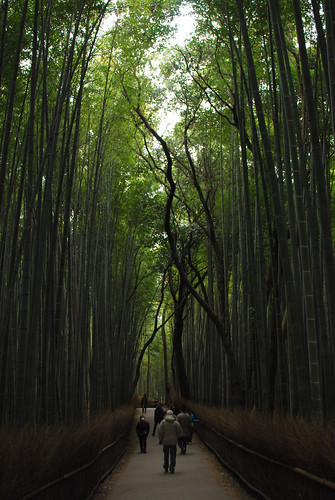
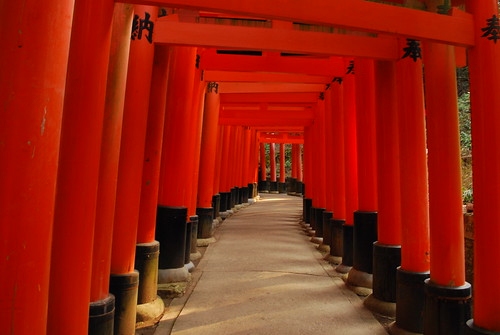
We start each day with sumptuous 7-11 breakfasts because we're men and because we're adventurers. Then it's off to some corner of this sprawling temple complex of a city, to see some sprawling edifice that is inevitably a UNESCO world herritage site.

Seems you can't hurl a stone in this place without striking something that is the biggest/oldest X of it's kind. But don't let my glib jibes belie the value of these structures. Though all of the grand, sweeping temple vistas may be beginning to blur into one, that one image formed is an image of wonder.

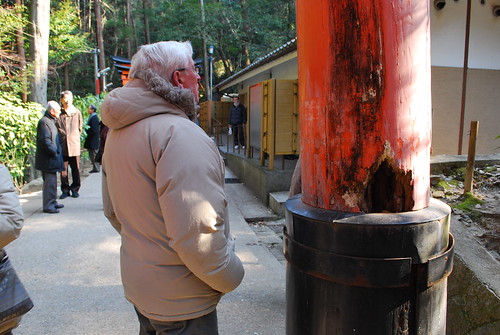
Helping me to understand the true heights of that wonder is my father: the structural engineer. I don't think I realize just how megalithic these wooden structures are until I view them through his eyes.

He makes it crystal clear that these thing are descended from tree and clay and stone, back in a time before the steampunk magic we devised to move such things quickly and easily. He reminds me that men were broken to build these things; that a good many men likely died to make these things.

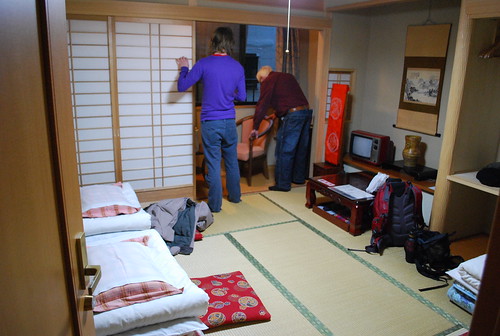
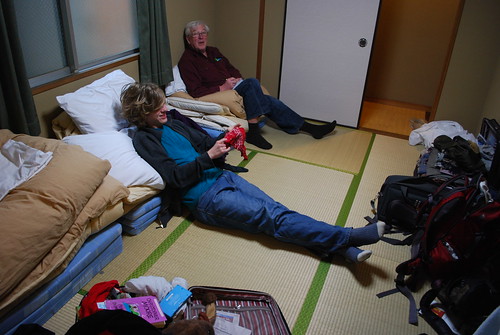
Our Japanese-style Ryokan hotel has served us well. It is comfortable without being opulent; spacious without being grandiose. It is all tatami mats and futons and sliding paper screens.

The facilities are shared with the rest of the inhabitants of our floor, which has yielded frustrations like the toilet with the automatic light that switches off after 15 seconds, and it has also yielded luxuries like the Japanese bath in the shared bath/shower room. Onsen it is not, but every afternoon the staff fill the largish square bath with steaming water and seal it in with an insulating layer. I swear the stuff must stew in there and get hotter as the afternoon turns to evening, and by the time I drop my temple-hopping-wearied frame into it, it seems to scald every inch of me as I submerge. It is very much like a hot tub, except with all the glitz of jets and bubbles and lights and seats traded in for unadulterated HEAT.

Craig and I have made a game of sneaking food up into our room at the hotel, whether that sneaking be required or not (in japan, it's better not to ask). He's become a veritable ninja houdini at it, having his shoes off, slippers on, and being nearly all the way up the stairs before our host even realizes we've returned.

Like poor students or romantic poets, we chill our beers out on the sill outside our window, and as our father snores, Craig and I talk about lost loves in whispered voices behind the paper screens of our narrow sitting room. We send you emails and compose blog entries in our heady state, sharing the things it's taken us far too long to voice.

With the exciting promise of Tokyo looming tommorrow, I'm sad to have to abandon the steady rhythm we've achieved here in Kyoto. I'm disappointed to have to trade the millennia-old capital for the neon city of the future.

With this greater understanding of what this place means, I am even more haunted by something I came across when reading up on the Hiroshima and Nagasaki bombings. I couldn't find a great place to slot it into all of this, so I'll leave it as the last word on Kyoto, where it might send shivers up the spines of those who have had the fortune to know this place and perhaps instill some wonder in those who never have seen it:

During the second world war, a number of Japanese cities were spared from the American incendiary bombing campaigns. These cities were left untouched becuase they were being considered as potential targets for something far more devastating: atom bomb tests. Reading about the full extent of the United States' plans to wage atomic war on Japan should the nation have elected not to surrender immediately was a haunting experience, but most haunting of all was reading that Kyoto was on the list of potential targets--learning about the fickle annecdote that saved 1200 years of Japanese cultural history. For a time, it was believed that the decision to spare Kyoto was made by Edwin O. Reischauer, the Japan expert for the U.S. Army Intelligence Service, but in his autobiography he clarified the truth of the matter, stating "...the only person deserving credit for saving Kyoto from destruction is Henry L. Stimson, the Secretary of War at the time, who had known and admired Kyoto ever since his honeymoon there several decades earlier."

He had it coming

I've come down with something. I think Craig and Dad brought it over with them. It's a condition that's exacerbated by having such a significant part of my old Canadian life here in Japan for such an extended time: telling me stories of the people I used to see all the time. It's a sickness you can control, but--just like going out without a jacket--I don't take care, and I start having dreams with Amandas and Allisons and Garcias and Lindsays in them. It puts the chill in me, and when i should be taking nice Japanese vitamins, I wallow instead in foreign junk food like Canadian tunes from Amy. And, at my last possible opportunity to kick this thing by getting to bed at a reasonable time, i elect to stay up, emailing with friends who i feared had forgotten about me, and they assure me that I'm very much still on their minds.

And--just like that--I'm afflicted. It's the antithesis of the Wanderlust, and there's just one way to say it:

I miss you.

Thursday, December 31, 2009

Year's Ending

I hope that, wherever you find yourself in the world, you have yourself a よいお年お.

You know I'll be thinking of you as i stand here, alone on a mountain top, crammed in with hundreds of my closest strangers. My brother and dad crapped out after all our temple hopping today, so its just me and the crowds and 17 monks and their 74-ton bell here in Kyoto.

But between the clouds, the moon is full, and when the clouds do come, they bring me snow: dusting down in the yellow floodlight. It's come down all the way from Hokkaido tonight, little white pieces of home to keep me company.

It's just over two hours now before year's turning here, on the other side of the world. Gong will go the bell, and gone will be the first decade of this brave new millennia.

I hope this beginning finds you well, and just maybe, if you listen closely, you'll catch the faintest echoes of the Chion-in bell in the night, chasing the change around the globe.

Wednesday, December 30, 2009

広島県 (Of Hiroshima)

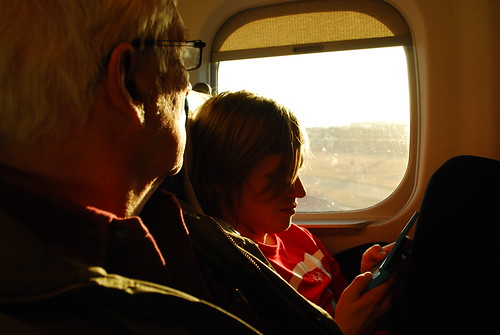
For all my anxiety about making sure this trip went off without a hitch and my brother and father were rested, fed, and happy, it's only gotten better since leaving Hokkaido. For all my adamantly proclaimed love of snow and winter, as we flew in over the geometrically perfect, man-made island of Kansai airport, and the sun glinted in the window off the waves of the inland sea, I started to yield to the idea of a temperate winter. And then on the train from Kansai in to Shin Osaka, as the Kansai craddle from which all of Japan was born whipped by outside the window, I marvelled that the trees still had leaves. Coming out of the grey-white dark of Hokkaido, the prospct of warmth and sun and growth seemed so distant as to be fantasy.
But here it is, and it warmed me. On that train, I was hit by sentimental waves of Greece and Scandinavia and Estonia and London, and in the midst of being buffeted by them I realized this adventure of ours had really begun.
Our hostel in Hiroshima was bare bones in that livably Japanese way, with our own toilet, sink, and futons, but little else that wasn't shared. It provided dad with coffee and Craig with facilities for pursuing his ongoing mochi addiction.
_____________


Hiroshima itself has been two worlds:

Yesterday: sunny Miyajima.
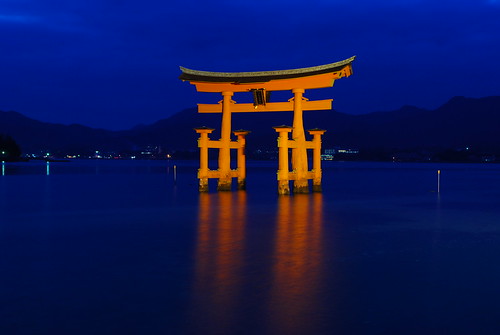
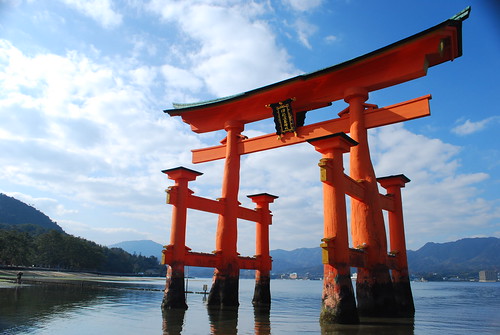
The sacred island that man couldn't set foot on until he built a colossal, vermillion Torii gate in the water off its shore through which boats could approach in deference.
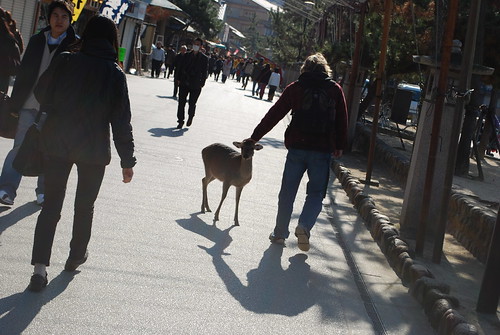
A knot of hills and temples, possessed by its island spirits embodied in the curious yet indifferent deer that stalk the crowds of visitors, searching expectantly for their offerings.
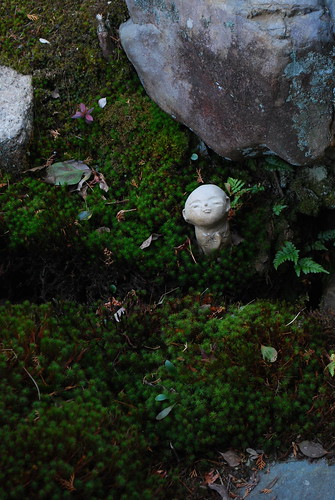
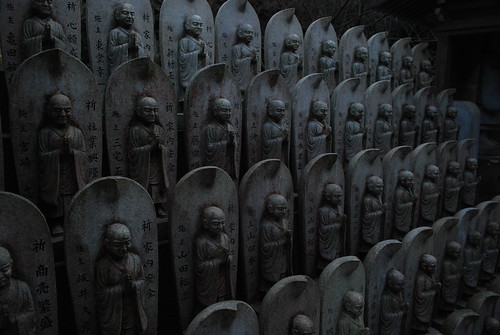
And the mountainside sprawling complex of Holy that is Daishou-in temple. A place of Buddhist worship infested by lawn-gnome-like Chibi Buddhas: oriental leprechauns that have studied the stoney disguises of the tanuki. When you look upon them, they are statues frozen in comedic, almost mocking poses.
And when you turn your back, they gambole off between the rocks and plants of this massive zen garden. They play hide and seek with monuments and shrines many times their size: springing them upon you as you turn corners and hiding them away as you try to capture the wonders with your camera.
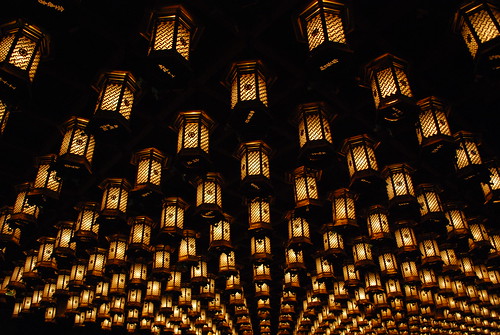
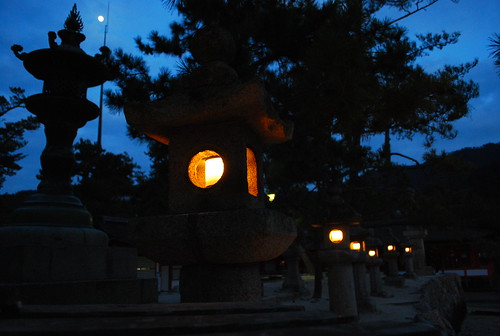
As the night falls on Miyajima, these diminuative Buddhas descend from their mountain home to light the stone lanterns along the shore and to shoo the deer back into the forests.
Lastly they spark the great bulbs that set fire to the Floating Torii, assuring that its reflection glows in the rising tide and burns itself into the minds of the footsore and windblown visitors as they leave Miyajima on the last of the ferry boats.

Today: The A-Bomb Dome and Peace Park of Hiroshima city proper: grey before the coming rain.
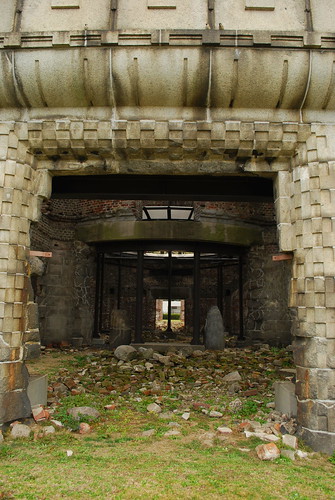
The last sun of yesterday disappears behing a slate of cloud as we descend from the tram, the irradiated remains of the former prefectural office full before us without any build up or any reveal. You don't wander down a path to find the A-Bomb Dome. There is no coy game of cat and mouse where the path approaching it gives you fleeting glimpses before revealing the full of it. It's just there. Vivid and whole and undeniable. The ruins, mere meters from what was once the epicenter of man's greatest folly of curiosity, they seem almost a sculpture of destruction, an image carefully fashioned to embody the archetype of a ruin.
Every protruding, twisted girder; every heaping of rubbled masonry, a flourish of a brushstroke intending to make the meaning of this oeuvre explicit.
It is more monument than any amorphous blob of modern art could ever be. And in my mind it brings down an avalanche of images:

The shockwave hurtling down from a height of 580 meters to strip away the majority of the prefectural office like rags or flesh, leaving only the current skeleton of steel and rock; the firey ball of plasma boiling down in the shockwave's wake--a vivid visual of fire passing through the metal remains of the dome, like smoke through a latticework.

The birds that now roost among the ruins of the A-Bomb Dome; pidgeons still picking hopefully through the rubble; something like starlings perching on the metal work of the actual dome and flitting to and frow among the standing remains in a flock.

Thousands of people being reduced to atoms, the trauma and absolute nature of their destruction going so far as to undo the very boudaries of their spirits so that both the molecules of their DNA and the shadows of their souls begin to overlap. And in the heat and the dark, as everything that once composed them is forced upwards into the azure sky, they fuse. Thousands of souls all rising together; a vast, sentient thing that rides the winds away from the inferno. The one, eclipsing soul of Hiroshima's dead.

Enola Gay, learning of that daft son of hers' last attempt to do something to make her proud. She, rolling her eyes and shaking her head with a morbid laugh, wondering if that ol fool will ever learn.

Thursday, December 24, 2009

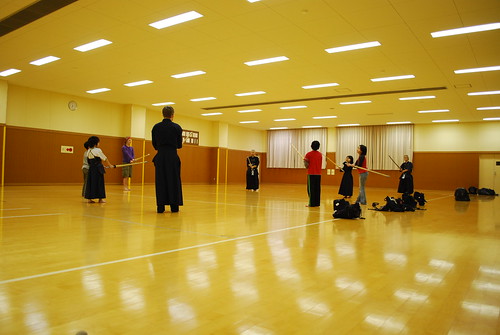
'Twas the night before Christmas...

...and all through the town,
every creature was stirring
even the Jones clowns.

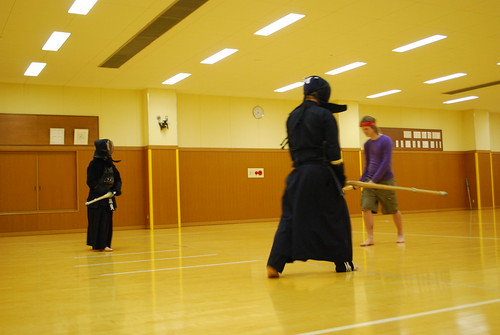
With Craig in his bandana
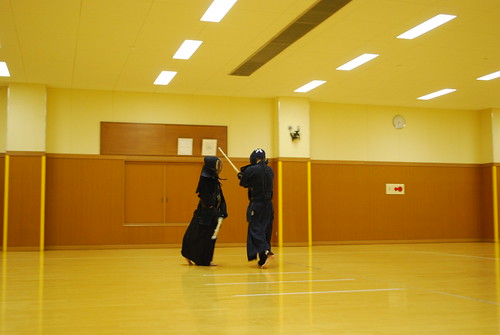
and me in my gi,
we'd just arrived at the dojo
to do Kendo for free.

When out on the floor
there arose such a clatter
we sprang to our feet
with hopes of making it louder.
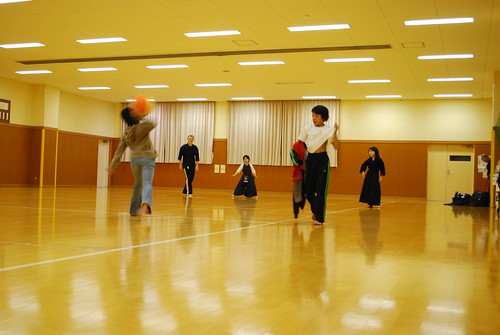
Children did run
and hurl balls with glee
screaming their lungs out
for Kurage and Me.
Shinais were laid
round the centre with care
in hopes that some violence
soon would be there.
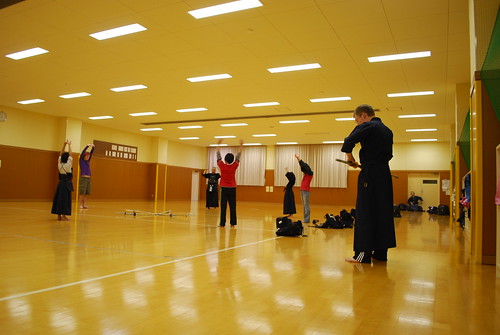
We stretched and we armoured
we men'd and we do'd
Children with Miura
and Shinkai with we.

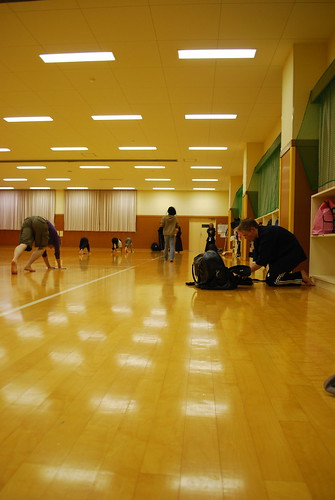
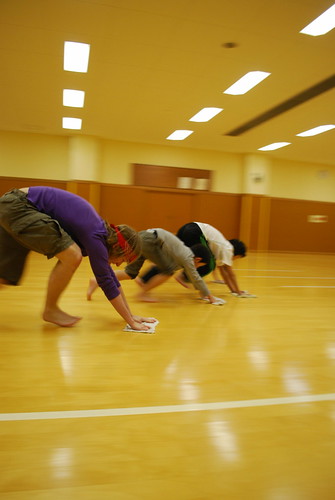
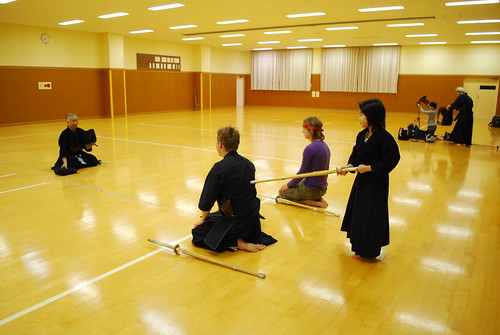
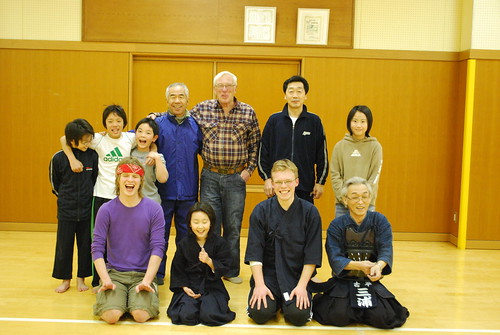
Okay. Maybe I should just let the photos tell the rest of the story.