Showing posts with label Furubira. Show all posts

Sunday, August 01, 2010

Kaerimashita

After days of travel that started at Toronto Pearson on Thursday July 29th at 13:00, I finally got back home to Furubira at 16:00 today, after sojourns in humid Tokyo hostels and on the floor of Maggie’s wind-swept apartment in Sapporo. The clouds that had been grey and ominous from Otaru through to just past Yoichi are riven in blue and white as my bus passes through that high, narrow tunnel and down into the rocky, coastal roads of the Shakotan peninsula. Having heard tales of flooding in Furubira while I was away from Mark, I half expect to come back upon my town as a ruin.

As I pass through the last tunnel, I find it to be anything but. It is the same sun-and-clouded, tree-choked-mountains-of-green place that I left. The only evidence of the torrential rains of last Thursday lingers in the spindly and still-green trees up-ended in the shallows where the Furubira river empties into the Sea of Japan.

I climb the stairs to my apartment for the first time in three weeks to find that some of me has gone out of it. In my absence, it has settled back to the dusty smell of tatami mats and sunshine that I remember so keenly from when I first arrived here a few days shy of a year ago. It is a smell that was once tinged with the anxiety of finally being on my own in this distant land. However, now the same smell comforts me. It is a smell of the relatively clear spaces in this apartment—a smell of traditional, tiled shower rooms and warm, astroturfed sun rooms. It is a smell of golden light through sheer curtains and of vague tinkling from unseen wind chimes.

And that smell makes me sane, on this Sunday end to my long adventure home—when all of my emotional history screams that I should be mourning the end of a vacation; mourning another year away from all that is familiar and Canadian.

But I don’t.

And I’m not.

And I’m wondering if it has to do with the overwhelming sense of right I felt when I walked off flight AC001 and into Tokyo Narita for the second time this year, this time very much without the support of dozens of other Toronto JETs. I wonder if it has to do with how all of my consternation over training my way into sweaty Tokyo and finding my hostel fell away, only to be replaced by a profound and irrational love for the Japanese people—by a strong desire that I never knew I had to be back home with them.

Wednesday, June 02, 2010

a year in The Life

Well, it’s been a year since I started this thing. I figured I’d commemorate it with some updates. This is the pretty straight forward, year-of-blog update. I've got something a little more linguistically interesting in the offing, but it will have to come a bit later.


First, I ain’t coming home

Despite thinking I was pretty clear on my decision in the Christmas cards I sent to most people, as well as in my six month post, it appears that there are some folks who are still getting surprised by my news that I recontracted with JET and will be hanging on in Furubira as the ALT until July 2011 at least. So here it is; one more time:

I’m not coming home in August 2010.

Right now I’m scheduled to be back in August of 2011, but there is always the possibility of extending my contract for a further year.


That being said, I’m coming home soon

Sorry to be contrary, but I’m coming home for a visit to Canada this July. The first bit will be in Vancouver for Amy’s birthday (that’s two years running, Thede. I hope you’re keeping track…) and Amanda’s wedding, and the second bit will be in Toronto to catch up with the family and all you mad city rats. However, for reasons of paid vacation limits and planning to work at Tokyo Orientation (even though they decided I wasn’t genki enough >:( ), it will be a very short visit. Therefore, I’m really hoping I can set up some kind of mass do so I can make sure to see everyone.


So where is Furubira, anyway?

I took a look back at those first posts and realized that I got the location of my town pretty wrong. So, though Amy’s likely the only one to care, here are some revised maps to show where I’m at in this mad archipelago.

Further, Furubira is a small fishing town of 3,800 souls—far less than the 14,000 it boasted at its prime, back when we had movie theaters and herring mansions, back before a change to off-shore fishing laws started a steady bleed of our fisherman population. I’d love to make a romantic comparison to the outports of Newfoundland, but the reality is that the fish processing our town is still engaged in seems to keep us running.


The Schools

The junior high school second graders who used to alternate between telling me to leave and telling me to die are now third graders who tell me I’m cool and that I should stay. They’re also entertaining themselves by yelling “hige!” at me from time to time and laughing as I stroke my beard in epic fashion. The junior high first graders who used to be the apple of my predecessor’s eye have slowly degraded into junior high second graders who are only now discovering the joys of telling me to die. Thankfully, my new junior high first graders became far less straight-jacket insane in their transfer over from sixth grade at the elementary school, and there are some among their number that completely blow me away with their level of English acumen.

The Elementary students are angels, like always. Well, the new fifth graders have inherrited the manic mantle from the old sixth graders, complete with the dubious honour of having their homeroom teacher leave on undisclosed, yet surely unrelated, indefinite leave. The new sixth graders are developing some attitude, but it can’t get the better of their genuine interest in learning. The new fourth graders continue to prove themselves to be wunderkind in the interest and ability they demonstrate in our twinning with my mother’s second grade class. The third graders are as fun as third graders should be, the second graders are suffering bit from a possible Sensei-Importance of English disconnect, and the first graders are the light of any day. God, that I could spend my every day trying to come up with new and creative ways to make them explode into those uninhibited peals of laughter. I’m convinced exposure to my first graders could cure cancer, those kids are so cute.

The High School is as a slowly closing High School should be, I guess. Since the year change in March-April, the third graders have graduated and moved on, the seconds have become thirds, the firsts have become seconds, and the first year class is no more. With only two classes to teach there now, I spend even less time at the school, and when we go through the whole process again next March, I’ll have only 50 minutes to teach at the high school, once every two weeks. It will be worth it, though, as the now-second-and-then-third graders at the high school have always been my very favourite students, and my Japanese Teacher of English (JTE) there is unquestionably my most manic, most entertaining teacher. He makes mad things like this on the regular.


The BOE

The other half of any ALT’s job: The Board of Education. Or, perhaps, the Bored of Education when we have to report to it on days when the schools are out and make work to do as our coworkers seem just as confused about what we’re doing there as we are. Thankfully, my BOE seems to be better than most: it is just the right mix of invested in my well-being while not being overbearing in my life. The people there are also as muppet-like as I am.


I’ve got hair

Didn’t say all these updates were going to be particularly interesting, but I’m thin on material, and this is the most hair I’ve had in a while, so deal.


And I’ve got a lady.

Which seems like a fundamentally impersonal way to talk about it, but just like with the recontracting thing, people still seem to be surprised by the news. I guess my less-than-subtle implications could have stood to be far less subtle. Her name’s Heather, and she’s from the UK. She showed up over here in the same JET group as I, and we’re placed not too far apart up here in Hokkaido, with Sapporo as a convenient meeting point between us. To quote the Barenaked Ladies, “she loves me, and her body keeps me warm…”


And since it's what started all this off, here is my own, snowier take on that photo by that Bassguitar guy on Flickr; the one that was my first image of Furubira. I'd been meaning to photograph these rocks for a while, and I finally got the chance in early April. Back then, I said that the picture had convinced me that Furubira was the kind of place I wanted to be. Now, twelve months later, I'm still thinking the same thing.

Tuesday, May 25, 2010

Sakura Saturdays


Sometimes I talk too much.

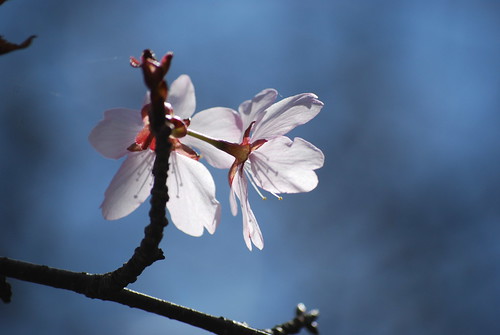
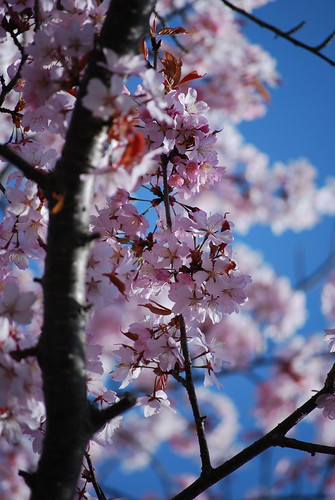
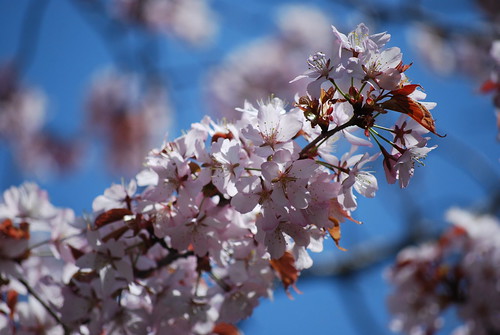
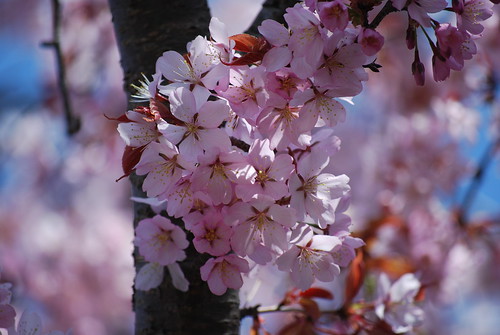
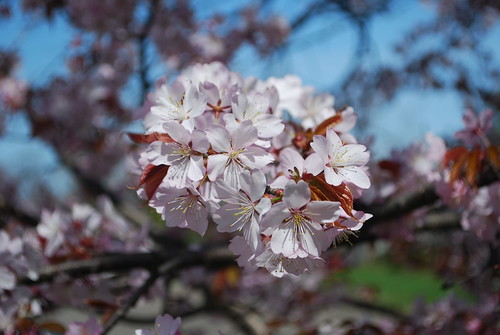
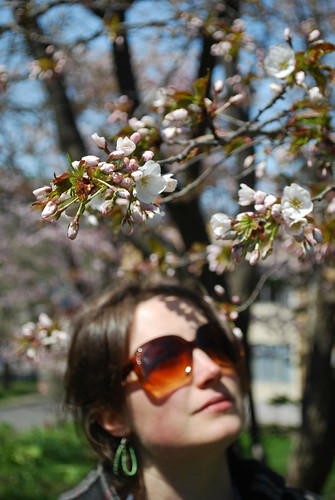
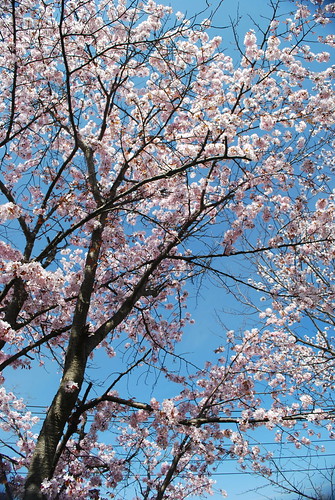
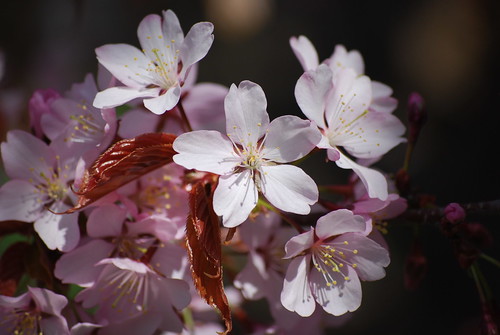
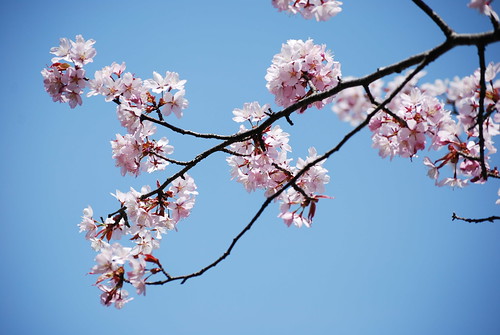
There's something to be had in the extreme weight of the sakura (cherry blossoms) in Japanese society, in the fact that they invest so very much of their cultural capital in something so fleeting, but for now I'll let the photos tell their own story. These were taken in Furubira on the weekend of May 15 when Heather came down for a visit.

Her timing couldn't have been better.

Monday, May 24, 2010

Kitsune Station


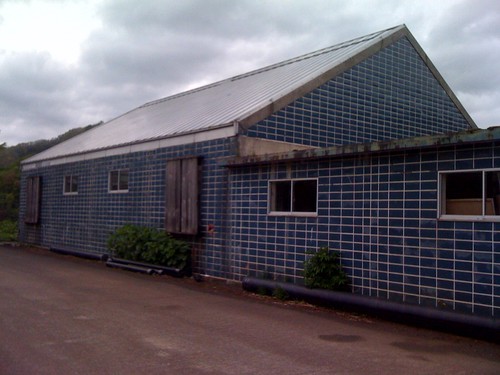
Today, on one of the booken (adventures) that my supervisor often takes me on, I was lead through a locked door to the interior of an abandoned-looking building. I’d been by on my bike to investigate the building and the construction going on beside it last year. However, what windows there were began at least five feet off the ground, and even those were boarded over. As I craned my neck to see in, all that I could glimpse between intervening boards were hints of greenery inside this obviously derelict, yet remarkably intact, structure.

Heading inside today, we first entered a large, garage-like room that was being used for town storage (as most of the disused municipal buildings seem to be), but beyond the piles of signs and snowmobiles and miscellaneous ceremonial bits, there were metal stairs up to a half-sized sliding glass door. As my supervisor and the facility’s technician poked around in the storage, myself and Obara-san went on through the small sliding door and out onto a concrete catwalk.

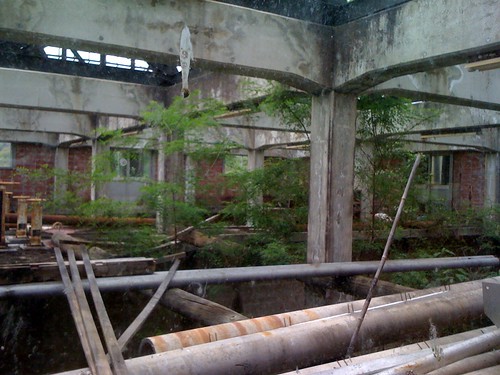
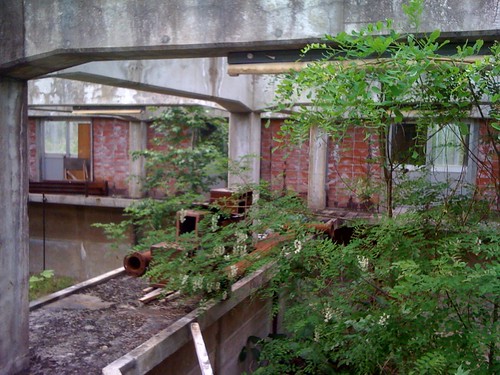
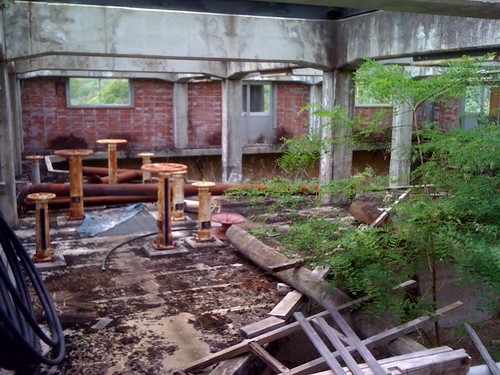
The temperature beyond the door jumped a good ten degrees beneath the unbroken, peaked glass roof. All along the catwalk were remains of valves and piping, and below were two large concrete pits. Though they were dry, pipes running through their walls betrayed the fact that they had once been pools…as did the trees growing among their broken concrete. It had been these slim saplings, taking advantage of this water-treatment-facility-cum-greenhouse, that I’d glimpsed between the boards over the windows—these trees that had so confused me about what this place was.

The once-purposeful-yet-now-gone-to-seed feel of it reminded me of nothing so much as a Dharma installation out of Lost. The setting of the facility, half-way up the side of a verdant mountain, with similarly lush hills ringing it and blocking out any hint of the town beyond, certainly helped to give the impression that somewhere along the way we’d left Hokkaido and wound up on The Island.

And if the de-facto greenhouse gave the impression of Dharma That Was, walking across the courtyard, past a coy pond and through the barbed-wire-lined gates into the operational building next door was like stepping back to Dharma’s Golden Age. We were given a tour of the facility’s cool, wet interior, and the site’s technician spoke to me in Japanese about processes that I wouldn’t have understood in English. While describing the methods and apparatuses used to distill raw water into something fit for us to drink, the parts of his vocabulary I picked up on were like incantations or haikus for the hydromagic that they wrought in that building.

There was “snow” and “mountain” and “electricity;” “garbage” and “water,” and “up” and “down.” To describe the clean water, he used kirei, the word that also means “beautiful,” and the notion that the end goal of this collection of pools and pipes and pumps was “beautiful water” only added to the alchemy of it. He took us across the more modern, concrete facsimiles of the catwalks we’d been out on in The Greenhouse, and he peeled back flexible layers of plastic sheeting to reveal ponds far deeper than those we’d encountered next door. He pointed down into the dark water, indicating the arcane machinery stirring menacingly in the depths.

Standing on the lips of those wells, with only a scant rigging of aluminum lattice and plastic siding standing between the observer and meters of water, I was gripped by a unique vertigo that was as much being afraid of the dark as it was a fear of falling.


And, of course, in a turn of events fitting of the sustained mystery that is Dharma, the only camera I had to hand upon making this wondrous discovery was my poor iPhone one.

Thursday, October 15, 2009

INFLU

Monday October 5, 2009.

Plague masks out, kids.

What was a humorous one-liner last week appears to have fully descended on the schools of Furubira this week. I realized it when I walked into the teacher’s office of the elementary school on Monday, and I had the normally laughy-jokey Kyoto Sensei (vice principal) pretty much forcefully apply one of those sick masks to my face before I could breathe too much of the air unprotected.

INFLU, as the Japanese call it, had finally gotten its pestilent little claws on the schools in my town.

This wasn’t the first I had heard of it as the teachers had been throwing the word around for about a month now, but I had written the whole thing off as media-boosted heebie-jeebies, akin to what was going on in Canada before I left around the whole Swine Flu threat. However, when I rolled in on Monday and was informed that my awesome third grade class had all been quarantined at home, and the teachers (every last one of them with a plague mask on) were planning to close the rest of the elementary for a week at the end of the day, it was clear how seriously the town was taking this whole thing.
And the reaction at my junior high school was no different on Tuesday. Fortunately, the first victims of the seemingly sympathetic superbug were three of my favourite {sic} students. It was also decided that the second year class would be closed and sent home for the week at the end of the day. The teachers at the Jr. high weren’t wearing masks yet, but they might as well have been as their speech was already infected and every second word out of their mouths was “infruenza.”

For me, the whole thing resulted in a kind of half-assed holiday as I still had to show up for work, but I had no students to teach.

For the town, though, it has had a broader impact than expected.

Another second or third year JET had once told me that my town was dying. There was some truth in the statement as my town once had roughly 14,000 inhabitants but has since shrunk to only some 3,800 people. The high school I visit will be closing in two years, and the public kindergarten has already closed. And having this other JET pronounce this death sentence got me down for a bit as I began to dread the idea of spending a year or more in a “dying” town.

Then I took an objective look at the situation and realized that the JET was wrong. There was still life in this place, and that life took the form of 3- to 5-foot munchkins that ran along its streets and through its parks. I saw that as long as Furubira had children, Furubira would be alive.

Strangely, this whole INFLU thing has served to prove my observation.

On my morning walk to the junior high school, I cross paths with the patchy stream of elementary school kids flowing in the opposite direction toward their school. Where we meet, they invariably greet me with a “HARRO NIKORASU!”, and I reciprocate with a “goodmorning!” or “hello!” in a tone that is probably a little loud for first thing in the morning. I also come across their crossing guard, the jack-of-all-trades Nakamura Sensei. He always greets me cheerfully, forces the children to greet me in English, and then he wishes me a good day. The best word to describe the whole exchange is “Genki.” (Japanese for “energetic,” but, as with most Things Japanese, it means a good deal more than that)

But on Tuesday morning, with the elementary closed for the rest of the week, there were no loud elementary students, and there was no genki Nakamura Crossing Guard Sensei. The walk to work was quiet, uneventful, and the furthest thing from lively.

It was the same case at Kendo on Tuesday night. On Tuesdays and Thursday nights, the kendo dojo at the sports centre is usually filled with the screams of the kendo kids. Climbing the stairs to the dojo, I can hear the kids before I can see them. The stairs resonate with their laughter and the explosive impacts of the balls they whip around in their indecipherable version of dodge ball. The game passes for a warm up activity as they wait for their kendo senseis to arrive. When I walk in, the kendo kids assign me to one of the two teams, and the other team gets to delight in firing balls at my head.

But that Tuesday night, I walked up the stairs to the dojo in complete silence. I entered the half-darkened, empty room, and there wasn’t another soul around. It appeared that the quarantine instated at the elementary school extended to all of the students’ extra curriculars as well. I warmed up on my own and even had the opportunity to attempt something like meditation in the quiet room before the senseis showed up. As it was just me there with the two teachers, we were able to get down to some pretty intense sword fighting action, but it wasn’t the same without a gaggle of 3rd to 5th graders running interference. The class was far more serious and far less alive.

So maybe I was right. Maybe it is the case that Furubira survives so long as it has children flowing like life through the arteries of its streets. And should the town ever lose those children, like it did last week, it would slowly start to fade to a cold, dead thing.

Wednesday, September 02, 2009

Beacons


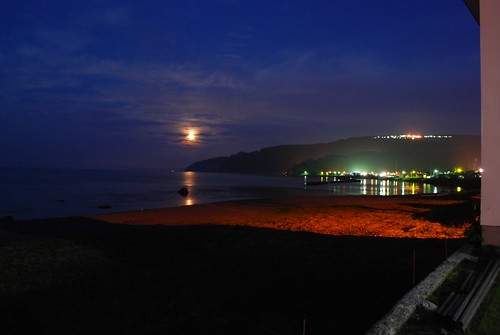
Down by the black waters of the harbour
I try to read beacons that shine in the night
just over the horizon;
Like small, dense, coastal cities
they sit, equidistant and equibright.
Were it not for the knowledge
that these waters flowed out to infinity,
joining the Sea of Japan,
I could believe the points of light brilliant metropolises
dotting the distant shore.

They must be the fishing boats I saw in port
with giant bulbs, strung in lines, from bow to stern.
I wondered at the purpose of those chains of light,
and now I can picture it:
Them burning brightly in the night
Obliterating shadow on deck, for a wide radius
and summoning, from the depths
Fish, scores of fish
mothlike as they flock towards the glow
swirling upwards out of the unfathomable dark.


Tuesday, August 11, 2009

What our apartment does when we're not around...

The screen fairy visited me again today while I was at work.

When I came home for lunch today, after being dutifully sent on my way from work by the Furubira noontime air raid siren, I thought I was hallucinating when I opened the window over my laptop and found a screen in it. I was pretty sure there hadn’t been a screen there before, but with all the multitude of sliding panels that make up Japanese windows, I couldn’t be certain that I hadn’t simply missed the screen in all my sliding about.

However, when I came home from work at the end of the day and found two sliding screens in the massive windows of my sun room, I knew for absolute certain that something was afoot.


Fortunate for my paranoia, as I was standing before these new screens, looking part perplexed and part creeped out, a kindly face smiled up at me from the street below and gave a patented Japanese wavebow. I thanked him from above in my pidgen Nihongo, then rushed down to introduce myself and thank him properly with some omiyage from The Great White North.

His name was Kurokawa-san, and he was the somewhat gaunt, somewhat sunripened figure who I’d often seen labouring away in the workshop below my apartment. I’ll be sure to impart his life story to you once we’ve both had beer enough to improve my Japanese or his English.

The fact that he popped in some screens for me, without me having to ask him, is just another one of the reasons I’m so happy with my apartment. Though I pay far more for it than most of the other JETs who were sent to the Cold White North of Japan (meaning, I pay 50,000 Yen [500 Canadian beaver pelts] and most of them pay nothing, plus get a car, a bike, and anything else their heart desires), I can’t exactly complain about my accommodations. So, without further ado, here they are:


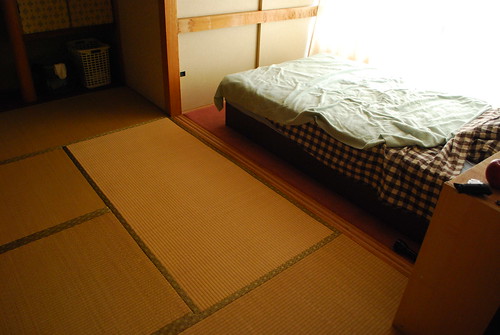
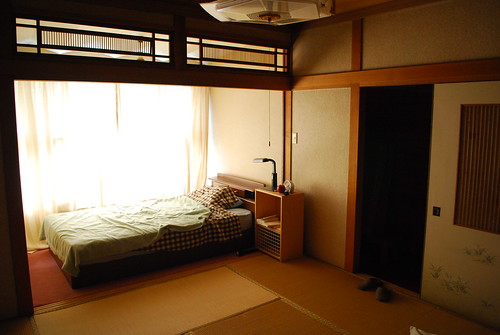
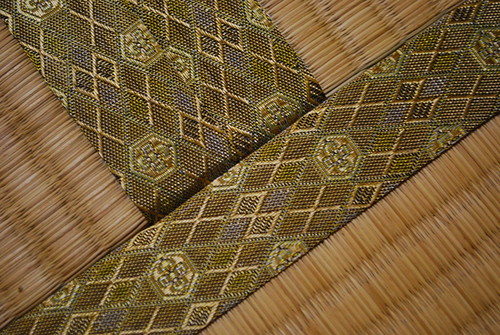
My bedroom, complete with Tatami mats


I seriously think I may need to marry these mats so I can take them with me when I leave.


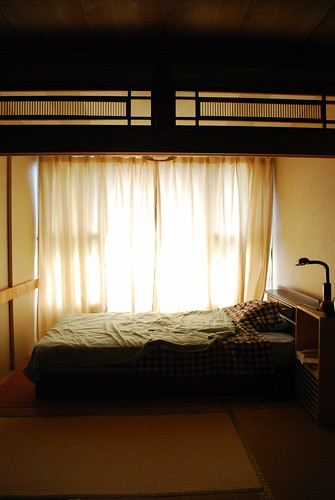
My western bed. For all my talk of being hardcore and sleeping on the floor, I was VERY happy to see it when I showed up here my first night.


I can't explain how fun it is to be sleeping in this room. All Zen. All the time.


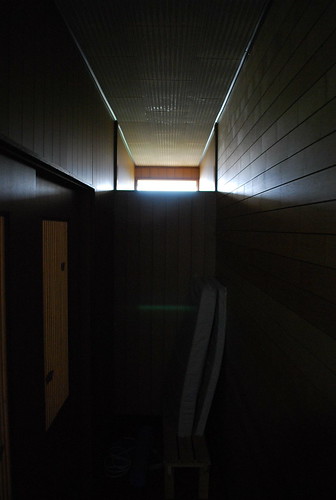
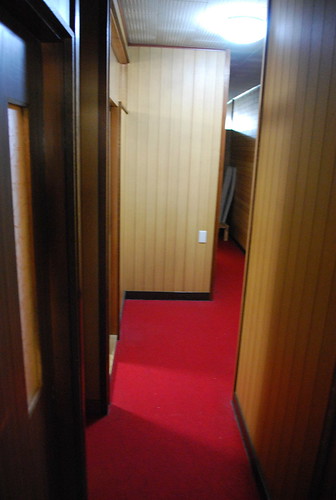
There's a tiny window at the end of my hall. I can't explain it, but it feels right.


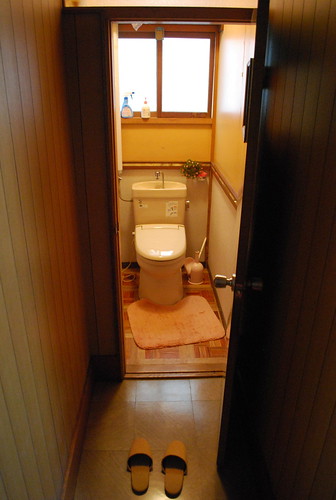
The toilet's got its own room and its own slippers. It is also the only room in the house that you step down from the level of the hall to use.


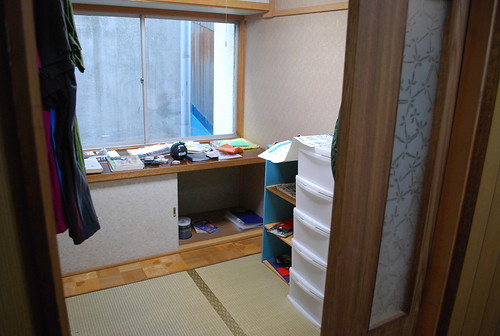
For all my veneration of my tatami bedroom, I've relegated this smaller tatami room to the role of closet/storage.


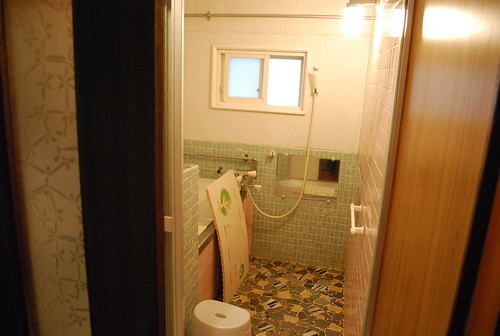
Shower room! You could have a dance party in here...but I'm not sure if that would be good naked or bad naked.


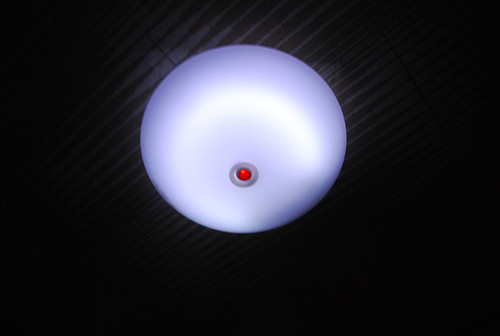
Meet HAL 11,000: My Japanese Robot Light. He anticipates my every need by turning on as I approach and off as I depart. He even tries to show up other lights by brightening when they're on.


The hallway in my place is actually lower than the floors of all the other rooms, so you have to step up to enter the rooms...except for the toilet. You step down to use the toilet.


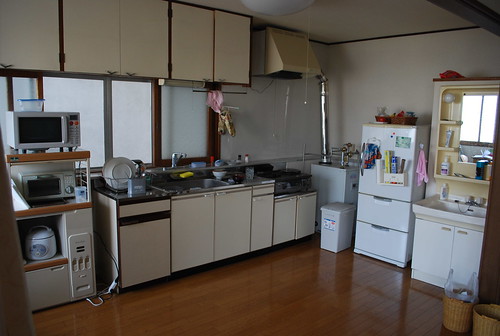
Kitchen + Bathroom Vanity - Oven = Meh, but it will do.


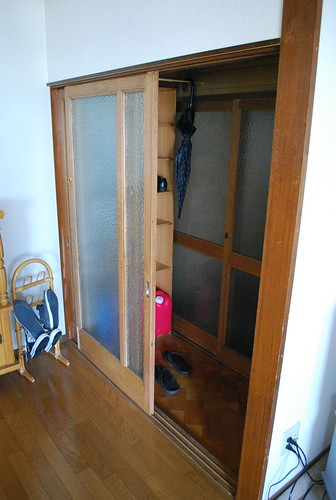
Entranceway. Notice the awesome slidiness and the lack of a real lock. I've had friends leave windows and doors unlocked for days at a time without having anything walk from their apartment.


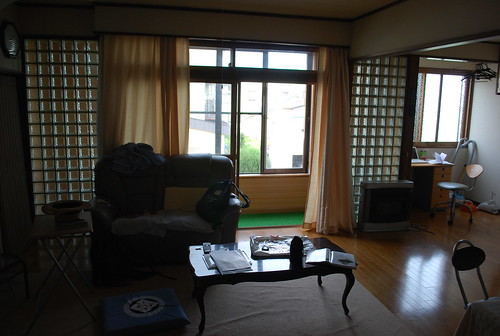
My living room and sunroom.


Saturday, August 08, 2009

Of Time Travel on the Shakkotan Peninsula

This was inspired by Amanda when, upon asking her how the painting of her new house had gone, she reminded me it had been less than a week since last I’d seen her, and the painters were still very much hard at work.

My god; you're right. It’s only been a week.

It's a strange thing, but with all the change in my life over the last week, it kind of feels like I've lived lifetimes in the interim. The idea that exactly a week ago I was finishing up my farewell dinner with my family and heading back to my mom's place to do the very last of my packing seems so incongruous as to be fictional.

That I could have spent 17 hours on a plane (only 13 of them actually in flight); that I could have lost 12 hours somewhere between Saturday and Sunday--somewhere between Toronto and Tokyo in a never-ending day; that I could have spent three nights in Tokyo and met all the people that I did, that I could have flown to Sapporo, met my new supervisor, and come all the way out here to Furubira to get settled in my monster apartment and work two days at the Board of Education...

That all this could have transpired over the span of a week is a feat of science fiction. Time travel or quantum singularities or boogeymen or something along those lines.

If a week could feel so very long, if it could be filled with so much change and growth and difference, what will I be like at the end of next week? What huge and remarkable things will I have accomplished? How will I have grown and changed? Weeks like this make me wonder if I couldn't be completely fluent in Japanese by this time next Saturday--if, perhaps, I will have met and become friends with everyone in this town. I mean, sure, such feats are impossible for one person to accomplish in the span of a week, but, with the way I've watched time balloon and ebb and fluctuate over the last week, I can almost convince myself that those were attainable goals.

Though, funnily enough, thinking about how one week could stretch out to become like a month gives me my first real pangs of homesickness. I wonder how I could possibly live in this place, detached from you and all of those like you who I love and need in Canada, for another 51 weeks?

HA!

Then again, when you put a number like that on it—51 weeks—it all of a sudden becomes fleeting and totally surmountable. When you do that, all of a sudden it's a countdown, and it brings out the very converse feeling: that I'm running out of time and a year will be up before I know it; that there is so very much I wish to accomplish in that year, and how could 51 weeks possibly be enough time to do so!?

Regardless of whether my time here is too short or too long, I’m here, and every so often stuff like this happens to remind me I’m in the right place at the right time: