Wednesday, December 15, 2010
Modern Myths: The Tanuki
Wednesday, October 20, 2010
Yuki Mushi
Wednesday, September 01, 2010
Know the Points 3: Shiretoko
Shiretoko.
The eastern peninsula. The last untouched wilderness of Japan. The spear of mountains and forests and hotsprings and bears, unbroken by civilization beyond the communities of Rausu and Utoro, which sit like anchors at its base.
Shiretoko.
It was the inexplicable destination of our initial mad attempt at this Four Points road trip, back when we hardly knew this island from a hole in the ground. Even then, there was some phantom magnetism pulling us towards it. And, now that we’ve reprised this wild adventure; now when we know where we’re going and how we’re getting there; now when we’ve researched what to see and why it’s important; even now there still seems to be this same, unspoken, ethereal-yet-domineering group telepathy about it.
Shiretoko.
We’re going, and, beyond spouting off about trees and rocks and bears, I don’t know that any of us could really tell you why. It's just a certainty. Like roads and cars and konbinis. If all the fluff of sight-seeing and friend-visiting and draconian circumnavigating in this trip fell away, one thing would still remain:
Shiretoko.
Wednesday, May 12, 2010
Geographic Illiteracy
"I think I went to Tofino once or twice," he replied.
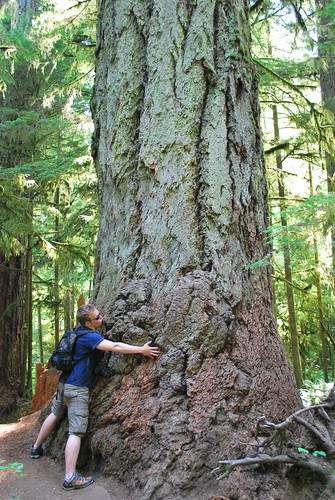
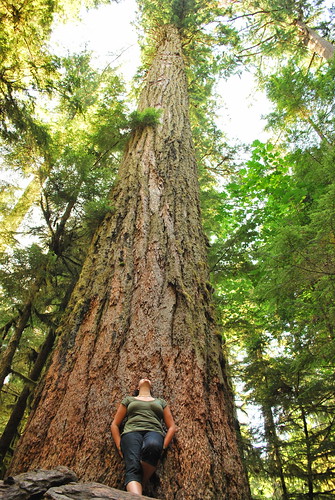
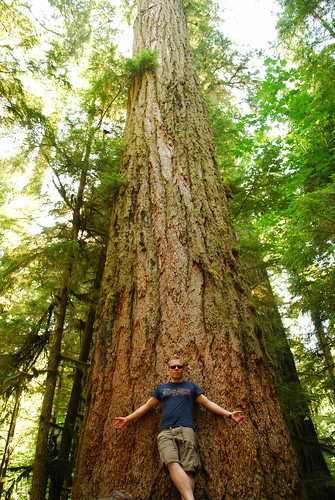
"Well then SURELY you stopped in Pacific Rim to see the coastal rain forests? SURELY you would have turned in at Cathedral Grove to try and wrap your arms around some of the larges trees in Canada?"
He replied that he hadn't, replied that be was amazed to discover that not only did Canada have rainforest but that they were located so close to where he'd lived all of his life.
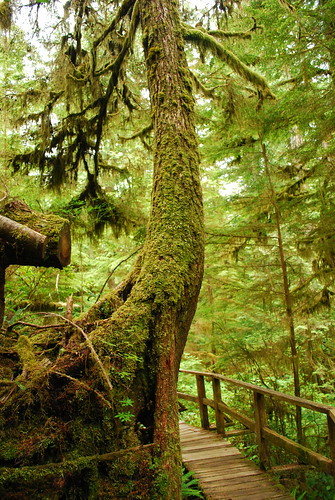
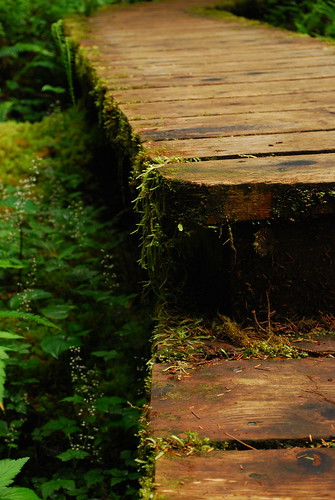
My eyes misted slightly as I told him about the Douglas Firs like colossal columns in Cathedral Grove, about the forests of Pacific Rim where the bark of trees was so moist as to serve as soil for ferns and mosses and other trees. Each was a place so full of life that they could serve as archetypes for Nature and Growth and Forest.
He mused that he'd have to put them on a list of places to visit when he got home, seeming to imply that he'd never thought there was all that much to see on Vancouver Island.
In an alternate reality, wherein failure to appreciate beauty naturally wrought was a corporally punishable offense, I could have throttled the guy. He lived within spitting distance of some of Canada's greatest natural wonders, and he'd gone his whole life without knowing they existed. Some people have joked about me moving to Japan and never coming back (and there have been times when I've had fleeting thoughts of it), but the place they should really worry about losing me to is British Columbia.
Though when I come back to visit Canada this summer I will be stopping in BC on a point of business (attending Amanda's wedding), I nonetheless am relishing the excuse to be back in that place--secretly hoping that I had MORE time on the coast to rent a car to go climbing up the sea-to-sky highway along Howe Sound, on the way to the mountain valley of Whistler, or taking that car up through Coombs and Cathedral Grove, over the mountainous hump of Vancouver Island, and down into the mists of the Pacific Rim.
I reigned in my shock and disappointment, and I tried to put it to Matthew straight:
"There is so much of Canada that you have yet to see: so much in your very backyard that is essential and you have yet to experience."
And that is advice that I feel I should perhaps endeavour to diseminate more widely. Even if the only person who ever takes it to heart and actually sees these wonders on Vancouver Island is Saff, I'll feel like it will have been worth it.
You should all go, though: to Tofino and to the Avalon Penninsula and to Peggy's Cove; to Lake of The Woods and to Haida Gwaii. We all seem to spend so much time dreaming about the foreign climbs we'll summit when there is still so very much to see in the country where we lay down our heads to sleep every night. I feel like being so far away from it all in this foreign place has given me more perspective on it; an absence to make my heart grow fonder of its lakes and its trees. As I give my advice to Matthew, my fellow Canadian, in far-off Japan, I can't help taking the advice myself--planning already to practice what I preach when I say "there is still so much to see in Canada."
Monday, April 12, 2010
Modern Myths: Inari
There is a thing of wonder that exists in the burbs of Kyoto, the Japanese Holy Land that has been home to wonders for more than 1100 years. It is a large hillock to the southeast of Kyoto Eki: a mountain shrine that has become more shrine than mountain. They call it Inari, and it is home to one of the rarest species of tree in Japan:
The Torii.
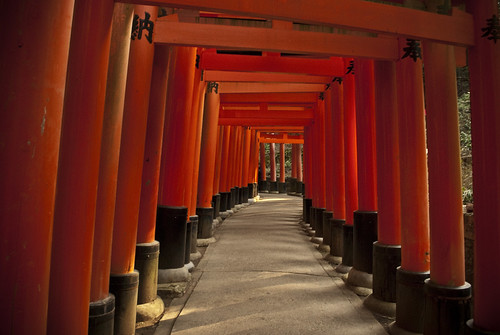
Yes, it is at Inari that Torii gates are grown for Shinto shrines all over Japan. A close inspection of the vermillion gates in your town may lead you to believe that they are, in fact, built and not grown, but a visit to Inari would show you otherwise. For the Torii grow thick like a wood across the surface of the mount, snaking rows of them running from base to summit. So dense and well-ensconced are they that one can no longer determine whether the trails up the mountain came first, as planting paths for the Torii, or whether the Torii were always here, and the paths were laid out as dictated by the spaces between their twin trunks.
From sproutling to sapling to shrine gate, you can watch the life cycle of the Torii at Inari. Where mature gates have been harvested and transplanted to their shrines elsewhere in Japan, the fertile soil at their stumps already seeds their tiny successors.
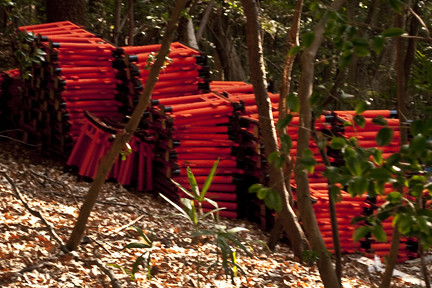
In wooded glens just off the beaten trails, Torii saplings sit stacked, waiting to be moved to the secret nurseries on the mountain’s back side.
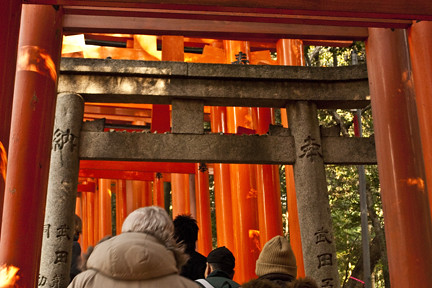
In a few, rare places among the growing, living Torii, there are also Torii of stone that cross the paths. They are far older than the vermillion forest at Inari, and their mysteries are deeper still. They could well have been the first Torii: their histories stretching back to a time immemorial, when Gods descended on mountain tops and rock was as alive as wood.
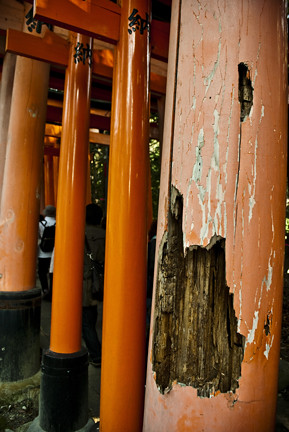
The Torii Wood at Inari will not last forever, though. It is a creature of myth like the dodo or the dragon or the Douglas fir. It requires faith to exist, and as the mountain shrine becomes more tourist trap than sacred site, the Toriis are beset by the first signs of disease, of rot.
It becomes harder and harder to grow new Toriis here, and every year more shrines across Japan resort to steel or timber facsimiles of the living shrine gates as their orders to Inari go unfilled.
Tuesday, November 24, 2009
Where They Left it Wild
So I was listening to the live stream this morning (your yesterday afternoon), through the wonders of the internet, and I liked Hawksley’s tune so much that I went ahead and downloaded it from iTunes. It starts out as a haunting number, with a vaguely aboriginal beat, and it climaxes in an odd cheery bit with the vivid image of
the moose and the deer come to the side of the road
to eat the salt from the winter
get away from the blackflies
that will kill you come June
before receding to a single, unrepeated statement:
and you realize quickly that its easy just to die
when you don’t got much inside of you that’s wild…
It’s where they left it wild.

The experience has left me in a fugue state, my mind wandering and evaluating its identities: me the half-assed pagan environmental crusader, as I expressed in my Sacrifice of Nines bit about the Golden Spruce. Me the City Boy realizing that the City also needs the Wild, as Sarfaraz expressed well in his bit last week about the Bruce Peninsula and Canadian conservation. Me as a boy positively dreading trips up to my father’s cottage off Georgian Bay, where there was no TV and no toilet and no sandy beach and if the mosquitoes didn’t carry you away then the rattlers surely would. Me with my lingering guilt about never loving that cottage as much as Dad and Craig and Alton and Curt and Jill and Eric and Evan and Stephanie did.
It would seem that I’m finally coming around, though. Over the last little while, something in me changed, and I went from loving the city and wanting to spend my holidays in it to loving the city but needing to escape it whenever the opportunity presented itself. Maybe it was Amy and all her outdoor hickery, or maybe it was Lindsay and her house in the woods. Maybe it was a realization come of cottaging with my friends: that you didn’t need comforts as long as you had company and beer and a nice long-drop. Or maybe it was a part of my genes, a legacy from my father the woodsman that had lain latent all these years as I lived in the City, slowly waking and driving me further and further into the woods until my strongest escape fantasies while working a 9-to-5 job took the form of jumping in my car and blazing up the 400 and the 11 and 60—not stopping until I hit the West Gate of Algonquin.
And here, in Japan—with all of its other-worldly wonder of natural hotspings and mountainous volcanoes and aquamarine-blue seas—some of my keenest bits of homesickness come from memories of the lakes of Ontario. Me, the city boy, on some big Japanese adventure, pinning for the very woods that I couldn’t get far enough away from as a child. In my spare time, I find myself idly daydreaming about tours to Haida Gwaii or cross-Canada roadtrips with my brother, wherein Lake of the Woods is as much a destination as Vancouver is.
I’ve still got a long way to go before I wind up a woodsy hermit, squatting in one of the few remaining cottages in Algonquin. But the possibility seems to be more appealing with each passing day, and it’s little ditties like Hawksley’s that remind me of the fact that—like Saff touched on—I need the wild (and maybe the greater We of Canadians need it too).
And I “realize quickly that its easy just to die when you don’t got much inside of you that’s wild…”

Here are the lyrics to the Hawksley tune, if you’re interested. The Ragged reference made me, of course, think of Amy Thede as I wouldn’t know what Ragged Falls was were it not for her. If Simon Ze German is reading this, he should note that Ragged was the frozen waterfall we stood on in our snowshoes, in the dead of February, in snowy Algonquin.
Where They Left it Wild by Hawksley Workman
And on the highway 60 in the middle of the night
on the sides of the roads are the following eyes
and you listen for the calls of the owl and the wolves
and you hang back silent as they fall against the moon
(and you tell yourself)
It’s where they left it wild
and then I called to the moose and I called to the deer
and we married in a swamp as the night became clear
and Centennial Ridges tell a story by the lake
and the loon cries hard to the lover that escaped
(and you tell yourself)
It’s where they left it wild
and Ragged Falls pour as we tumble in our sleep
and we dream of the beavers who are clogging up the creek
and Tea Lake ripples to the softness from the shore
and you kneel at its beauty and you worship it alone
(and you tell yourself)
It’s where they left it wild
And the moose and the deer come to the side of the road
to eat the salt from the winter
get away from the blackflies
that will kill you come June
they will change you to a skeleton in the bold wind of June
And the moose and the deer come to the side of the road
to eat the salt from the winter
get away from the blackflies
that will kill you come June
they will change you to a skeleton in the bold wind of June
they will kill you come June
they will change you to a skeleton in the bold wind of June
and there’s no service here for your mobile phone
and we feel so close here, so far away from home…home…
and you realize quickly that its easy just to die
when you don’t got much inside of you that’s wild…wild…
Friday, October 09, 2009
Torii Gates
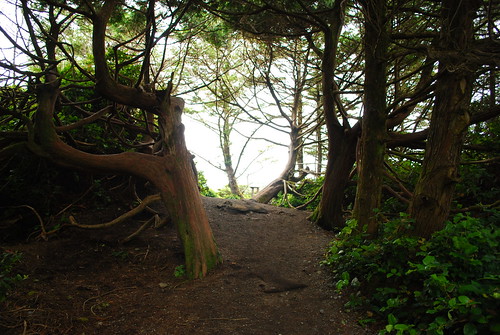
As Will Ferguson touched on in his note on the Shinto religion, the Japanese mark the entrances to their holy sites with big, red, pi-looking things called Torii Gates. When one crosses the threshold of the gate, he knows that he’s stepping into the territory of a particular spirit or deity. Initially, I wondered if the sacredness might not be artificial when these bright red structures are slapped up in front of small shrines to worship river gods or spirits of the forest. I pictured them as somewhat overdramatic “DEITY APPROVED!” stamps, where the holiness of the site was derived from the Tori Gate alone, and without it there would be little of any great import to that particular place.But in my recent trip out west to BC, I feel like I came upon some understanding of the Torii Gate. Ironic, that: coming to understand Torii Gates in Canada. Regardless, as I was rambling through the woods and up the sides of mountains, I would often chance upon things that looked remarkably like the Gates. It would be two trees of roughly the same size, growing more or less abreast with an arm span between them. The worn paths we were following would run between them, beneath boughs that swept together like a truss over our heads, and often I wondered if, perhaps, a coyote lay concealed in the brush to one side, and a cougar in the brush on the other: the north american ahh and nn.
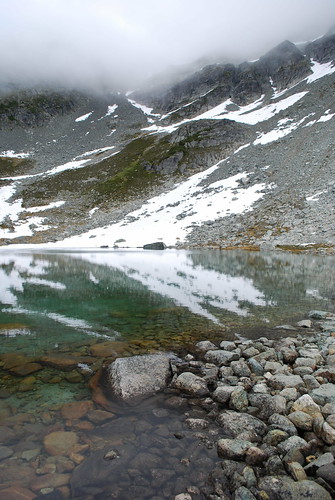
On the sparsely forested upper slopes of Blackcomb, I caught one natural gate that split light and dark at the edge of a stand of stunted trees. As we were passing back through it from the lakeside loop, I felt I should pay tribute in some way for the beauty we’d witnessed behind us.
Along the black, rocky shores of Ucluelet on Vancouver Island’s west coast, I came upon another natural gate that opened up on a seaside lookout. The grey, ocean-tossed view beyond of the Broken Group of islands and the area once known as the Graveyard of the Pacific inspired a reverence in me and lent a degree of proof to the idea that the trees with out-swept boughs we had just past through were meant to mark this place.
So perhaps I was wrong at my initial thought: that Torii Gates are divine salience artificially foisted upon the inane—a roadside attraction plopped down in an unimportant stretch of land to lend it import. Perhaps the idea and the design of the Torii Gates was once inspired by natural thresholds between the quotidian and the magnificent. And now, when these gates are built by man, they are just a frame, erected in front of a particularly special stretch of nature where someone was once inspired and they thought that you might be, too. The Gates are a “hey! Lookit that!” to pull us out of the hectic pace of our lives momentarily and cause us to take the time to really see something and catch the wonder in it.
Wednesday, September 09, 2009
A Sacrifice of Nines
Sorry. That’s the half-assed pagan in me poking out. One of the reasons I have a mild interest in the Japanese Shinto belief system is that some of the only religious ideologies that have ever made sense to me have been the ones that centered on worshiping nature. Venerating and paying tithe to the one thing that can be empirically shown to have given us life—the one thing that sustains us on a daily basis—is something I can believe in. Nature is also one of the sources of wonder that we can rely on to provide miracles on a regular basis. You can study the science of how a Douglas Fir—a tree that can grow to heights of beyond 100 meters—can manage to grow out of something as small as a seed on air, water, and sunlight alone, but the science of it can’t fully explain away the wonder required.
Sorry, once again. I half lifted that last bit from the latest book I finished reading. Though it has little to do with Japan, it’s underlying message aligns fairly well with the Shinto belief that there are spirits present in the land.
The book, published in 2005, was The Golden Spruce by Canadian author John Vaillant, a book that won the Governor General’s Nonfiction prize in 2005. I was put on to the book by Amy, my token Parks/Trees-and-rocks-and-shtuff friend, and she was put on to the book by a field course that she took in Haida Gwaii (once known as the Queen Charlotte Islands) last May. The book was required reading for the course, and, having now read the book, I can understand why. Golden Spruce aims to tell the history of resource exploitation in the Pacific North West (B.C. and Alaska) by arranging the story around a very real and very destructive act of protest that transpired on Haida Gwaii in 1997.
On January 27, 1997, a man named Grant Hadwin who was no stranger to the logging industry took a chainsaw to a unique Sitka spruce tree that was hundreds of years old and roughly 50 meters tall. It was known to local anglo residents of New Masset as “The Golden Spruce” and was a popular tourist attraction of their remote town. It was know to the Haida People of Old Masset as Kiidk’yaas and was a central element in their cultural mythos. And, in the eyes of Grant Hadwin, it was known to Macmillan Blodel, the logging firm who had bought rights to the majority of the timber on Haida Gwaii, as their pet tree and was a shinning gold medal of conservation behind which they could hide their destructive logging practices.
Around the central characters of the Golden Spruce and Grant Hadwin, author John Vaillant is able to weave a complex and informative narrative that is at once a biography of Hadwin, a snapshot of the cultural traditions of the Haida people, an ecological profile of the rainforests of the pacific northwest, a history of northwest logging, and a sobering view of the practices—and abuses—of the modern day logging industry. All of that mixed into one book seems like the perfect recipe for a dry, snore of a narrative, but Vaillant somehow manages to use Grant Hadwin’s story to pace all the facts that he imparts and to lend a sense of crisis—if not out-and-out suspense—to the narrative. By the end of the book, I felt both moved and informed by it. Vaillant had told this expansive, at times rambling, narrative, and in so doing he convinced me to rethink the way I use wood and paper products while also convincing me that I absolutely had to visit Haida Gwaii.
He also convinced me—unintentionally, I’m sure—that Grant Hadwin might have been right. But that’s something for the ramble below. For those of you not interested in the contemplation/rant, I’ll distill The Golden Spruce for you here:
If you love nature and want to believe in wonder, read The Golden Spruce.
If you’re ever been moved by something as simple as a forest or a tree, read The Golden Spruce.
If you’ve ever visited the temperate rainforests of British Columbia and been worried about the prospect of losing them, read The Golden Spruce.
If you’ve ever worried about the rights and legacy of the North American First Nations, read The Golden Spruce.
What was interesting, for me, about Grant Hadwin’s seemingly mad decision to cut down the Golden Spruce is that, from some perspectives, it makes sense. But, if I were to admit that I could agree with what Hadwin did, I would be in the minority. When I finished reading The Golden Spruce and googled “Grant Hadwin” to try to find some other photos of/interviews with the guy, all I could find were angry, opinionated articles about how heinous and dastardly a villain he was for cutting down a beautiful, old growth tree. But none of these articles/posts/blog entries mentioned anything about the thousands of people working in logging in the Pacific Northwest who cut down beautiful, old growth trees on the daily as part of their jobs. These angry posts talked about the salience of the Golden Spruce to the Haida cultural heritage, and they mentioned nothing of the importance of the forests of Haida Gwaii to that same heritage, forests that were appropriated from The People by the Canadian government and sold off to International Lumber. Everyone seemed happy to rally around those calling for Hadwin to be strung up for his crime, but no one seemed to be giving any thought to the message he was trying to communicate.
In the book, John Vaillant dredges up a curious historical factoid, mentioning how as the warriors of the Christian faith conquered Europe they would set fire to the sacred groves and forests where the indigenous peoples (many of them our own Germanic/Norman/Celtic ancestors) practiced their pre-Christian religions. He mentions in other places how it was common for these people to attribute particularly large trees to gods, and he even found a reference to a particular, symbolically grotesque means of disembowelment as the punishment for one who was so crude as to commit the crime of removing the bark of a living tree. These historical factoids, and many more like them referenced in the book, point to the fact that our ancestors once saw nature as holy and the forests as sacred.
But we’ve moved away from that now—we, the enlightened, who worship distant, faceless deities who we have created in our own image. And we worship them in buildings of wood and stone that we have hewn and remade to better serve our purpose. We’ve forgotten that the forests were once holy and that the largest of the trees were once our gods.
This could well have been this was the mysterious “great revelation” that Hadwin experienced (but the details of which he never imparted to another living soul) that set him on the path to the Golden Spruce—this sudden revelation that had been brewing in his subconscious as he worked in the logging industry for most of his life.
Maybe Grant Hadwin thought that this was the only way to make people realize the importance of the forests and the severity of the crimes against them. He elected to slay the most well known and most treasured of the old growth trees on Haida Gwaii to make people realize the wholesale slaughter that was going on, unseen, in old growth forests across British Columbia. In effect, he chose to kill Jesus to make the people realize that all of the other gods were already dead. He saw that our sacred groves had been gutted, and the only way people might start to realize it would be to see that destruction wrought on the only tree they seemed to care about.
As Vaillant reveals through scientific facts in the text, and as Grant Hadwin stated in his all-call fax after he made his attack on the Golden Spruce: the tree was a mutant. Where it was meant to have green needles, it grew yellow needles. This fact earned the tree its name, and it appears to be this fact that spared the tree (as well as some of the forest around it by proximity) from the MacMillan Blodel’s logging operations on Haida Gwaii. Hadwin refered to the tree as a circus freak, which seems apt as this mutant tree was spared while MacBlo was felling trees just as old, just as large, and just as majestic (if not older, larger, and more majestic) elsewhere on the islands. To keep this one tree standing in a token patch of spared forest while these other trees are cut down and sacked is somewhat akin to “preserving” a few token members of a certain species in a zoo while butchering and consuming the rest of their population. What Grant Hadwin’s attack on the Golden Spruce boiled down to was a question of “Why this tree? Why now?”
So that’s where I can agree with what Hadwin did. He staged a violent attack on a tree to prove a point, and it was shocking to all who had invested themselves in the life of that tree, but, in the end, people sat up and paid attention precisely because the tree meant so much to them.
And he was right.
Why this tree? Why does this one get to live while all the others just like it have to die? Because it is recognizable due to its mutation? Because we can’t see the forest: just the trees? Maybe the loss of this mutant could finally convince those who had invested themselves in the tree—maybe it would serve to give them a local frame of reference for the horrors that logging visited on their province regularly and had been doing for some time.
Where it gets a little harder to agree with Hadwin—and an area that I’d pretty much avoided thus far in all of this—is when you take into account the interests of the Haida People in the Golden Spruce. The Haida were the first inhabitants of Haida Gwaii and made the islands their home centuries before the first loggers or Anglo settlers ever arrived. The Golden Spruce had been woven into their myths and beliefs for generations. It was not a tree to them; it was the spirit of an ancestor who had taken the form of a tree. In a way, it was more alive to them than a typical tree is to us, and some believed that when it fell it would signal the end of the Haida nation. One could try to use the same arguments when contemplating the Haida’s investment in the tree: that they only developed their myths because the tree’s unique colouring made it stand out. One could try to rationalize the attack on the Golden Spruce as a wake up call for the Haida, hoping that it would galvanize them, the only people who had any real claim to the land of Haida Gwaii, and inspire them to be more protective of their island ecosystem.
In short, one could try to implicate the Haida as passive participants in all of this madness and try to suggest that the felling of the Golden Spruce was just a shot across the bow to rouse them to action, but it seems wrong. When Vaillant tells of the former height of Haida civilization before smallpox cut a swathe through their villages, when he paints the picture of the clear cutting that took place across the breadth of northern Haida Gwaii, it becomes clear just how much the Haida have lost already. It makes it hard to try to paint the loss of the Golden Spruce—a part of their myth and their culture—as a learning opportunity. Even Hadwin admitted when he was contacted directly by Guujaaw, the President of the Council of the Haida Nation, that if he had known of the Haida legend about the Golden Spruce, he may have thought twice about attacking it.
So, yeah, with the exception of the attack on the Haida people, I can understand what Grant Hadwin did when he cut down the Golden Spruce, and I can almost agree with it. This act of destruction has convinced me that I should look into joining Greenpeace—that when I get to a place where I’m thinking of buying a house, I should consider alternate building materials like bamboo and straw bale. I'll tell anyone who asks that my aforementioned half-assed paganness tends to manifest in a veneration for trees, and, looking at what Hadwin did, I think it takes some pretty big love for trees to have the stones to cut a big, beautiful one down to save the rest. It's the kind of statement/act of protest that I kind of wish I had the stones to do myself. And I hope, even if I do so in vain, that there comes a time when people can look at Grant Hadwin's attack on the Golden Spruce for what it was:
An Alarm Call.
A Necessary Sacrifice.
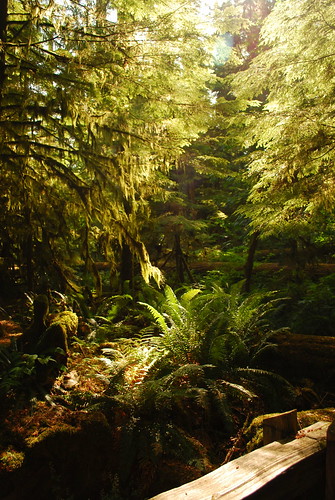
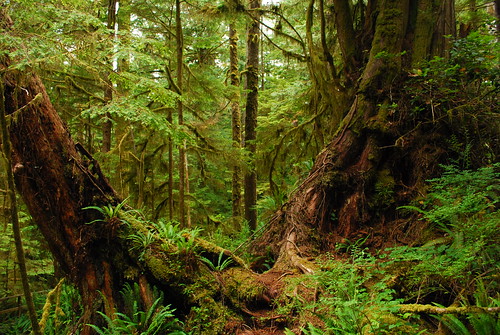
Not the Golden Spruce, but another Pacific Northwest reason to care about trees from Pacific Rim National Park.
Edit: Here's some supplementary video about the Golden Spruce from CBC's Six String Nation documentary:
Tuesday, July 21, 2009
Modern Myths: Unagi

Wednesday, July 08, 2009
We've got your gods right here

Turns out that when you’re heading somewhere for a year, everyone and their brother wants to recommend books for, about, from, and only loosely inspired by that place. Such was the case with Japan, and I have been hard pressed to stay on top of the flood of book titles that have been thrown at me over the last few months.
Luckily, one of the recommendations stuck out. The book was Hitching Rides with Buddha, and it was recommended by the president of the company I used to work for. When I looked into the book, I discovered that it had been written by Canadian humourist Will Ferguson, who had traveled to Japan to teach English in his youth. Will used his hitchhiking trek from the southern Cape of Sata to the Cape of Sooya at the far northern tip of Hokkaido as a framing device for the book. Under the guise of chronicling his pursuit of the Sakura Zensen (Cherry Blossom Front) as the trees flowered from south to north, he presents a good humoured portrait of Japanese culture.
That being said, this isn’t meant to be a book review. I’m only about 50 pages in thus far, but Will just blew me away with his explanation/depiction of the indigenous Japanese Shinto religion, so I thought I’d share an excerpt from the book for anyone who has ever wondered about Shinto. Will’s description may just have nailed me because I tend to go in for that kind of world-worship, nature-hippy, odenic-pagan stuff, but I think there’s something pure and organic about the animate nature of Shinto beliefs that will appeal to people tired of theistic belief systems.
The following italicized passages are in no part my own and belong entirely to Will Ferguson, his publisher, blah blah blah etc. If you think you like his writing, well then help a Canadian brother out, and buy his book.
Of Shinto
…As a faith, it grew from the natural awe, the fear and trembling, that humans have for the world around them: the fertility of womb and earth, the natural forces and the mysteries of life.
In Japan, the world is filled with primordial spirits. The kami are everywhere. The unseen world is pregnant with them, rich in life and charged with energy. Historical figures have been elevated to kami, and so have abstract nouns and animals.
Deeper still, Shinto is about being Japanese. One is not converted to Shinto. One is born into it. One simply is Shinto in the same way that one simply is—or isn’t—Japanese. The idea of Shinto proselytizing is absurd. During World War II, the Japanese Empire built massive Shinto shrines in the countries it occupied: Singapore, Korea, Taiwan. But, removed from its Japanese soil, Shinto withers and dies. It is perhaps the only religion in the world that failed to convert the people it conquered.
Although it was used as a propaganda tool during World War II, and still contains heavy imperial connections, Shinto has largely returned to the more earthly, joyous roots from which it sprang. Shinto celebrates life. It is optimistic. Buddhism [the other widespread religion in Japan], in contrast, is gloomy. Shinto is for weddings; Buddhism is for funerals. Buddhist festivals are somber. Shinto festivals are freewheeling, drunken affairs, intent on entertaining the gods. Buddhism worries about the afterlife. Shinto is concerned with the everyday and the here-and-now.
Now that’s a religion I can get behind. “…It grew from the natural awe, the fear and trembling, that humans have for the world around them” sounds just about perfect.