Showing posts with label Japan. Show all posts

Thursday, June 16, 2011

a second year in The Life

Crap.

I’ve been so hit and miss on the old bloggerino (mostly miss) that I neglected to commemorate two years of blogdom last week. Thus, inspired by my more timely post last year, here’s a belated, バラバラ sort of update that should cover a number of things in a random sort of manner.

Wednesday, April 06, 2011

Ananthema

At the entrance ceremony today, the new elementary 1st graders are sandwiched between their new peers to the back and The Stage with The Flag to the front. They are drowned in the dreary droning of the haunting melody and words of the antiquated, imperialistic, controversial Japanese Anthem. It is a dirge that has always given me the eerie impression that it lingers in time: never starting or stopping, just existing. It fades in, gradually building to a see-sawing, moaning climax, before fading--or flowing--away, back to that place of shadow and light where it waits in time.

Don't get me wrong; there's beauty in it. It's just a beauty that harrows more than it inspires. I am relieved when it fades out, and the lost-looking new 1年生 are fished out of the dark by the nothing-but-sunshine-and rainbows Furubira Elementary school song: a song I'm so in love with that I not only want to learn it before I leave, but I kind of want to ask if I can sing it with the school--if I can bathe in their sometimes-screamy, midget-melodious light.

Tuesday, March 15, 2011

In the midst of madness...

...there is still beauty to be had.

I realize it when I, guiltily, pull myself away from my order-in lunch at the junior high school today, put my suit jacket back on, and file into the school's genkan with the other sensei. We welcome one of our students--the last of the third graders to graduate--back to the school for the first time in months. We all follow her into the principal's office and cram in around furniture to be the witnesses to the presentation of her diploma. In this small office, they do it with all of the pomp and ceremony that they used when the rest of her class graduated "normally" this morning in the cavernous gym. With the exception of the odd setting, there is no mention or recognition of whatever demons have kept her from school these last months. Her homeroom teacher announces her just like any other student, and the principal hands her the certificate just as woodenly as he's handed all the others, and then we teachers--us small posse--we clap like it was the most regular thing in the world.

In the parts of Japan untouched by the recent tragedy, life goes on.

Tuesday, January 11, 2011

A Year In The Life (Part Deux)

100 posts in 2010. A first full year in Japan. I started it off alone in Kyoto, outside a temple in the snow, listening to the largest bell in Japan gong 108 times, and I finished it up with Heather in Warwick, England, in a big old house far older than my home country, surrounded by her family and her closest friends.

Last year at this time, snowboarding was some "I should get to that..." pipe dream that I was kind of terrified of trying for the first time. Now I'm pretty damn decent at it, if not--in fact--good, and of the four weekends I have in Japan this January, three of them will be spent on the hills.

When I started the year, I had already told my Board of Education that I'd be staying on for a second year of JET (nearly two months before the deadline for the decision). The year ahead was nothing but wild Japanese adventure potential. Now I head into 2011 very sure that, come August, I'll be leaving Japan. I'm suffering from Warwick withdrawal, and Japan is very much starting to feel like some bit of fantasy that is slowly breaking up and falling away--a dream that will soon vanish and maroon me on the shores of reality.

Yeah. I watched far too much Inception on the plane to, as well as on the plane back from England.

It's true, though. Come January on the JET program, it's time to make big important decisions about the next year of your life as the February recontracting deadline looms. Last year, I chose to extend my strange, Japanese, hedonistic (in terms of responsibility, at least) vacation as there was still so much to see and so many people to spend time with. This year I choose to get on with my life, I suppose, and I have to already start planning how I'm going to see all the people and do all the things I want to do before leaving this place.

What's cool about it, though, is that I get to take a part of this place with me as Heather and I are already concocting devious plans for our next year together. More on that later, though.
Warwick - Christmas Eve

This is getting random.
So. 100 posts in 2010. I figure that ain't bad, even if I did SPAM Four Points posts and excerpts from NaNoWriMo. I'm certainly not going as balls-to-the-wall on Japanawriting as I was at this time last year, so here's hoping I can get back to it in a bigger way. If nothing else, I'll at least endeavour to keep on posting photos.

I can say that 2010 treated me nice, though, and that's a bit of an understatement to be sure. There was Craig and My Dad and sharing Proper Japan with them, as well as where I live. There was The Month of Adventures (also known as February), and with it snow and boarding and more snow and girlfriends and lacks of drift ice. Shit. There was the passing of Ross...
...and there was also golden life and sakura. There was the joy of being a part of HAJET, which may wind up being one of the best decisions I ever made over here. There was a whole lot of hair and camping and mountain climbing and JET town festival invasions. There was the return to Canada with its attendant weddings and boats and Amys and Vancouvers and Torontos and my Dad inadvertently and timelyly reminding me that I shouldn't forget. There was dripping, sweaty Aomori (christ! I never really wrote about Aomori!) and manly log pushing and moving out of expensive fucking apartments and Four Points and birthdays. There was NaNoWriMo and the promise of snow, then its dearth, then its glut.

And, finally, there was England, and a New Years Eve that was hundreds of miles from the last one I lived through, no matter what physical or metaphorical scale you used to gauge it.

2011 has got some big shoes to fill.

Sunday, August 01, 2010

Kaerimashita

After days of travel that started at Toronto Pearson on Thursday July 29th at 13:00, I finally got back home to Furubira at 16:00 today, after sojourns in humid Tokyo hostels and on the floor of Maggie’s wind-swept apartment in Sapporo. The clouds that had been grey and ominous from Otaru through to just past Yoichi are riven in blue and white as my bus passes through that high, narrow tunnel and down into the rocky, coastal roads of the Shakotan peninsula. Having heard tales of flooding in Furubira while I was away from Mark, I half expect to come back upon my town as a ruin.

As I pass through the last tunnel, I find it to be anything but. It is the same sun-and-clouded, tree-choked-mountains-of-green place that I left. The only evidence of the torrential rains of last Thursday lingers in the spindly and still-green trees up-ended in the shallows where the Furubira river empties into the Sea of Japan.

I climb the stairs to my apartment for the first time in three weeks to find that some of me has gone out of it. In my absence, it has settled back to the dusty smell of tatami mats and sunshine that I remember so keenly from when I first arrived here a few days shy of a year ago. It is a smell that was once tinged with the anxiety of finally being on my own in this distant land. However, now the same smell comforts me. It is a smell of the relatively clear spaces in this apartment—a smell of traditional, tiled shower rooms and warm, astroturfed sun rooms. It is a smell of golden light through sheer curtains and of vague tinkling from unseen wind chimes.

And that smell makes me sane, on this Sunday end to my long adventure home—when all of my emotional history screams that I should be mourning the end of a vacation; mourning another year away from all that is familiar and Canadian.

But I don’t.

And I’m not.

And I’m wondering if it has to do with the overwhelming sense of right I felt when I walked off flight AC001 and into Tokyo Narita for the second time this year, this time very much without the support of dozens of other Toronto JETs. I wonder if it has to do with how all of my consternation over training my way into sweaty Tokyo and finding my hostel fell away, only to be replaced by a profound and irrational love for the Japanese people—by a strong desire that I never knew I had to be back home with them.

Saturday, June 12, 2010

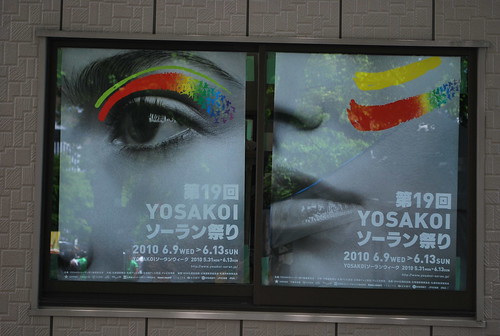
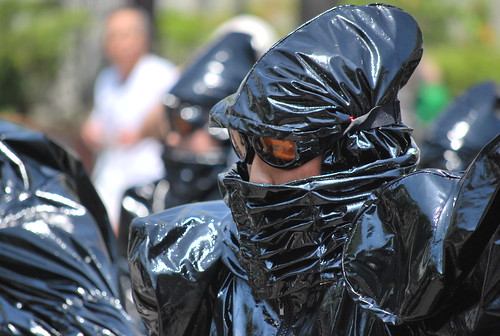
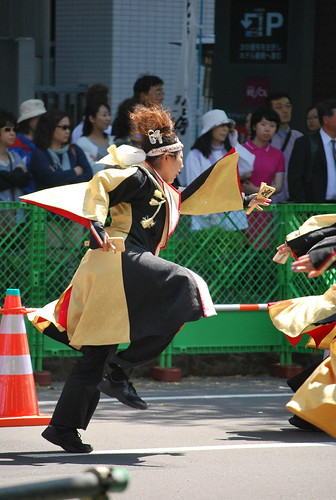
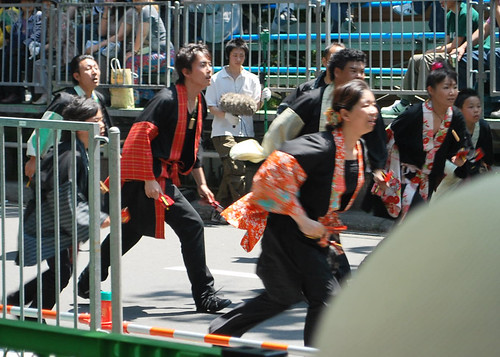
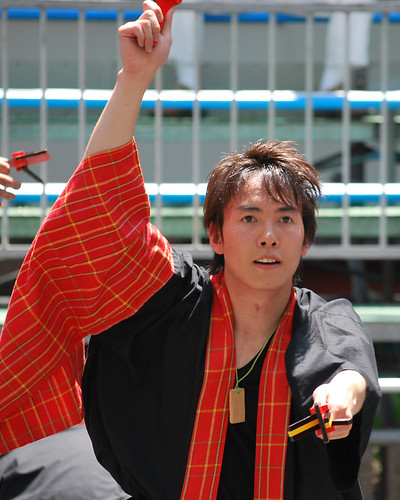
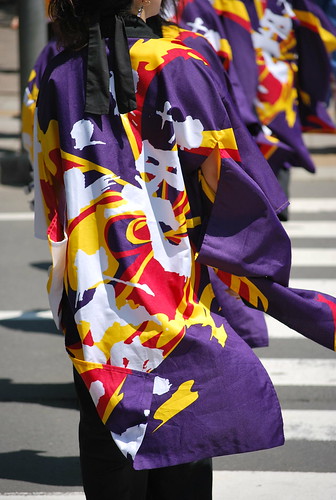
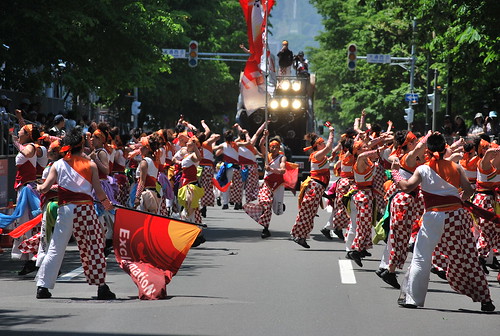
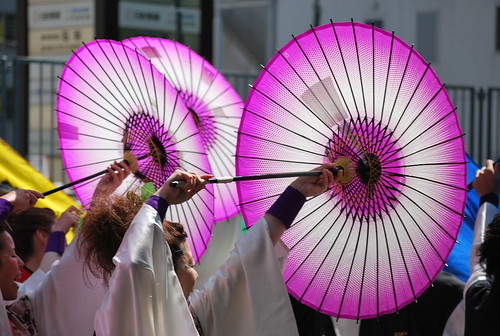
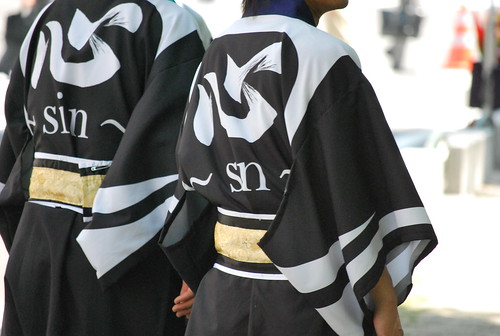
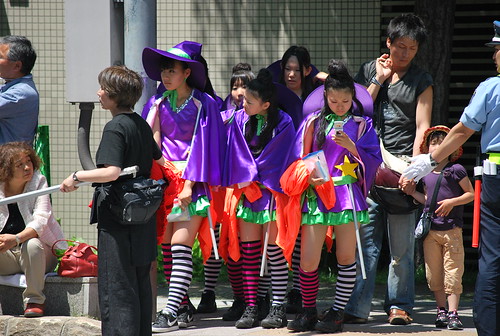
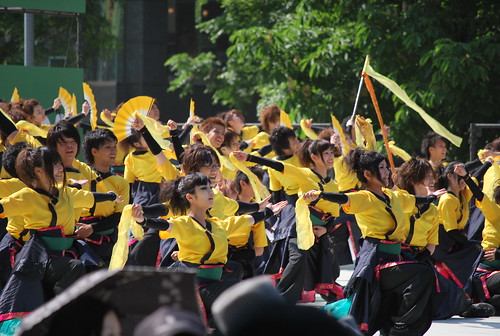
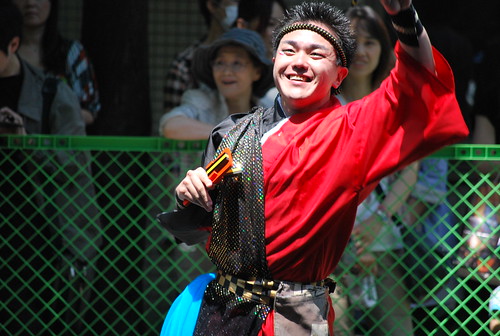
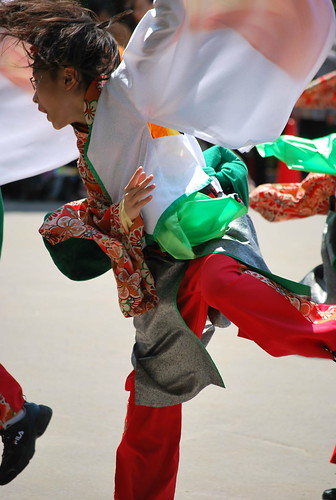
Yosakoi is


Yosakoi is madness.

Yosakoi is forward motion.

Yosakoi is colour and music and light.

Yosakoi is a thing with a life of its own: a synergetic, Frankensteinian abomination of the fishing-inspired dance that birthed it. Yosakoi is the void that was filled by the surface-shy, but deep-down-explosive Japanese soul. Yosakoi is one voice expressing itself in a multitude of languages and dialects and idioms. Yosakoi is a rough framework for imaginations that express themselves best in rhythm. Yosakoi is the Will-To-Performance of a people.

Yosakoi is your visual definition for “genki.”

Yosakoi is energy uninhibited.

Yosakoi is fire.

Wednesday, June 02, 2010

a year in The Life

Well, it’s been a year since I started this thing. I figured I’d commemorate it with some updates. This is the pretty straight forward, year-of-blog update. I've got something a little more linguistically interesting in the offing, but it will have to come a bit later.


First, I ain’t coming home

Despite thinking I was pretty clear on my decision in the Christmas cards I sent to most people, as well as in my six month post, it appears that there are some folks who are still getting surprised by my news that I recontracted with JET and will be hanging on in Furubira as the ALT until July 2011 at least. So here it is; one more time:

I’m not coming home in August 2010.

Right now I’m scheduled to be back in August of 2011, but there is always the possibility of extending my contract for a further year.


That being said, I’m coming home soon

Sorry to be contrary, but I’m coming home for a visit to Canada this July. The first bit will be in Vancouver for Amy’s birthday (that’s two years running, Thede. I hope you’re keeping track…) and Amanda’s wedding, and the second bit will be in Toronto to catch up with the family and all you mad city rats. However, for reasons of paid vacation limits and planning to work at Tokyo Orientation (even though they decided I wasn’t genki enough >:( ), it will be a very short visit. Therefore, I’m really hoping I can set up some kind of mass do so I can make sure to see everyone.


So where is Furubira, anyway?

I took a look back at those first posts and realized that I got the location of my town pretty wrong. So, though Amy’s likely the only one to care, here are some revised maps to show where I’m at in this mad archipelago.

Further, Furubira is a small fishing town of 3,800 souls—far less than the 14,000 it boasted at its prime, back when we had movie theaters and herring mansions, back before a change to off-shore fishing laws started a steady bleed of our fisherman population. I’d love to make a romantic comparison to the outports of Newfoundland, but the reality is that the fish processing our town is still engaged in seems to keep us running.


The Schools

The junior high school second graders who used to alternate between telling me to leave and telling me to die are now third graders who tell me I’m cool and that I should stay. They’re also entertaining themselves by yelling “hige!” at me from time to time and laughing as I stroke my beard in epic fashion. The junior high first graders who used to be the apple of my predecessor’s eye have slowly degraded into junior high second graders who are only now discovering the joys of telling me to die. Thankfully, my new junior high first graders became far less straight-jacket insane in their transfer over from sixth grade at the elementary school, and there are some among their number that completely blow me away with their level of English acumen.

The Elementary students are angels, like always. Well, the new fifth graders have inherrited the manic mantle from the old sixth graders, complete with the dubious honour of having their homeroom teacher leave on undisclosed, yet surely unrelated, indefinite leave. The new sixth graders are developing some attitude, but it can’t get the better of their genuine interest in learning. The new fourth graders continue to prove themselves to be wunderkind in the interest and ability they demonstrate in our twinning with my mother’s second grade class. The third graders are as fun as third graders should be, the second graders are suffering bit from a possible Sensei-Importance of English disconnect, and the first graders are the light of any day. God, that I could spend my every day trying to come up with new and creative ways to make them explode into those uninhibited peals of laughter. I’m convinced exposure to my first graders could cure cancer, those kids are so cute.

The High School is as a slowly closing High School should be, I guess. Since the year change in March-April, the third graders have graduated and moved on, the seconds have become thirds, the firsts have become seconds, and the first year class is no more. With only two classes to teach there now, I spend even less time at the school, and when we go through the whole process again next March, I’ll have only 50 minutes to teach at the high school, once every two weeks. It will be worth it, though, as the now-second-and-then-third graders at the high school have always been my very favourite students, and my Japanese Teacher of English (JTE) there is unquestionably my most manic, most entertaining teacher. He makes mad things like this on the regular.


The BOE

The other half of any ALT’s job: The Board of Education. Or, perhaps, the Bored of Education when we have to report to it on days when the schools are out and make work to do as our coworkers seem just as confused about what we’re doing there as we are. Thankfully, my BOE seems to be better than most: it is just the right mix of invested in my well-being while not being overbearing in my life. The people there are also as muppet-like as I am.


I’ve got hair

Didn’t say all these updates were going to be particularly interesting, but I’m thin on material, and this is the most hair I’ve had in a while, so deal.


And I’ve got a lady.

Which seems like a fundamentally impersonal way to talk about it, but just like with the recontracting thing, people still seem to be surprised by the news. I guess my less-than-subtle implications could have stood to be far less subtle. Her name’s Heather, and she’s from the UK. She showed up over here in the same JET group as I, and we’re placed not too far apart up here in Hokkaido, with Sapporo as a convenient meeting point between us. To quote the Barenaked Ladies, “she loves me, and her body keeps me warm…”


And since it's what started all this off, here is my own, snowier take on that photo by that Bassguitar guy on Flickr; the one that was my first image of Furubira. I'd been meaning to photograph these rocks for a while, and I finally got the chance in early April. Back then, I said that the picture had convinced me that Furubira was the kind of place I wanted to be. Now, twelve months later, I'm still thinking the same thing.

Wednesday, December 30, 2009

広島県 (Of Hiroshima)

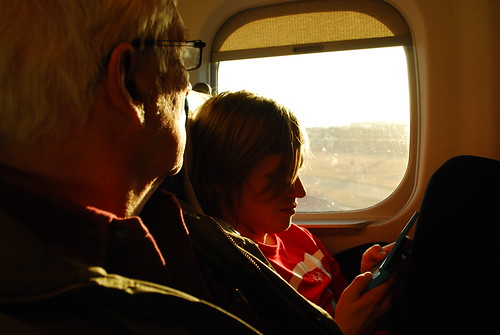
For all my anxiety about making sure this trip went off without a hitch and my brother and father were rested, fed, and happy, it's only gotten better since leaving Hokkaido. For all my adamantly proclaimed love of snow and winter, as we flew in over the geometrically perfect, man-made island of Kansai airport, and the sun glinted in the window off the waves of the inland sea, I started to yield to the idea of a temperate winter. And then on the train from Kansai in to Shin Osaka, as the Kansai craddle from which all of Japan was born whipped by outside the window, I marvelled that the trees still had leaves. Coming out of the grey-white dark of Hokkaido, the prospct of warmth and sun and growth seemed so distant as to be fantasy.
But here it is, and it warmed me. On that train, I was hit by sentimental waves of Greece and Scandinavia and Estonia and London, and in the midst of being buffeted by them I realized this adventure of ours had really begun.
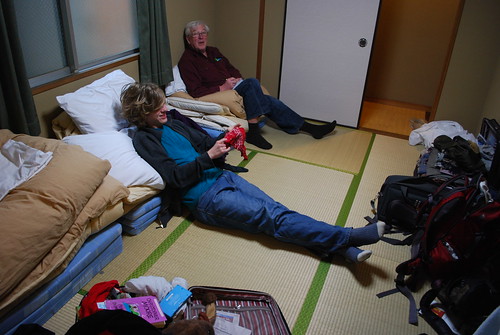
Our hostel in Hiroshima was bare bones in that livably Japanese way, with our own toilet, sink, and futons, but little else that wasn't shared. It provided dad with coffee and Craig with facilities for pursuing his ongoing mochi addiction.
_____________


Hiroshima itself has been two worlds:

Yesterday: sunny Miyajima.
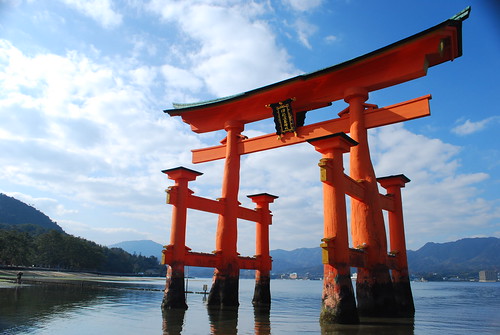
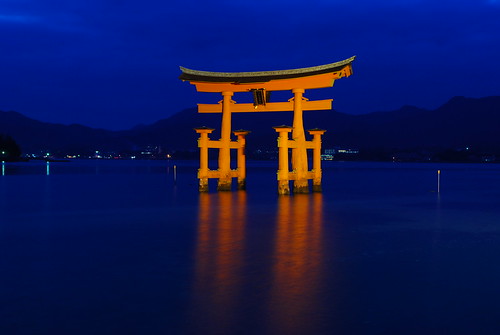
The sacred island that man couldn't set foot on until he built a colossal, vermillion Torii gate in the water off its shore through which boats could approach in deference.
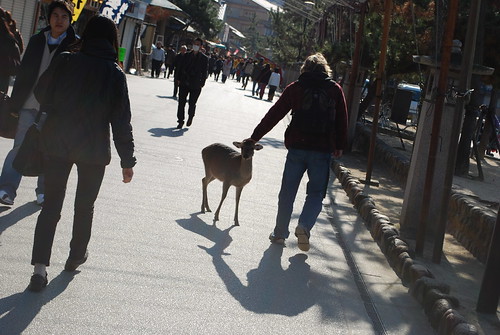
A knot of hills and temples, possessed by its island spirits embodied in the curious yet indifferent deer that stalk the crowds of visitors, searching expectantly for their offerings.
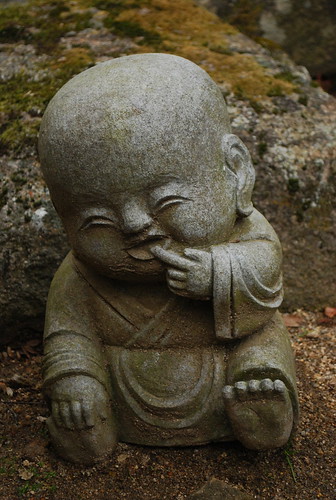
And the mountainside sprawling complex of Holy that is Daishou-in temple. A place of Buddhist worship infested by lawn-gnome-like Chibi Buddhas: oriental leprechauns that have studied the stoney disguises of the tanuki. When you look upon them, they are statues frozen in comedic, almost mocking poses.
And when you turn your back, they gambole off between the rocks and plants of this massive zen garden. They play hide and seek with monuments and shrines many times their size: springing them upon you as you turn corners and hiding them away as you try to capture the wonders with your camera.
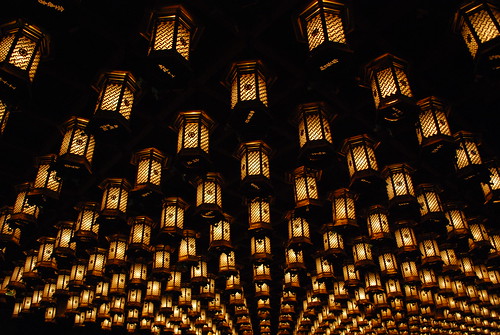
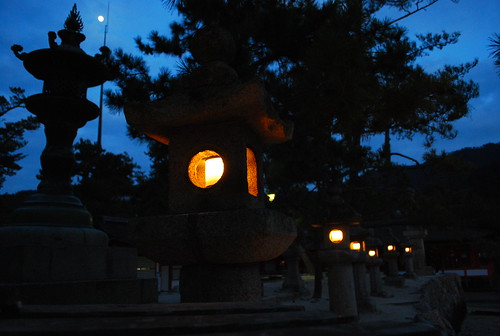
As the night falls on Miyajima, these diminuative Buddhas descend from their mountain home to light the stone lanterns along the shore and to shoo the deer back into the forests.
Lastly they spark the great bulbs that set fire to the Floating Torii, assuring that its reflection glows in the rising tide and burns itself into the minds of the footsore and windblown visitors as they leave Miyajima on the last of the ferry boats.

Today: The A-Bomb Dome and Peace Park of Hiroshima city proper: grey before the coming rain.
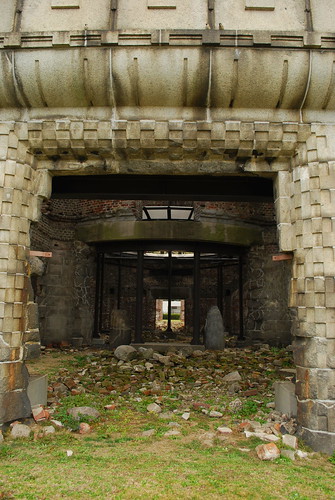
The last sun of yesterday disappears behing a slate of cloud as we descend from the tram, the irradiated remains of the former prefectural office full before us without any build up or any reveal. You don't wander down a path to find the A-Bomb Dome. There is no coy game of cat and mouse where the path approaching it gives you fleeting glimpses before revealing the full of it. It's just there. Vivid and whole and undeniable. The ruins, mere meters from what was once the epicenter of man's greatest folly of curiosity, they seem almost a sculpture of destruction, an image carefully fashioned to embody the archetype of a ruin.
Every protruding, twisted girder; every heaping of rubbled masonry, a flourish of a brushstroke intending to make the meaning of this oeuvre explicit.
It is more monument than any amorphous blob of modern art could ever be. And in my mind it brings down an avalanche of images:

The shockwave hurtling down from a height of 580 meters to strip away the majority of the prefectural office like rags or flesh, leaving only the current skeleton of steel and rock; the firey ball of plasma boiling down in the shockwave's wake--a vivid visual of fire passing through the metal remains of the dome, like smoke through a latticework.

The birds that now roost among the ruins of the A-Bomb Dome; pidgeons still picking hopefully through the rubble; something like starlings perching on the metal work of the actual dome and flitting to and frow among the standing remains in a flock.

Thousands of people being reduced to atoms, the trauma and absolute nature of their destruction going so far as to undo the very boudaries of their spirits so that both the molecules of their DNA and the shadows of their souls begin to overlap. And in the heat and the dark, as everything that once composed them is forced upwards into the azure sky, they fuse. Thousands of souls all rising together; a vast, sentient thing that rides the winds away from the inferno. The one, eclipsing soul of Hiroshima's dead.

Enola Gay, learning of that daft son of hers' last attempt to do something to make her proud. She, rolling her eyes and shaking her head with a morbid laugh, wondering if that ol fool will ever learn.

Sunday, November 08, 2009

An Ode to the Chatti

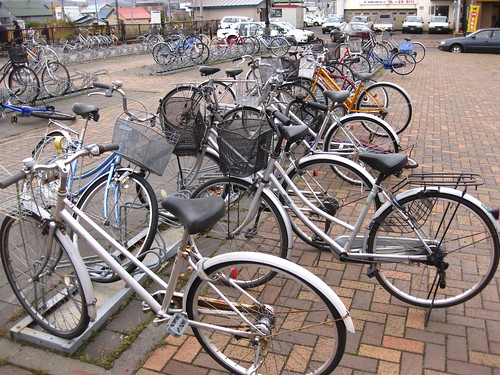
As the cost of a car in Japan began to seem more and more prohibitively expensive, I started contemplating getting a bike. I wanted to get something reliable and hardy like a road bike in the hopes that, with some practice, I might be able to get into Yoichi (the bigger town down the road) with it for grocery shopping and the like. However, once I had decided that I wanted to get a real bike, I realized that I would have to go into Sapporo to get it as it seemed the only bikes that they sold in Yoichi and Otaru were Mama Chatties.

When a friend first warned me about the Chatti culture in Japan, I didn’t believe him. I assumed that only Obachans would ride around on those things. Worst case scenario, maybe some elementary and junior high school girls could be seen riding around on them. However, there was no way in hell that any self-respecting Japanese man would be caught dead on one of the things.

Then, very soon after I had arrived in Furubira, I was stopped in the street by one of the younger guys from the town office. He looked like some smooth operator straight out of an anime, with his styled spiky hair and slick black suit. He even whipped out a space-aged Japanese keitai so chunky and uber-masculine that you’d think the thing doubled as a lethal weapon when he wasn’t making calls on it. He was the very image of a virile Japanese male…

…except he was riding a Chatti.

I mean, it wasn’t as bad as some of them. It didn’t have the front basket or the mudguards on both the wheels. But the frame was most definitely powder blue, and everything metal on the bike definitely gleamed like chrome.

Initially, I tried to rationalize all the Chatties I came across as very old hand-me-downs used by people too lazy or too frugal to upgrade to something more modern. Then I came across my first Chatti shop in Yoichi. As I stared at row upon row of befendered, bebasketted two wheelers, I realized that the Chatti might as well be the official bike of Japan.

I still don’t get it, though. Is this another bit of Japanese Modernization Hipocrisy—like how the Japanese bank machines have in-built money counters for deposits that will even accept coins, but you’re out of luck if you want to find one that has the technology to stay open past 6 pm. This is Japan: the land that fixed the automobile and is currently working on replacing us all with robots. However, as far as the Japanese are concerned, the Bicycle was perfected in the 1950’s.

Japan: WTF?!

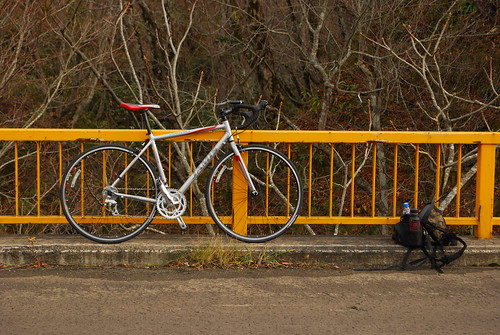
In related news, I did wind up picking up a road bike in Sapporo. I likely won’t be riding it for very much longer this year before the snow flies (Thus does my love affair with seasonal forms of exercise continue), but it has treated me nicely thus far and allowed me to explore a little more of the area around my town.

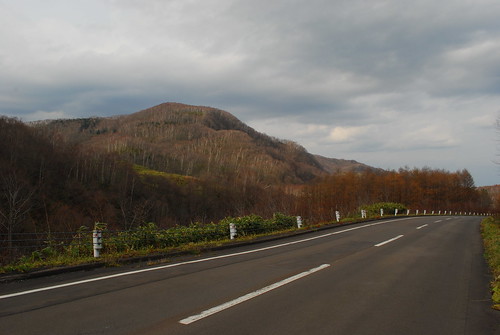
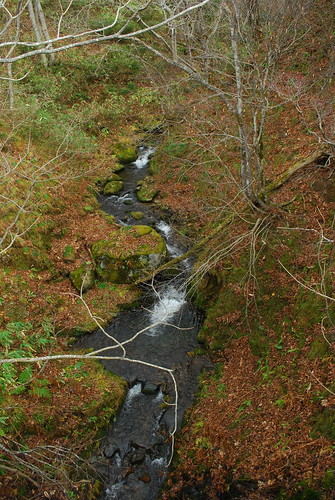
Most interestingly, I've used it to get up the valley that runs away from Furubira, up into the mountains to the south. Since Amy asked me what there is to see up the valley, I figured I'd take my camera with me.


Tuesday, October 27, 2009

The Three R's


This one is for environmentally-/waste-minded friends like Amy and Lindsay. Before I ever made it here, they were warning me that Japan is notorious for the large number of garbage incinerators that they have in use. When you look at the place and see how remarkably uncommon flat, useful land is in this archipelago nation perched on the shoulders of volcanoes, and you think about how any flat, useful land there is was probably first settled several hundred (if not a thousand) years ago, it’s clear why these people can’t rely on landfills to dispose of their waste, as we do in land-rich North America.

Still you’d hope that, with all the people here, and all the futuristic technology for making various parts of their lives more efficient, the Japanese may have developed some kind of space-aged composting technology to capitalize on the vast amounts of organic waste they do create.

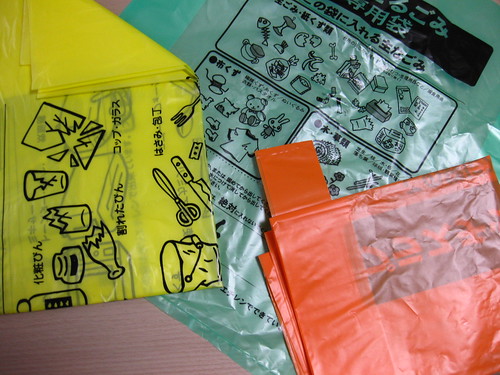
And when I first arrived here, the outlook seemed like a good one. I had been warned about the very anal-retentive approach the Japanese take to sorting their garbage, and that was completely on the mark. There were three different, colour-coded garbage bags to be used when sorting your garbage, and recycling was divided between different bins for cans, plastics, glass, and coloured glass.
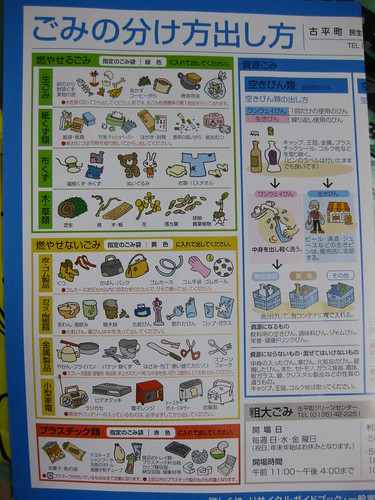
Certainly a nation that was so scrupulous with sorting their trash would be just as scrupulous about disposing of it. Maybe Lindsay and Amy were wrong; maybe the Japanese had turned over a new leaf and mothballed all of those big black incinertators. As I tried to make sense of the document detailing how the garbage system worked (which, thankfully, had more pictures on it than words), I was happy to see that the very eco-looking green bag was the one that we were supposed to put all the biodegradables like paper, food waste, and tea bags into. Surely this thing was heading straight for the local composting depot.

Then I received a presentation from the town official in charge of waste management. He didn’t speak much English, but he used the little English he did have to burst my bubble about an eco-friendly Japan. He pointed to the green bag and all the lovely compostables in it and uttered one syllable:
“Fire.”

He pointed to the orange bag, where we were supposed to deposit all of the plastic and foil wrap (there’s so much of this crap on Japanese food that I’m pretty sure their packaged food would ride out a nuclear holocaust just fine. They put bunches of bananas in plastic bags. They saranwrap nets of oranges. They shrinkwrap tomatoes to Styrofoam forms.) and said:
“No fire.”

He pointed to the yellow bag, which we were supposed to use for broken glass, dead appliances, used batteries, and any other household detritus too substantial for the other two bags. He raised his arms in a shrug, gave me his surprised face, and said

“Uhh-Ooh!”

I assumed he meant “broken” by that.

And just like that, my dreams of an eco-Japan went up in smoke. All those lovely compostables were also the most burnable items of Japanese refuse. Not only that, but as I’ve asked around about what they do with the plastic and foil/orange-bag items, the kind of veiled, non-answers I’ve gotten have lead me to wonder if they’re not hucking these on the bonfire as well—just in some other, more specialized incinerators.

I’m a little disappointed that they don’t have a separate garbage bag for silica packages. It seems that every packaged food item I pick up from the kombini not only has several dozen yards of plastic wrap in successive layers to hermetically seal it off from the outside world, but it also has a silica package in it, sporting some awesome Engrish brand name like “Everflesh” or “Infinisoftu.” I’ve honestly bought the most insignificant of donuts from the kombini and had the thing sitting on its own plastic tray, with a silica package beneath it, and a layer of plastic wrap around it. When I take it to the cash, they’ll put it in the world’s only individual-donut plastic bag, and they'll try to hand me some disposable hashi to eat it with. If I succeed in waving all that off, they’ll still slap a plastic sticker on the plastic packaging of my individual donut incase someone mistakenly tries to bust me for shoplifting in the four feet between the cash and the door.

And once you get all of that annoying plastic packaging out of the kombini, and you head off to your eventual destination, merrily eating your donut along the way, you face another harsh reality of the Japanese waste management system:

Waste management is your problem.

Public garbage cans are so rare in this place as to be mythical. You can only really find garbage cans outside kombinis, and even then not all kombinis have them. While Mark, Lindsay, and I are out and about, we’ll always keep an eye out for a garbage. When one of us spots one, it is that person’s duty to announce it to the rest of the crew so everyone can empty their pockets of all the plastic wrap and silica packages they’ve accumulated. Hell, with the amenities provided by all of the kombinis, it tends to be easier to find a clean public toilet than it is to find a trash can. It’s another one of the little paradoxes of Japanese society: they create more waste than anywhere else on the planet, but they don’t make it easy get rid of it.

Back in September at my town’s big festival, when they’d ringed a town shrine with food vending (and plastic dispensing) stalls, I approached aforementioned Town Waste Guy and asked him where the garbage bins were. He laughed and engrished “you take it to MY house.” Despite the possible comedic misinterpretation waiting in that sentence, I understood that what he meant was “Your” house, in the same way that the Japanese will call your personal chopsticks “MY hashi.” The town had set up this little waste generation station, but they’d be damned if they were going to help me dispose of the ridiculously hot fishdog-on-a-stick that my sneaky JR High students had bought me as a joke.

Then again, though the Japanese may not yet have “Reduce” down pat, they are certainly rocking “Reuse.” The Japanese have put second-hand shops to work like I’ve never seen before. Recycle Shops, from "2nd Street" to the hilariously named "Hard-Off," are everywhere, and since the Japanese like having new, shiny stuff, you will often be able to find their almost-new, just-less-than-shiny stuff for a bargain at these stores. I’ve caught some stores making a real buck off it—like the 2nd Street clothing shop in Sapporo that marks second-hand stuff up to retro-chique prices—but, for the most part, these stores seem to be on the level and they offer used goods at a considerably higher quality level than you’d find at Goodwill.

The Sisters Co would think they’d died and gone to heaven.