Showing posts with label social commentary. Show all posts

Sunday, June 27, 2010

Two Sundays: The Souls of Cities

or “Two Sundays: Sunday The Second

This should likely be retconned back to here to go with the other Sunday, and I'll do that eventually, but I figured I'd post it today as I likely won't be posting much while I'm off in Van, and some of the Torontonians might be interested. Also, it's not Japan-related, but it is meant to contrast with that other Sunday. Though I took my sweet ass time agonizing over this, all of these thoughts materialized concurrently with all of that sweetness from the Sunday spent camping.

In Canada, or Toronto, specifically, Sunday was spent in tense anticipation of the kind of madness that had gone down the day before under the cover of the G20 protest. The kind of stuff I came home to find out about my city couldn’t have been a starker contrast to the leisurely, amicable weekend I had just spent in Japan. Witnessing the coverage of everything that went down in Toronto, I find the whole thing depressing and perhaps even a little sickening. It’s been kind of haunting me since, like a nebulous storm cloud over my head, and the first time I tried to sort through what I was feeling and thinking was in an email to Saff.

Sorry, sir. Was away all weekend when all the G20 stuff/messages from you dropped. I looked at all your tweets and a bunch of the pictures you took, and it only served to depress me, so much so that I've been completely unmotivated to read any of your blog posts.

You see, I'm a pretty passionate guy, and I can set myself on fire when it comes to ideas or certain beliefs, but...I don't know. I can't get behind either side on this G20 thing. I'm angry with the security force for making my city something it's not, but I'm angry with that black block bullshit for doing the same. If it's true that the cops were baiting the black block to legitimize themselves, then I'm pissed at the black block for being stupid enough and juvenile enough to take the bait and revel in the opportunity for destruction. They ruined everything, and they single handedly damaged the image of all of the other peaceful, legitimate protestors. The conflict seekers and the drama queens baited the police and cast their shadow over all the people behind them with real things to protest about.

I think it comes down to the fact that these people described themselves as Anarchists, and I don't think I can ever get behind Anarchists. I don't care what end they're trying to justify with their means: in my eyes they are devoid of beliefs. Their only god is chaos: their only moral, destruction. Anarchy is a cop-out masquerading as beliefs. To have beliefs, you have to be accountable to something.

If you’ll permit me a tangent, it reminds me of a university course I took in the Rhetoric of Dissent. As a group project, we were asked to start our own resistance movement. There were anti-smoking groups and anti-cell-phone groups and anti-meat groups, but the one I’m remembering now was the “X” group. It was populated by the hipsters and the counter-culture kids in the class, and it was…well I don’t really know what it was. It was anti-anti, I guess, and thinking themselves clever the group did little in their presentation other than sit at the front of the class, doing little, delighting in how much more clever and ironic they were than all the rest of us with our predictable, so-very-yesterday causes. They were the black block of our class, and they were a cop-out. They took advantage of their freedom, and they worked towards nothing. They claimed the nothing to be their cause, to be their end goal, but all they succeeded in accomplishing was a void. They insulted everyone who had come to that class with a purpose, and they mocked the authority of our professor.

The black block anarchists are as unwelcome in my city as the riot cop darth vaders that clashed with them. The only way I can adequately express my distaste for both sides is by saying I want them both to not exist; I want them all teleported to Mars where they will never again trouble Toronto the Beautiful.

At the same time, I don't want to dwell on this. It has affected me more deeply and more inexplicably than I would have thought it had any right to. I'm not someone who comes to depression naturally, but this has depressed me. Even if the Toronto police/the security force were unconstitutional and truly cruel, and even if there is some way they can be held accountable for their actions, I don't care.

I don't give a flying fuck.

The damage has been done to the soul of a city, and to drag it out with investigations and finger pointing and attempts to justify the violence and the cruelty will do nothing to heal that bleeding gash in what our city is.

A lot of people fucked up in all of this, and the Free City, as you call it, was the only one that paid the price for those fuck ups. No matter what either side tries now, after the fact, to validate their actions, it will never make it up to the city.

The main point that came out of all this, though, for me was the idea of the Soul of the City. Maybe that can be the kind of thing worth posting up here; the kind of thing worth sustaining with the madness of Toronto as an illustration. The notion of the Soul of the City if something I’d touched on before, with dutiful thanks to Italo Calvino’s Invisible Cities (Read this book. Why haven’t you read this book yet?) and Neil Gaiman’s Worlds’ End.

If cities were to have souls, they’d likely be mostly people-based. There is the city’s architecture and its infrastructure and its ecology, but I’d like to think these constants compose a body, and it is the people who breathe the life into that body. That being said, without the body of architecture and infrastructure and ecology, those people would be other than what they are within the body of the city.

Just as the souls of cities can become hot, running fevers that infect their bodies, they can become protective. Even if they’re composed of thousands if not millions of individuals, the souls function as one. The many, fractured views of what the city should be that are held by those millions of individuals average out and harmonize into an overarching identity just below the surface of the city. Its soul lives in their beliefs, in their impressions of what the city is.

And when the city is threatened, this collected soul reacts.

In Berlin, Germany, a hundred or so German Nationalists (Neo Nazis) need a cordon of officers to protect their freedom of speech as a crowd of thousands of ordinary Berliners gathers around them to silence them. They are the soul of the city, demanding that the same mistakes should not be made again.

In Tallinn, during the Soviet occupation of Estonia, the Estonian people in the capital created their own, non-soviet radio station and would broadcast from the former legislature building. A group of hundreds of Russians, possibly organized by Soviet authorities arrived to ring the building, attempting to force their way through the gates to silence the Estonian voice within. The radio station sent out a call to the city, telling it that their freedom was under siege. And it was the soul of the city that responded. Thousands of Tallinn residents of Estonian descent peacefully descended on the legislature building, ringing in the Russian protestors with a force dozens deep. In the end, Estonian police had to escort the Russians away through the gathered mass.

In each case, the city defended itself through its latent soul: through the tiny magic that it holds in the minds of its residents—a guarding enchantment disguised as municipal patriotism and an investiture in the clear notion of “home.”

However, when a violent darkness descended on Toronto, and it needed its soul to protect it, that soul was drained away. The foolhardiness of the few was favoured over the averaged wisdom of the many. Ahead of the G20, great walls were erected through the heart of the city, obstructing its natural flows and pushing the residents that made up its soul out of the city’s heart. Soldiers were fashioned out of peace keepers: they were armed, they were encased in armour.

I think John Cruickshank, Publisher of the Toronto Star, said it best in his article immediately following the madness over the weekend in Toronto. I think it was the following statement from him that set me off down this contemplative path about cities and their souls. I think it was the following statement that was the only sanity I’d heard in all of this:

“The only force that can prevent vandalism and mayhem in a city is the presence of its population.”

The soul of the city responds.

When the city is in peril, its citizens move to protect it.

When the nihilistic black block infiltrated our city, we didn’t need riot cops: we needed civilians, living in the city and making it alive as they do every Saturday and Sunday. In the presence of civilians—in the presence of the soul of the city—violence and anarchy will not be tolerated.

And let it not be the case that people think the black block as the only threat to this city—the only force that the soul of the city would have rejected. Though the authorities would tell you that they emptied the core to protect the civilians, I don’t doubt that they made this decision to protect their force of Darth Vaders as well. Just as the Soul of the City would not have tolerated the black block, I very much believe that it would not have tolerated the gas-masked and plexiglassed black cops, either.

Gah. I’m not sure what this was meant to be, and I know it has little to do with Japan, but I’ve agonized over it for long enough, so here it is as it is. Here’s hoping something in it speaks to you, even if it isn’t as artfully wrought as it could have been.

Wednesday, June 23, 2010

Red & White

Heather recently informed me of a striking chromatic difference between Japan and North American/Western society.

In Canada, and America, and likely most of the European nations, it is understood that white and black are binary opposites: chromatically as well as philosophically. Were you to try to illustrate the concept of a binary to someone, it is likely that the first example to come to your mind would be “well, it’s like black and white, really.”

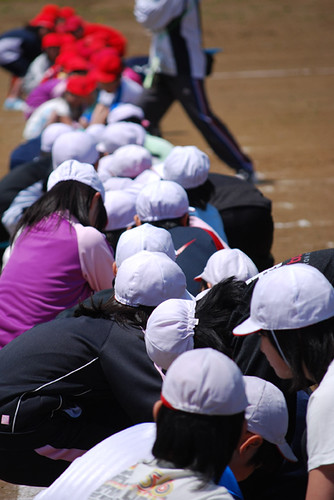
In Japan, however, it is white and red that are opposites, and not white and black. Such a chromatic revelation is not so shocking in a country that had to invent the notion of green—or midori—as the result of foreign influences (before green was just another shade of blue to the Japanese, and traffic lights are still considered to be red, yellow, and blue). However, the fact that red and white are opposites becomes necessary context when you realize just how often the two colours appear together in this society. The Japanese flag, of course, is the most obvious use of red and white. However, there are also the graduation ceremonies in the schools, wherein the rooms are ringed with white and red striped curtains. And in the day to day, my elementary students, from first grade to six grade, all have reversible red/white caps hanging from hooks on the sides of their desks: ready to be deployed in any activity that calls for splitting the class into teams.

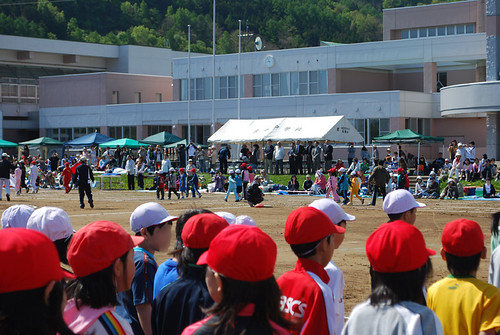
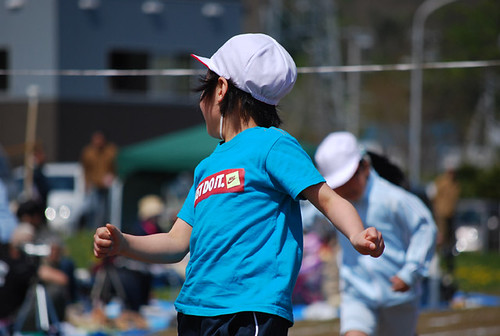
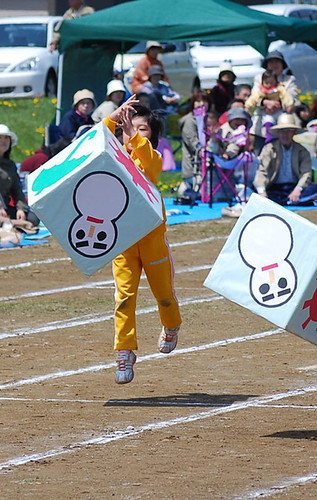
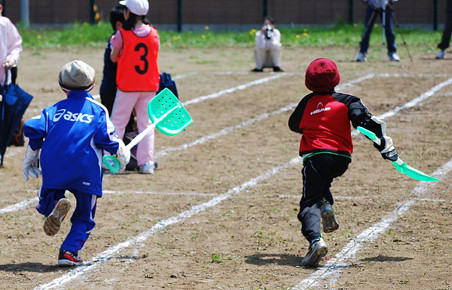
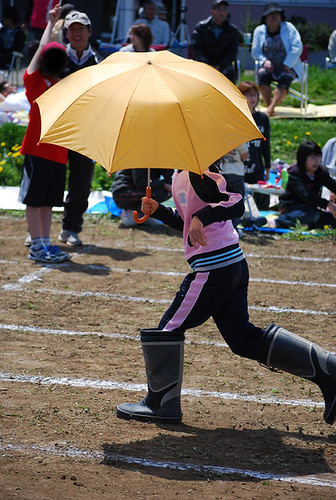
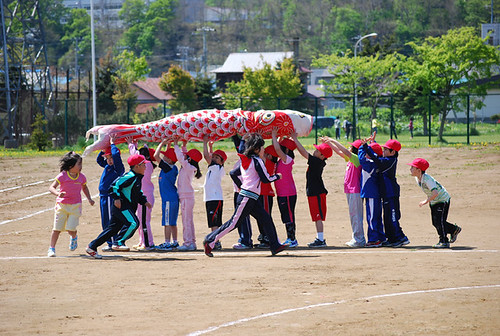
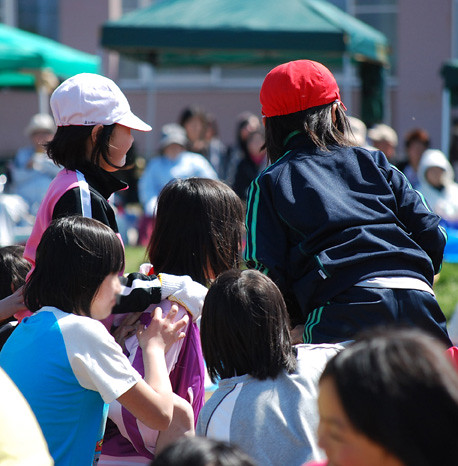
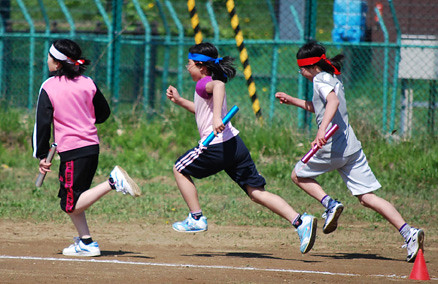
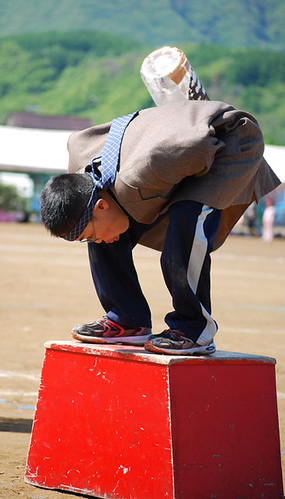
One such activity occurred on the weekend of May 29th at my elementary Undokai (school sports day), which saw the entire student population divided down the middle into two teams: Red and White. Each team had representatives from every grade, and when certain grades were competing, the remainder of the team would form the cheerleading squad: maniacally waving their team’s colours and following along in the pre-set, full-body, preset, foot-stomping, hat-waving red or white cheer routines.

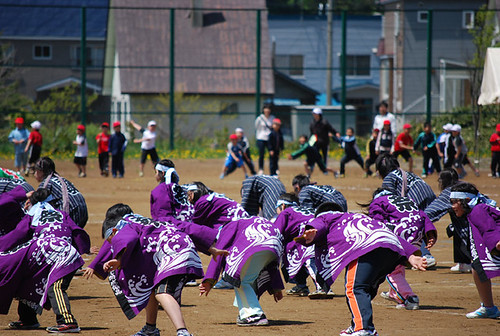
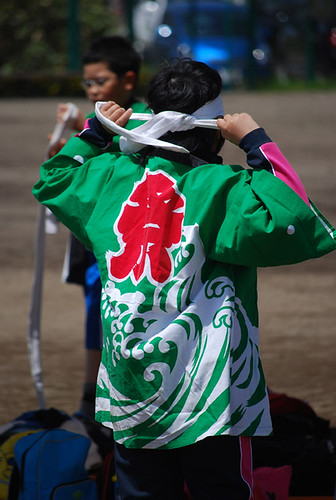
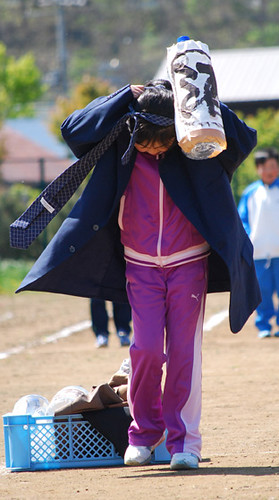
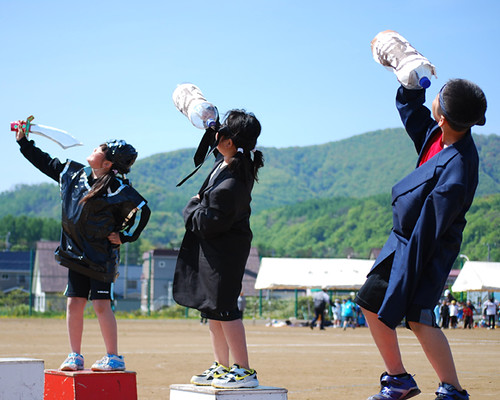
The closest approximation for an Undokai that we have in Canada is a Track & Field Day. And such a comparison would be apt when it comes to the Undokai’s X-meter-dash and relay events for the students. However, such a comparison fails to capture the importance of the Undokai as a community event that sees student’s entire extended families coming out to cheer them on (indeed it seems to be, in a way, mandatory for parents to show up for the Undokai, and they are encouraged to arrange vacation if they usually work weekends). The comparison to a normal Track and field day also fails to capture the rest of the Undokai events, which are best described as delightful madness. There are tug-of-wars, and piggy-back chicken fights, and yosakoi-like dance numbers. There are caveman races and weather races, family races and beer bottle races, koi races and ball races. And—my personal favourite—there were dress-up-like-a-sarariman-and-act-out-getting-sloshed races. It was that last that caused me to exclaimed, when I was finally able to get my laughter under control, “God DAMN, I love this country!”

But coming back to the Japanese binary of Red and White for a moment, I wonder if it might not be a purer binary than Black and White: if it might not be better able to illustrate the notion of a binary: of opposites.

I fear that our own western white and black has been too tainted by the associations with other binaries that we’ve muddied it in. White becomes associated with ideas like light and good and air and life. Black, in opposition, is associated with the conflicting notions of dark and evil and earth and death. Black and White, in western society in specific and, likely, in the English language in general, have become value judgments and no longer a simple chromatic binary. To assign either colour to someone or something is to risk contaminating it with these further binary associations or residual meanings.

In Japan, if you’re not white, you’re red. At the end of the day, those students at the Undokai are wearing white hats that are also red hats, and the others are wearing red hats that are also white hats. To change from one to the other is only a matter of inversion: of taking the hat off, changing it, and putting it back on. And, in the end, it’s just a hat.

To transition from Black to White in western society requires far more work. If you are black then you are the absence of white. You carry all of the negative, unclean associations with the black. Should you wish to change sides, to ascend into the white, so strong are our society’s peripheral associations with these two colours that, even if you succeed in changing, your previous colour will cling to you like a phantom miasma. It is like trying to mix white from black when dealing with pigments: no matter how much light you pour into the dark, all you will ever accomplish will be grey.

This is a theoretical discussion dealing with abstracts and is not meant to be a commentary on race. That being said, with the way that talking about someone being white or black aligns so easily with western notions of race, perhaps the race issue is the purest example of the implications of, and inherent dangers in, western society’s classification of the colours Black and White. Just as the Japanese arbitrary aesthetics decided that red and white would be opposites, so, too, did western arbitrary aesthetics draw race lines in Black and White.

Friday, January 08, 2010

Of Bonding

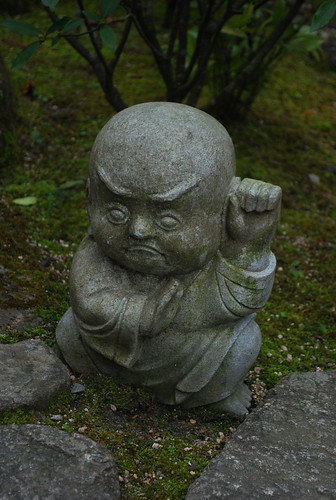
Angry Chibi Buddha

The subtitle for this one should probably be "(A Rant for Saff)" since he's, likely, one of the only people who will be motivated to follow this through.

I think it's appropriate to go here as it's about my trip with my brother and my Dad, and it's about New Years Resolutions, and it's about being repressed (as the Japanese sometimes are), and it's about the ways that our society approaches certain things--approaches that really piss me off.

What's more, it's about something I believe in very passionately.

So, without further screwing around, here she be:

You have to realize something:

The majority of our Supercalafragilisticexpialidotion Father-Sons Miracle Bonding Vacation was spent in silence. We'd walk around, we'd look at stuff, and, if pressed, Dad would reveal how amazed he was about the construction of the stuff we saw. We didn't sit around, crying and giving each other hugs. It's not how we do things. Not ever. It's not who we are.

You go on and on and on about how we need to have this epic, father-son bonding vacation together. What you have to realize is that we don't need it because we're beyond it. We don't need to have two weeks together in a foreign land to tell each other how much we mean to one another because we do it every time we have dinner together. I don't need some big bonding adventure with Dad because a long time ago I realized I needed to see him and talk to him more, so I made a point of going over there every week for dinner, and we'd talk for hours thereafter. Every time Craig, Dad, and I sit down together around Dad's table, we're bonding. We've been doing it for years.

People who don't talk about their feelings and don't tell their loved ones that they love them often enough need big, epic, bonding experience adventures. They need a new setting to share their feelings because they are, for some reason, too afraid to do so in their standard settings. It's like the Japanese when they drink to let go: relying on a change of state--whether it be a mental one from inebriation or a physical one from travel--to break down the barriers you've set up around yourself.

People who talk about "Bonding" need an excuse to do it. They give intimacy and sharing a name, set it on a shelf, and they keep telling themselves they need to get to it some day. And, in so doing, they never get to it. It's like making a New Year's Resolution: you realize you're not doing enough of something, and you set that something on a shelf as a lofty goal and one of two things happen:

1) You achieve your goal by forcing yourself to do it. You don't do it because it's natural or right or it moves you. You do it because you have to, and you're motivating yourself with guilt.

OR

2) You never achieve your goal precisely because you've set it on a shelf. By making it your Resolution--your Goal--you endow it with an extra bearing...you make it bigger than it ought to be by making it something that's so hard to do that you need to make a resolution to do it. It carries all the guilt of you not having done it before, and that guilt makes it seem all the more insurmountable.

People who never mention the word bonding are, in all likelihood, the people who are already doing it. Instead of attaching a name to it, putting it down on their list of things to do, and saying they need to get to it one day, they do it naturally--organically: just like breathing, just like circulation. They go to the people they need to go to, they say the things they need to say. I'm not saying it's easy to do. I'm saying that when you do it, you have to do it naturally.

If you slot in "bonding experience" on your calendar, and you schedule a defined amount of time for it, you are destined to fail. The exchange will be stilted, synthetic, defined. At 11:00 am The Bonding will commence, and at 1:00 pm The Bonding will be completed. You cannot bond with someone on a schedule. It's not a matter of gaining bonding points through scheduled interactions until you gather enough to trade in for a bonding level.

I guess what I'm trying to get down to is a cliché:
Talk is cheap.

Don't talk about bonding. Don't talk about New Year's Resolutions.
Just do it.

I don't like talking about bonding; I just try to do it.

So, on our Jones Family Trip, what we did was spend time together and see stuff together. There was nothing overtly deep and meaningful about it in the instant; that kind of stuff comes with time. The kind of Hallmark, saccharine sentimentality that you seem to be hoping for never transpired, and I'm glad it didn't as it would have been false--for all of us. Any bonding or life changing that occurred occurred silently, inside our heads, and it's the kind of bonding and life changing that Daddio will seldom if ever talk about, but it's the thing that will occur to him with a smile when he's sitting on his own somewhere.

We are what we are, and this trip will be what it will be. To try to force it to be anything else--to try to force it to be meaningful in a loud, showy, let's-talk-about-it way would be to counterfeit the experience. The meaning exists inside our heads. It's as real in there as our names and our passions. To try to make broad, sweeping, heart-warming statements about it is to cheapen it.

In short, I don't think I can give you the answer you're looking for because that answer would be a lie. Just know that this was good. I enjoyed it, and I think Craig and Dad enjoyed it, too.


Wednesday, December 02, 2009

Uniformity 2.5 - Of Gaijin and the Goblin King

One of the advantages to being a foreigner and sticking out like a sore thumb in Japan is that no matter how messed up you act/dress/are, the Japanese will lump it all in together under the banner of “those crazy Gaijin.” I remember back at the Noboribetsu Jigoku Matsuri (Hell Festival), I flipped down my oni mask, hid in some bushes, and proceeded to terrorize some Japanese children. The retrogressive nature of the situation was delicious as some of the more pejorative views of foreigners by the Japanese over the years have resulted in them likening us to slobs, barbarians, and, in extreme cases, demons. So here I was, playing the demon and jumping out at these kids before scampering away down the path in front of them, thrusting my fingers in the air in imitation of the oni dance. The kids were midway between screams and laughter, and their parents smiled, saying only “cheeky gaijin!”

And that’s the way of it. The most mental, certifiably straightjacketable north american public offenses can be gotten away with, scot-free, in Japan under the broad banner of Gaijin Eccentricity. I mean, with the absolute lack of street crime here in J-land, you’re not going to get away with anything malicious (in fact, the cops are twice as likely to nab you for it because you’re a foreigner), but as long as you stay on this side of the evil gaijin line and stick to eccentricities, people are just going to point and laugh.

So I’ve made it my unofficial goal to take advantage of this exemption from social decorum when the opportunity presents itself. I try my damndest to represent for polite gaijin in important settings like the onsen and at meals, wherein wavering from the rules brands you as more of an ass than an eccentric. However, in less formal situations, where a little bit of eccentricity isn’t going to irreparably harm foreigners in the eyes of the Japanese, I can get a little crazy.

The realization that you’re going to be conspicuous no matter what you do is freeing in a way, and it leaves me feeling freer to pull off stunts I might not have the courage to attempt in Canada. It inspired me to show up in two different costumes, days before Hallowe’en, at my junior and senior high schools. And tonight at a HAJET-hosted, 80’s-themed winter ball, I intend to get a little crazy while simultaneously fulfilling one of my greatest dreams:

To dress up like Jared: The Goblin King (or, more accurately, David Bowie FromTheNineteenEightySixMovieLabyrinth), obscenely large package and all.

Such a feat would take a lot of gusto to pull off in Canada, where you’d be judged on sight for looking like such a fruit in public. I mean, you could do it in Canada, you’d just need back up the outfit with balls the size of…well, I guess the size of Bowie’s in that ridiculous costume.


However, in Japan we’re all already judged on sight, and the Japanese have—pretty much—already passed judgment on all of us Gaijin being absolute lunatics, so, really, there’s nothing to lose :)

So bring on the Dance Magic Dance!


And if you are one of the poor, unfortunate souls who has not yet seen the Jim Henson/George Lucas/Frank Oz wonder that is the Labyrinth, go check it out. It moves the imaginations of children, and it is a good way to accompany booze for adults. Plus, where else are you going to see David Bowie trying to seduce a near-pubescent Jennifer Connelly in the role she'd just as soon forget :P


Monday, November 30, 2009

Gaijin Desu Ne

(or, I suppose, Uniformity Part 2)

The exotic appeal of foreigners in Japan is at such a level as to be ridiculous by western standards. Over here my hair isn’t “blonde,” it’s “Golden.” I’ve had students ask me if I died my eyebrows to make them blonde. I’ve had a gaggle of school girls squeel “kakui!” at me when I took off my sunglasses and they saw my blue eyes. I’ve even had a woman marvel at my blonde arm hair and tell me that she wanted to shave my arm just so she could have the hair. All of these physical traits that are so quotidian in western society are aberrant here—are exotic here. At your first brushes with the reactions they elicit, you have to try hard to keep the reactions from swelling your head and making you feel like some kind of golden demi-god.

The reality is that these reactions are indicators of just how racially homogeneous—how uniform—Japanese society truly is. I’ve noticed this most when the on-the-street style reporters on Japanese news programs would ask average people for their opinions.

Every last one of the people interviewed was Japanese.

Back in Canada, you’d see a news spot like this, and the reporter would be getting opinions from all kinds of folks: from white folks, and black folks, and Middle Eastern folks, and asian folks. In Japan, all you’ve got is Japanese folks.

And that’s not just on the news. Wherever you go in this country, all you see is Japanese people. Racial diversity and multiculturalism are such alien ideas over here that when I try to talk about them, all I get in terms of a reaction are blank stares. Even when conversing with the few Japanese people I know who are, essentially, fluent in English, I get the furrowed-brow-head-tilt when I bring up the word “multiculturalism.”

It could be that I am keenly sensitive to this because I come from Toronto, and I am told that it is one of the most culturally diverse places on the north american continent (if not one of the most multicultural places on the planet). I was born and raised in Toronto, so maybe, to some degree, the normality of diversity was bred into me and I walk around with rainbow-coloured glasses on.

Regardless of whether I’m over sensitive when it comes to multiculturalism, it is a fact that Japanese society is pretty damn culturally homogenous. And it is from these seeds of cultural homogeneity that the apparent worship of the alien and the exotic grows. But It’s best not to let that veneration go to your head as the Japanese venerate the differences of the foreigner just as much as we north americans might venerate the differences of a lion when we have it behind plexiglass and steel mesh in a zoo. The exotic in Japan—that which deviates from the centuries-reinforced uniform—is a curiosity. It will always be held at arms length, no matter how interested the Japanese may seem in it. They will ask you all manner of questions to learn more about your exoticism, but the answers won’t endear you to them or provide some measure of understanding; they will only serve as further hallmarks of your oddness, and your answers will only satisfy a certain zoological interest in the asker.

Take, for example, the following interaction I had with some students:

“Pubic hair. Gold?”

Sorry?

Pointing to my head “Hair. Gold. Pubic hair: gold?”
Tracing a circle around his body with his index finger, making sure to include the nether regions, “Hair. All gold?”

And all I could do was shake my head. I thought about, jokingly, teaching them “do the drapes match the carpet?” but thought better of it, recalling how hideously wrong things went when my students tried to ask me about masturbation, and I tried to diffuse the situation by teaching them the English expression “what’s shaking?”

This was a specific instance, but it’s been repeated in slightly different iterations throughout my time here. Sure, these are kids, and they’re bound to be a little more gutter-minded and inquisitive than your average adult Japanese, but their questions are still evidence of the zoological impulse that seems to be suffused throughout Japanese society. It’s the thing that makes students squeal at blue eyes, and it’s the thing that makes women want to make dolls out of blonde hair.

It is the way the Japanese deal with departures from uniformity: the novelty intrigues them enough to investigate, but the difference creeps them out enough to keep the exotic at a distance.

And, least that seem like some kind of indictment of the Japanese as racists, I should make it clear that that is not my intent. What I took from all these brushes with the homogeneity—the uniformity of Japanese society is a glimpse of just how monocultural the society is. Part of our mandate here as JET/ALTs is to promote the cultures of our own countries in an attempt to “internationalize” the people in our towns.

As ALTs, we become the token, and—in a way—the proprietary foreigners for our towns/schools. The Boards of Education bring us over to teach their students English, but they also hope that we can teach the students a bit more about the world outside of Japan. And, witnessing the uniformity of Japanese society first hand, I can understand how very much in need of a little internationalization the people are. I hope that programs like JET are working on the whole and slowly wearing down the wariness that the Japanese seem to feel around foreigners/English-speakers. It’s clear that this society, founded on centuries of isolationism, has to want and accept the internationalization it seeks.

Without that broad acceptance and motivation to open its doors to the outside it won’t matter how many young foreigners you throw at Japan, it will remain a cultural island off the coast of the globalizing, multicultural Pangaea of the world.

Tuesday, October 27, 2009

The Three R's


This one is for environmentally-/waste-minded friends like Amy and Lindsay. Before I ever made it here, they were warning me that Japan is notorious for the large number of garbage incinerators that they have in use. When you look at the place and see how remarkably uncommon flat, useful land is in this archipelago nation perched on the shoulders of volcanoes, and you think about how any flat, useful land there is was probably first settled several hundred (if not a thousand) years ago, it’s clear why these people can’t rely on landfills to dispose of their waste, as we do in land-rich North America.

Still you’d hope that, with all the people here, and all the futuristic technology for making various parts of their lives more efficient, the Japanese may have developed some kind of space-aged composting technology to capitalize on the vast amounts of organic waste they do create.

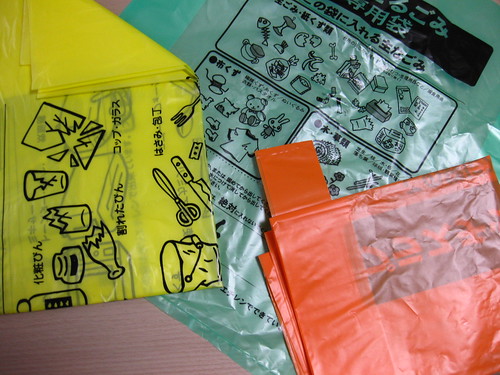
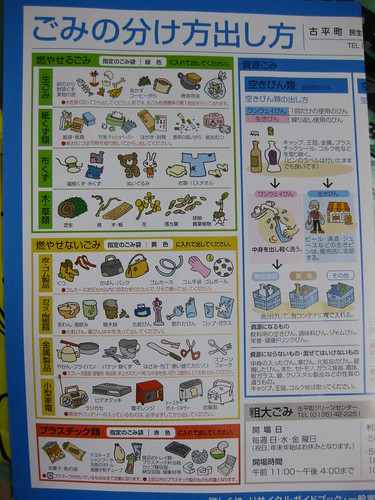
And when I first arrived here, the outlook seemed like a good one. I had been warned about the very anal-retentive approach the Japanese take to sorting their garbage, and that was completely on the mark. There were three different, colour-coded garbage bags to be used when sorting your garbage, and recycling was divided between different bins for cans, plastics, glass, and coloured glass.

Certainly a nation that was so scrupulous with sorting their trash would be just as scrupulous about disposing of it. Maybe Lindsay and Amy were wrong; maybe the Japanese had turned over a new leaf and mothballed all of those big black incinertators. As I tried to make sense of the document detailing how the garbage system worked (which, thankfully, had more pictures on it than words), I was happy to see that the very eco-looking green bag was the one that we were supposed to put all the biodegradables like paper, food waste, and tea bags into. Surely this thing was heading straight for the local composting depot.

Then I received a presentation from the town official in charge of waste management. He didn’t speak much English, but he used the little English he did have to burst my bubble about an eco-friendly Japan. He pointed to the green bag and all the lovely compostables in it and uttered one syllable:

“Fire.”

He pointed to the orange bag, where we were supposed to deposit all of the plastic and foil wrap (there’s so much of this crap on Japanese food that I’m pretty sure their packaged food would ride out a nuclear holocaust just fine. They put bunches of bananas in plastic bags. They saranwrap nets of oranges. They shrinkwrap tomatoes to Styrofoam forms.) and said:

“No fire.”

He pointed to the yellow bag, which we were supposed to use for broken glass, dead appliances, used batteries, and any other household detritus too substantial for the other two bags. He raised his arms in a shrug, gave me his surprised face, and said

“Uhh-Ooh!”

I assumed he meant “broken” by that.

And just like that, my dreams of an eco-Japan went up in smoke. All those lovely compostables were also the most burnable items of Japanese refuse. Not only that, but as I’ve asked around about what they do with the plastic and foil/orange-bag items, the kind of veiled, non-answers I’ve gotten have lead me to wonder if they’re not hucking these on the bonfire as well—just in some other, more specialized incinerators.

I’m a little disappointed that they don’t have a separate garbage bag for silica packages. It seems that every packaged food item I pick up from the kombini not only has several dozen yards of plastic wrap in successive layers to hermetically seal it off from the outside world, but it also has a silica package in it, sporting some awesome Engrish brand name like “Everflesh” or “Infinisoftu.” I’ve honestly bought the most insignificant of donuts from the kombini and had the thing sitting on its own plastic tray, with a silica package beneath it, and a layer of plastic wrap around it. When I take it to the cash, they’ll put it in the world’s only individual-donut plastic bag, and they'll try to hand me some disposable hashi to eat it with. If I succeed in waving all that off, they’ll still slap a plastic sticker on the plastic packaging of my individual donut incase someone mistakenly tries to bust me for shoplifting in the four feet between the cash and the door.

And once you get all of that annoying plastic packaging out of the kombini, and you head off to your eventual destination, merrily eating your donut along the way, you face another harsh reality of the Japanese waste management system:

Waste management is your problem.

Public garbage cans are so rare in this place as to be mythical. You can only really find garbage cans outside kombinis, and even then not all kombinis have them. While Mark, Lindsay, and I are out and about, we’ll always keep an eye out for a garbage. When one of us spots one, it is that person’s duty to announce it to the rest of the crew so everyone can empty their pockets of all the plastic wrap and silica packages they’ve accumulated. Hell, with the amenities provided by all of the kombinis, it tends to be easier to find a clean public toilet than it is to find a trash can. It’s another one of the little paradoxes of Japanese society: they create more waste than anywhere else on the planet, but they don’t make it easy get rid of it.

Back in September at my town’s big festival, when they’d ringed a town shrine with food vending (and plastic dispensing) stalls, I approached aforementioned Town Waste Guy and asked him where the garbage bins were. He laughed and engrished “you take it to MY house.” Despite the possible comedic misinterpretation waiting in that sentence, I understood that what he meant was “Your” house, in the same way that the Japanese will call your personal chopsticks “MY hashi.” The town had set up this little waste generation station, but they’d be damned if they were going to help me dispose of the ridiculously hot fishdog-on-a-stick that my sneaky JR High students had bought me as a joke.

Then again, though the Japanese may not yet have “Reduce” down pat, they are certainly rocking “Reuse.” The Japanese have put second-hand shops to work like I’ve never seen before. Recycle Shops, from "2nd Street" to the hilariously named "Hard-Off," are everywhere, and since the Japanese like having new, shiny stuff, you will often be able to find their almost-new, just-less-than-shiny stuff for a bargain at these stores. I’ve caught some stores making a real buck off it—like the 2nd Street clothing shop in Sapporo that marks second-hand stuff up to retro-chique prices—but, for the most part, these stores seem to be on the level and they offer used goods at a considerably higher quality level than you’d find at Goodwill.

The Sisters Co would think they’d died and gone to heaven.

Wednesday, September 09, 2009

A Sacrifice of Nines

Preface: This one's a little wordy, but the first half is definitely digestible as a kind of book review. The latter part is more of a contemplation/rant on said book. It touches on some stuff that you might find interesting, but if you're looking for crap on Japan, you're, sadly, not going to find it in this post. Try clicking down to that "Go to Hell" post. It had more Japan in it ;)
That being said, if you stick with this one, and it moves you, please let me know as you'll be my hero.

I thought I’d note that 09-09-09 is just wrapping up in my part of the world right now, which means it’s just starting in yours. If you’re feeling pagan, you might want to throw back a few glasses of mead in honour of his royal norse highness Odin, the all-father (he liked nines). Also, what follows is the story of a real-world sacrifice.

Sorry. That’s the half-assed pagan in me poking out. One of the reasons I have a mild interest in the Japanese Shinto belief system is that some of the only religious ideologies that have ever made sense to me have been the ones that centered on worshiping nature. Venerating and paying tithe to the one thing that can be empirically shown to have given us life—the one thing that sustains us on a daily basis—is something I can believe in. Nature is also one of the sources of wonder that we can rely on to provide miracles on a regular basis. You can study the science of how a Douglas Fir—a tree that can grow to heights of beyond 100 meters—can manage to grow out of something as small as a seed on air, water, and sunlight alone, but the science of it can’t fully explain away the wonder required.

Sorry, once again. I half lifted that last bit from the latest book I finished reading. Though it has little to do with Japan, it’s underlying message aligns fairly well with the Shinto belief that there are spirits present in the land.

The book, published in 2005, was The Golden Spruce by Canadian author John Vaillant, a book that won the Governor General’s Nonfiction prize in 2005. I was put on to the book by Amy, my token Parks/Trees-and-rocks-and-shtuff friend, and she was put on to the book by a field course that she took in Haida Gwaii (once known as the Queen Charlotte Islands) last May. The book was required reading for the course, and, having now read the book, I can understand why. Golden Spruce aims to tell the history of resource exploitation in the Pacific North West (B.C. and Alaska) by arranging the story around a very real and very destructive act of protest that transpired on Haida Gwaii in 1997.

On January 27, 1997, a man named Grant Hadwin who was no stranger to the logging industry took a chainsaw to a unique Sitka spruce tree that was hundreds of years old and roughly 50 meters tall. It was known to local anglo residents of New Masset as “The Golden Spruce” and was a popular tourist attraction of their remote town. It was know to the Haida People of Old Masset as Kiidk’yaas and was a central element in their cultural mythos. And, in the eyes of Grant Hadwin, it was known to Macmillan Blodel, the logging firm who had bought rights to the majority of the timber on Haida Gwaii, as their pet tree and was a shinning gold medal of conservation behind which they could hide their destructive logging practices.

Around the central characters of the Golden Spruce and Grant Hadwin, author John Vaillant is able to weave a complex and informative narrative that is at once a biography of Hadwin, a snapshot of the cultural traditions of the Haida people, an ecological profile of the rainforests of the pacific northwest, a history of northwest logging, and a sobering view of the practices—and abuses—of the modern day logging industry. All of that mixed into one book seems like the perfect recipe for a dry, snore of a narrative, but Vaillant somehow manages to use Grant Hadwin’s story to pace all the facts that he imparts and to lend a sense of crisis—if not out-and-out suspense—to the narrative. By the end of the book, I felt both moved and informed by it. Vaillant had told this expansive, at times rambling, narrative, and in so doing he convinced me to rethink the way I use wood and paper products while also convincing me that I absolutely had to visit Haida Gwaii.

He also convinced me—unintentionally, I’m sure—that Grant Hadwin might have been right. But that’s something for the ramble below. For those of you not interested in the contemplation/rant, I’ll distill The Golden Spruce for you here:

If you love nature and want to believe in wonder, read The Golden Spruce.

If you’re ever been moved by something as simple as a forest or a tree, read The Golden Spruce.

If you’ve ever visited the temperate rainforests of British Columbia and been worried about the prospect of losing them, read The Golden Spruce.

If you’ve ever worried about the rights and legacy of the North American First Nations, read The Golden Spruce.

What was interesting, for me, about Grant Hadwin’s seemingly mad decision to cut down the Golden Spruce is that, from some perspectives, it makes sense. But, if I were to admit that I could agree with what Hadwin did, I would be in the minority. When I finished reading The Golden Spruce and googled “Grant Hadwin” to try to find some other photos of/interviews with the guy, all I could find were angry, opinionated articles about how heinous and dastardly a villain he was for cutting down a beautiful, old growth tree. But none of these articles/posts/blog entries mentioned anything about the thousands of people working in logging in the Pacific Northwest who cut down beautiful, old growth trees on the daily as part of their jobs. These angry posts talked about the salience of the Golden Spruce to the Haida cultural heritage, and they mentioned nothing of the importance of the forests of Haida Gwaii to that same heritage, forests that were appropriated from The People by the Canadian government and sold off to International Lumber. Everyone seemed happy to rally around those calling for Hadwin to be strung up for his crime, but no one seemed to be giving any thought to the message he was trying to communicate.

In the book, John Vaillant dredges up a curious historical factoid, mentioning how as the warriors of the Christian faith conquered Europe they would set fire to the sacred groves and forests where the indigenous peoples (many of them our own Germanic/Norman/Celtic ancestors) practiced their pre-Christian religions. He mentions in other places how it was common for these people to attribute particularly large trees to gods, and he even found a reference to a particular, symbolically grotesque means of disembowelment as the punishment for one who was so crude as to commit the crime of removing the bark of a living tree. These historical factoids, and many more like them referenced in the book, point to the fact that our ancestors once saw nature as holy and the forests as sacred.

But we’ve moved away from that now—we, the enlightened, who worship distant, faceless deities who we have created in our own image. And we worship them in buildings of wood and stone that we have hewn and remade to better serve our purpose. We’ve forgotten that the forests were once holy and that the largest of the trees were once our gods.

This could well have been this was the mysterious “great revelation” that Hadwin experienced (but the details of which he never imparted to another living soul) that set him on the path to the Golden Spruce—this sudden revelation that had been brewing in his subconscious as he worked in the logging industry for most of his life.

Maybe Grant Hadwin thought that this was the only way to make people realize the importance of the forests and the severity of the crimes against them. He elected to slay the most well known and most treasured of the old growth trees on Haida Gwaii to make people realize the wholesale slaughter that was going on, unseen, in old growth forests across British Columbia. In effect, he chose to kill Jesus to make the people realize that all of the other gods were already dead. He saw that our sacred groves had been gutted, and the only way people might start to realize it would be to see that destruction wrought on the only tree they seemed to care about.

As Vaillant reveals through scientific facts in the text, and as Grant Hadwin stated in his all-call fax after he made his attack on the Golden Spruce: the tree was a mutant. Where it was meant to have green needles, it grew yellow needles. This fact earned the tree its name, and it appears to be this fact that spared the tree (as well as some of the forest around it by proximity) from the MacMillan Blodel’s logging operations on Haida Gwaii. Hadwin refered to the tree as a circus freak, which seems apt as this mutant tree was spared while MacBlo was felling trees just as old, just as large, and just as majestic (if not older, larger, and more majestic) elsewhere on the islands. To keep this one tree standing in a token patch of spared forest while these other trees are cut down and sacked is somewhat akin to “preserving” a few token members of a certain species in a zoo while butchering and consuming the rest of their population. What Grant Hadwin’s attack on the Golden Spruce boiled down to was a question of “Why this tree? Why now?”

So that’s where I can agree with what Hadwin did. He staged a violent attack on a tree to prove a point, and it was shocking to all who had invested themselves in the life of that tree, but, in the end, people sat up and paid attention precisely because the tree meant so much to them.

And he was right.

Why this tree? Why does this one get to live while all the others just like it have to die? Because it is recognizable due to its mutation? Because we can’t see the forest: just the trees? Maybe the loss of this mutant could finally convince those who had invested themselves in the tree—maybe it would serve to give them a local frame of reference for the horrors that logging visited on their province regularly and had been doing for some time.

Where it gets a little harder to agree with Hadwin—and an area that I’d pretty much avoided thus far in all of this—is when you take into account the interests of the Haida People in the Golden Spruce. The Haida were the first inhabitants of Haida Gwaii and made the islands their home centuries before the first loggers or Anglo settlers ever arrived. The Golden Spruce had been woven into their myths and beliefs for generations. It was not a tree to them; it was the spirit of an ancestor who had taken the form of a tree. In a way, it was more alive to them than a typical tree is to us, and some believed that when it fell it would signal the end of the Haida nation. One could try to use the same arguments when contemplating the Haida’s investment in the tree: that they only developed their myths because the tree’s unique colouring made it stand out. One could try to rationalize the attack on the Golden Spruce as a wake up call for the Haida, hoping that it would galvanize them, the only people who had any real claim to the land of Haida Gwaii, and inspire them to be more protective of their island ecosystem.

In short, one could try to implicate the Haida as passive participants in all of this madness and try to suggest that the felling of the Golden Spruce was just a shot across the bow to rouse them to action, but it seems wrong. When Vaillant tells of the former height of Haida civilization before smallpox cut a swathe through their villages, when he paints the picture of the clear cutting that took place across the breadth of northern Haida Gwaii, it becomes clear just how much the Haida have lost already. It makes it hard to try to paint the loss of the Golden Spruce—a part of their myth and their culture—as a learning opportunity. Even Hadwin admitted when he was contacted directly by Guujaaw, the President of the Council of the Haida Nation, that if he had known of the Haida legend about the Golden Spruce, he may have thought twice about attacking it.

So, yeah, with the exception of the attack on the Haida people, I can understand what Grant Hadwin did when he cut down the Golden Spruce, and I can almost agree with it. This act of destruction has convinced me that I should look into joining Greenpeace—that when I get to a place where I’m thinking of buying a house, I should consider alternate building materials like bamboo and straw bale. I'll tell anyone who asks that my aforementioned half-assed paganness tends to manifest in a veneration for trees, and, looking at what Hadwin did, I think it takes some pretty big love for trees to have the stones to cut a big, beautiful one down to save the rest. It's the kind of statement/act of protest that I kind of wish I had the stones to do myself. And I hope, even if I do so in vain, that there comes a time when people can look at Grant Hadwin's attack on the Golden Spruce for what it was:

An Alarm Call.

A Necessary Sacrifice.


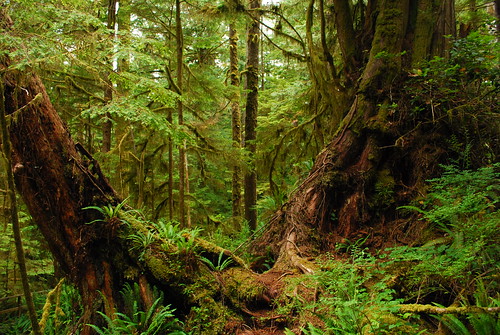
Not the Golden Spruce, but another Pacific Northwest reason to care about trees from Pacific Rim National Park.

Edit: Here's some supplementary video about the Golden Spruce from CBC's Six String Nation documentary:


Saturday, August 15, 2009

The Uniform

This little bit of contemplation is for Sarfaraz because he gets up to far more social commentary in his blog than I do, and I should really try to keep up!

So last month I had to go buy a tracksuit.

And I feel dirtier for it.

I have often sworn that I will never wear trackpants. I can’t quite explain it, but I find there is something unseemly about them. Perhaps I’ve just had my eyes scoured by too many sketchy men taking advantage of baggy trousers.

Regardless, apparently I need to get over it as tracksuits are a requirement in Japan.

Michael, the outgoing JET in Furubira/my predecessor and guru for all things Furubira-related had been getting me prepared for what it was going to be like for me over in Japan. One of the things we went over most recently was the dress code for my various workplaces. Since Furubira’s such a small town, I’m the only foreigner game in town and I’ll be working at the elementary, junior high, and high schools. And, unlike in North America where a teacher is pretty much good in business casual attire no matter what school they work in, in Japan the school very much dictates the wardrobe.

At the high school, Michael explained, everyone dresses very formally, and men are required to wear dress pants, a dress shirt, and a tie. As annoying as that may be, I had been previously informed that the Japanese view high schools as formal environments and that I should be so lucky as to get away with anything short of a full-on suit and tie.

At the elementary school, he described the environment as more informal and mentioned that I would be spending a lot of my day playing with the kids, so it was acceptable to wear a tracksuit. Tracksuit or not, that made sense.

With the junior high school/middle school being the step between elementary and high school, and being the place where Japanese students started wearing school uniforms for the first time, I expected it to be kind of a business-casual setting. And I was right, as Michael told me that the ideal wardrobe for the junior high school was dress pants and a button-up shirt with a collar.

“Or,” he said “you can just wear a tracksuit.”

I laughed, and explained that, from my perspective, a tracksuit was pretty much as far as one could get from business casual attire. I mean, hell, even on casual Fridays at my old employer, I would have gotten a fair few side-long glances, if not an out-and-out thinly-disguised, all-call email had I elected to show up in a tracksuit. Michael conceded that it did seem a little strange, but I accepted the advice, and I dutifully went out and bought my first track suit (shudder).

But I couldn’t stop thinking about it. Japanese society is focused on ceremony, formality, and handling pretty much every interaction in a manner that was officially sanctioned. Whether I’m going into a tiny grocery store or a big-box kombini, every single clerk greets me in the exact same fashion, and when I leave they all say the exact same thing to me. Every time the door to the store opens, they robotically spout the exact same thing, even when they are in the middle of an interaction with another customer. In a society that is this formal, how could something as informal as a tracksuit be on the same level as business casual attire?

Then I got it.

Like the suit and tie of the Japanese salaryman, and the polyester polo-shirt-and-visor numbers of Japanese fast food workers, the tracksuit was just another uniform. It didn’t matter that you were wearing a tracksuit, it mattered that everyone was wearing tracksuits. It mattered that you weren’t wearing something else.

The Japanese enjoy the uniform.

But should that “uniform” be a noun or an adjective? Is it the matching clothes or the elimination of differences—better expressed as uniformity—that the Japanese appreciate?

Indeed, uniformity would serve The Collective Mind/Cohesive Social Unit that seems to pressure and dominate Japanese society. The uniform erases the individual, as well as all of the inconsistencies and unpredictabilities that go along with it. Just as the uniform of cotton and polyester makes one comfortable knowing who is the one serving and who is the one being served, so, too, can uniformity provide us with a degree of tempting comfort. With Uniformity, there is no question as to who is leading and who is following. In the Uniformity of the collective, one is comforted by numbers and insulated from responsibility.

So, you can say what you like about how all the people in western society are drones, and how even individualism has been commodified and mass-marketed, but the fact remains that I can freely go swimming in a public place in Canada without worrying about bearing my tattoos. However, here in Japan, tattoos have been assigned to the uniform of the Yakuza, regardless of how archaic an association that may be. And, being part of this less-than-desirable uniform, there are certain places in Japan that people with tattoos are not allowed to go. One example would be the hotel we stayed at in Tokyo (the swanky Keio Plaza), where I was told that if I wanted to use the free, roof-top pool, I would have to rent a wetshirt for the equivalent of about $12 Canadian to cover my tattoos.

Another, better example is the Japanese Onsen or hotsprings/communal baths. The onsen, I’ve been told, is one of the single greatest Things Japanese to experience over here. I haven’t been yet, and I intend to go, but that plan is accompanied by a certain amount of trepidation on my part because of my tattoos. I mean, I’m luckier than most because my tattoos are usually concealed, and I could likely get into the onsen without the proprietors knowing, but I’ve been informed that they will have no problem coming and hauling me out of the communal hottub at any moment and telling me, in no uncertain terms, that I should leave.

This is because, in Japan, even when you’re bare-ass naked you are still wearing a uniform—or rather your body is being evaluated against the ideal of The Uniform. To say nothing of the overly-hyped western physiological differences that would go against the uniform, the ideal of the uniform is clear skin (to use a wince-inducing cliché: a blank canvas) and, should you have had the audacity—the individualistic GALL to accessorize your skin, to create the birthmarks that you wanted but were never born with, then, my friend, you are an aberration and an abomination.

The Japanese would claim the yakuza link for this pejorative stance. The yakuza are the only people in Japanese society who have tattoos, and the yakuza are not allowed in onsen. But, as a former JET explained in his rather rude, last-ditch tattoo defense, “Yakuza janai! Gaijin desho?!” I’m clearly not a member of the Japanese mafia. I’m clearly a foreigner. The little pictures I have on my back pale in comparison to the full-shirt irezumi of the yakuza, and trying to equate the two—trying to confuse whitey ‘ol me with Japanese-only, nine-fingered mobsters—is a thin smokescreen over what is actually going on: I am being denied because I do not adhere to the Uniform.