Alright, so this is a little late, but it's the official word that I rose to the challenge, I wrote 50,000 words towards a singular, novel-like project in the month of November, and I am officially an author. Well, so says National Novel Writing Month (or NaNoWriMo if you enjoy torturing your fingers). I'll believe it when my 'novel' evolves into something slightly more than 144 single-spaced pages of loosely-chaptered, loosely-plotted word stew. For now, let's go with "aspiring author."
So what have I got to show for it? Well, it's called The Building, and it's an idea that was loosely inspired by something Erica once said to me and heavily fed by ideas for it that I've been rolling around in my head ever since I lived in my apartment back in Toronto. Here's something that isn't a cover.
Next, as I have a questionable-yet-affectionate relationship with time, I'm going to be back-filling November with random excerpts from what I wrote that appeal to me but aren't yet fully seated in their complete stories. If you're interested in what this all produced, take a browse back through November as they come up or follow the NaNoWriMo tag (man, am I ever tired of trying to type that). If you can't be assed and would rather more Japananese content, well then you can happily pretend that November was the month that never was (much like October, apparently--sorry about that!).
To give you a basis for that back-diving, though, here's one of the most coherent things I've synthesized from The Building that hopefully makes a bit more sense of it all:
What is The Building?
A NaNoWriMo novel excerpt
“What is the Building?” “Who are you?”
Jeez. Look at you clever apes. Millennia of evolution and centuries of civilization, and still you can only come so far from what you are. I’ve watched your kind come to me for answers for longer than you can properly understand, and you have always approached the problem of this place from the same angle.
“What is the Building?” “Who are you?”
Always a realm and a power in your eyes. Always a creation and a creator; an aberration and an aberrator.
Well, I can tell you that I’m the Super. Superintendent? What? Never heard of him. I’m the Super. Just the Super. You could say I watch over this place.
But I guess that’s me starting you off with a lie. This Building is not a place. It rarely is. As Michael—our new tenant—will eventually come to realize, the Building is a wish and a promise. A motivation and a denial. Sometimes, It’s a place. Sometimes, It’s an energy. Sometimes It’s a force, or an idea, or a starting point. But It’s always a challenge.
This time It’s mostly a Building. It’s assumed many forms since It came into being, and if It stays in one form for too long, It will start to take on trappings of that form. Sometimes I catch lingering whiffs of the stomach-turning reek of iron from Its sojourn in your blood. I’m still finding and clearing up ponds and pools and oceans in the forgotten parts of It that have sloshed around in here since Atlantis. And it’s a good thing Watson and Crick made their discovery when they did because Its presence in the building blocks of life was starting to manifest weird traits in your young.
Here, as the Building, It’s become a bit more like a home than I like to give too much thought. It’s exerted that same, strange gravity that It always does, and It’s pulled all of these beings into Its orbit. We’ve had this before when It’s been a place. Back on Olympos, when Its traces in the minds of the Greeks turned into a pantheon of Gods on top of a mountain, I was the one forced to put up with all those Gods. That angry family of absolute powers, running around impregnating each other’s interests and setting their togas on fire with lightning bolts.
It’s different here, though: in the Building. It casts echoes and hints of itself into all minds equally, but It casts them most strongly and draws most directly from the ‘locals,’ as it were. And this city It’s set itself up in…have you seen this city? This city is huge in a way I haven’t seen since Babylon. It’s only got a few million people, but the variety of the worlds that they hold in their minds…Christ! Back on Olympos, the locals were all those Greeks: all with their selfsame ideas about incest and sodomy and vengeance. For all of their individual distinctness, their minds were as varied as porridge, and it manifested in here: in the Gods that they created out of It.
But this city…this world city, with its different minds from the many lands of this planet. I keep thinking that if It hangs around here too long, well we’re going to have Babylon all over again: all those languages from all of their minds, filtering into and being forged together in the unique of It.
With all of those minds out there, from all of those divergent places across this world, the Building manifests a multiculturalism of thought. They’ve got their beliefs and their stories and their gods, and all they do is think think think. Think think think all day long, and all It can do is listen until their thoughts all start shoring up in here: the Building filling its apartments with them like hard drives, like back-ups for all the wonders of the world. All of their dreams and their faiths. Makes me wonder if it’s not dangerous to keep It here: to keepthis big ol’ focusing lens in the middle of all that variance.
Man, I tell you, it’s like watching TV. It’s like having every channel in the world. There are times when I go down to the basement floors and sit in that forest of eyes that look in through the peepholes, and I just watch watch watch. You get bored and something new is bound to turn up. Out Front, this Building’s got a finite number of rooms and floors, but in the Back I don’t think It knows any limits. It just keeps pulling them all in—monsters and ideas and dreams—and handing them keys to apartments, and giving them physical form as human-looking tenants in those apartments. You wind up with Back things who have never had a Front before, like those wild children up on 17 and 18. They’ve wandered around out Back for so long that they can’t even remember that they were dreamt up by someone out Front. And then I’ve got to follow around after them: putting out their fires and blotting out their floors and making up Frontwards explanations for all of their Backwardsness.
I tell ya: this place wouldn’t last two ticks without me making sure it was all running tiggity-boo. Even with me around, there’s something in It that’s made a dangerous habit out of testing Its limits. There’s stuff that’s been allowed to set up shop in the Building that’s a little too aware of where it is and what this is all about: stuff that’s got too many ideas about where it’s heading and who it needs to step on to get there.
But I guess that’s the way of it, you know? The nature of the Building is a kind of vaguely vectored chaos. It shows up, It inspires, It draws in the one who’s meant to find It, and then It’s gone again—off to some other place or time or level of being. Everything else is just coincidental: distractions operating within the framework.
Still. This one’s a doozy. This one’s like I haven’t seen since sixty million BC. When you’ve been around as long as I have, and you’ve been put through the kind of wringers I’ve been, you get pretty good at spotting where stuff’s headed. But this one…
Well, I can't exactly say that service on here has been regular since that whole Epic Four Points Deally, but this is just a post to say that the month of November will, likely, be a write-off as far as blogging is concerned. I'll still be doing stuff, but when I'm not off and doing it, I should really be off writing.
After years of putting it off, I finally signed up for National Novel Writing Month. I'm now engaged in the process (well, I'm currently behind in the process, if you want to be accurate) of attempting to write 50,000 words--a novel-length work of fiction--in 30 days. I had thought that with all of the prep time afforded to JETs teaching in Japan, the process would be a breeze, but of late I keep getting distracted by work and volunteer responsibilities for HAJET, and, of course, The Doctor.
But, even if it's a little behind where it should be right now, the work is coming along well. It's a still-fragmented something about gods and monsters and buildings, and the hapless, very human tenants tasked with making sense of it all. There are libraries and lions and men who just might be turning into stars. There are gods above and below on undeniable collision courses. There is fiction, and there is experiential fact, and despite the many threads of story I'm trying to weave separately, there is already a terminus: a nice, convenient domino of persistent plot elements that will, hopefully, tie it all up in the end.
So, with that explained, I should probably be getting back to it, but here's an introduction to the idea behind the book:
Tenants in apartment buildings live, more or less, in a community with hundreds of complete strangers. Neighbours only ever see each other for so short a time, and the relationships that develop are one-dimensional: phatic. From the few points of contact with these people, guesses can be made to extrapolate the shape of their lives, but, what is the truth of the other 98% of the time when they go unseen? Are they just people, just as boring and quotidian as us all, or could they be gods and monsters.
Oh, and there's still no snow in Hokkaido--well, at least not in the low parts. That being said, the weather is odd today, and there seems to be hope in the high places. I'm keeping my fingers crossed for the possibility of boarding to celebrate the national holiday and the birth of The Season on November 23rd.
I did a “Yay! One year of BLOG!” thing a few weeks back, and it vaguely dealt with necessaries of what’s gone on in the last year. This is the “Yay! 101st post!” thing, and I feel like I’ve been planning this thing for longer, and it might be a little more the kind of stuff I like to write about than the last one. Here’s hoping it’s the kind of stuff you’d want to read about…
In the One Year of BLOG thing, I commemorated the birthday of this blog, but this blog started as a necessary evil for me—something I had a love-hate relationship with—and I gradually grew into it. I realized that I could channel some of my loathing for “guess what I ate for dinner today!” banal blogging into a motivation to do better. Yes, I’ve been guilty of banality (see: “BTW: Pocky, banana, and milk is AWESOME”), but I like to think that I’ve been guilty of more beauty. I try to put a lot into this thing, and I try to write things that are a little more interesting: things I would like to read.
But anyway. The Blog isn’t where it all started. The blog only served as a channel for the outcomes of the real inception:
My notebooks.
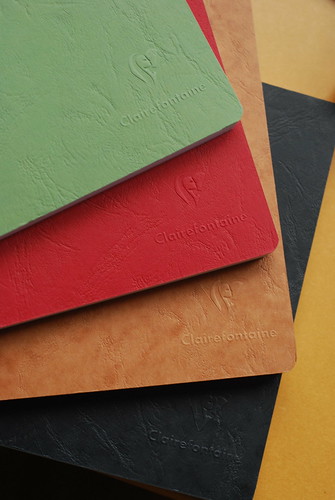
The Claire Fontaines.
The ever-present bundles of exquisite lined white that people infuriatingly insist on calling Journals or Diaries or Day Timers. Infuriatingly because, for some anal retentive reason, I believe branding them as such decreased their net worth—brands them as something much less than what they are. You label a thing with a loaded, clichéd word like that, and it becomes the label, losing all of its unique and inexplicable trappings. To call my books of writing "journals" or "diaries" is to render them less than what they are. It is to cheapen them in thought and risk that cheapening spreading to their bodies—to their physical stuff.
That’s a lot of English nerd talk for the idea that you can’t judge a book by its cover, I guess. I’ve always wanted these books to be something more than journals or diaries, just as I’ve wanted this place to be something more than a blog.
So though I might not have a concrete term for what these books are, I know what they were born of. Their ancestors started as Travel Writing, back in OAC (2001) when we went to Greece on a school trip and I needed a Writer’s Craft Independent Study Project. I took a random black notebook and a random black pen, and I held myself to writing in the notebook every day. People asked if it was a diary or a journal, but even then, roughly a decade ago, I aspired for it to be more than a day-to-day account of the quotidian. I tried to use the days events only as starting points for tangents of thought, grounding myself in the real and here and now only when it’d been a proper adventure. I called it Classical Studies.
It was the first, but when I went to Norway (and Sweden and Amsterdam and Denmark) with Amanda in 2004, I took a random red notebook and a blue pen with me. Though I didn’t keep to the same regimented schedule, I made sure to write as we traveled. I called it Viking Ghosts.
Then I did it again on the trip to Estonia, Finland, Germany, and Sweden with my mother in 2006: this time with a leather-sleeved, Estonian-designed, spiral-bound notebook number and the too-fancy pen mom had bought me for grad. I called it Baltic Son.
In 2007, when MHS sent me to the UK for the ICEI Conference we were hosting, and I took advantage to spin the free ticket out, for good or ill, into an English adventure, I took a blue notebook like the Norway one and a blue pen. I called it A Bit of Stuff.
Hell, when I headed out to BC in July of 2009, even then I had an insignificant—as of yet, unnamed—notebook with me, and I used it to note the thoughts and stories that all that ocean and trees and mountains bred in me.
It became like clockwork. Sure, I kept notebooks, and I wrote when I was kicking around Toronto. Sure, I had ideas. However, something about them was different: the consistency…the flow. I guess nothing inspires more uniquely than the unknown.
So that’s where they came from—their lineage, I guess. But what are they?
They are a record.
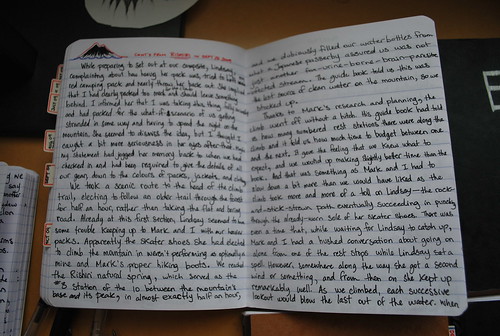
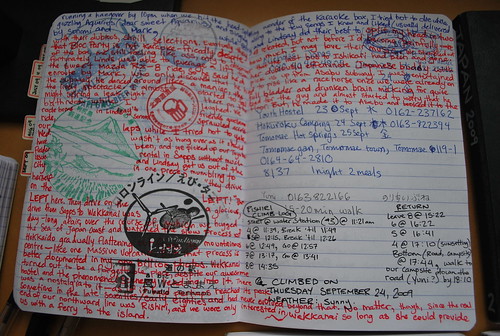
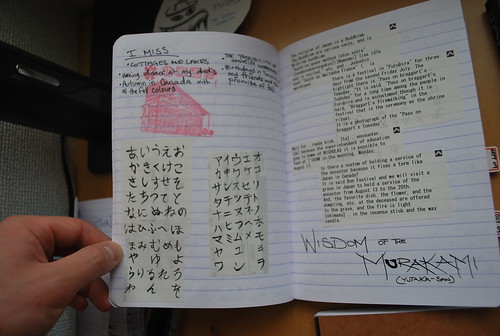
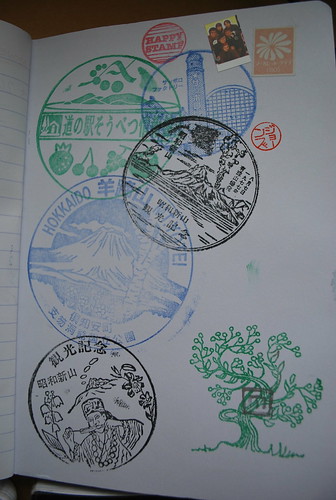
A record that I try to make as multi-faceted as possible by pasting in pieces of this or that, adding random pictures people print for me, scribbling stray thoughts and big ideas, noting banalities like (failed) budgets and useful Japanese words. I hold to dating most of the entries, and I hold to only using a particular kind of notebook (frustratingly, Made in France) and a very particular kind of pen (fortunately, Made in Japan), but other than that it’s no-holds-barred. A lot of the things that wind up posted here start as scribbles in there. They are blood samples or cores of wild and unknown trees. They are man made things that have been submerged in a flow of thoughts and experiences, and when they’re brought back up out of that flow you can see where bits of it have latched onto them—have become pressed between their pages or caught up in their spines or blotted into their paper.
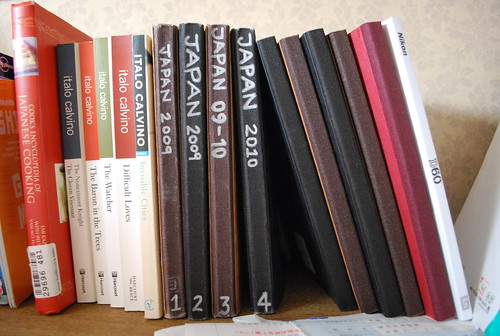
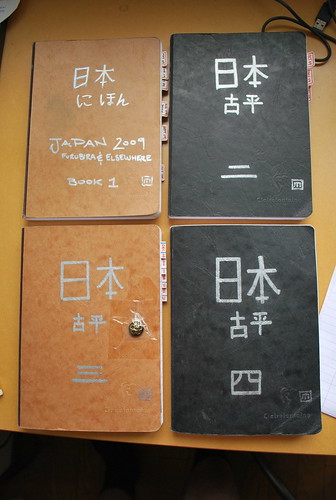
As for the books I’ve brought to Japan, specifically, they are still a work in progress. I’ve never held this travel writing regimen for this long before (as this is the longest I’ve ever been away from home). There are, of course, questions of whether this is still travel writing at all, if I might not be considered settled here and if some of the wonder might have gone out of the pages over the months. Regardless, I’m sticking to it, and I’ve filled four of them since I was accepted to JET and started attending pre-departure sessions last May. They still don’t have a name, but ideas like “Hokkaido Nights” or “I Was Promised Robots” have bubbled up from time to time. Some day I’ll do a better job of documenting them photographically, but they’re there if you want to see them, and here are some photos if you’re not kicking around Japan.
WARNING: this is another one of those glimpses into the literature I get into over here in Japan. It's got nothing to do with Japan other than the fact that I'm using some of my time over here to get caught up on reading. Highest on the catch-up list is Italo Calvino, who I've mentioned before and who is, likely, my favourite author (don't tell that Neil guy). People say he's a modern fabulist. I've likened his lucid style to a literary incarnation of intercourse. I guess this is a literary response to his t zero, and if you're interested it might give you a look at what he's all about. That being said, if you think you might be interested in him, best to start with Marcovaldo or Invisible Citiesas t zero is still a rather dense read.
From the sometimes indecipherable word stew of Calvino, a realization takes form. In the midst of the story I was about ready to abandon due to the sheer density of verbiage and thought, the long meandering streams of Calvino logic begin to crystallize and slot themselves in along one another like Tetris blocks. And, all of a sudden, “t zero” is the literary synthesis of time travel, just like that one scene in the sandstorm in Coelho’s Alchemist is the literary synthesis of magic. The words align so perfectly to express such a very abstract and, seemingly, insurmountable subject.
As my eyes grow wide and the corners of my mouth pull back in that which is none other than amazement, I read the words on the page, and like they did with Coelho, they seem like a spell: an incantation. The suspension of disbelief goes out of my mind as I sense it is no longer required due to the utter clarity of the prose. Calvino in “t zero” details moving forward or backward a second in time, and each second stands like a finite demarcation on the Z-axis of a time-space graph. It is like four dimensions are existing sustainably in my mind: forward and backward on the Z-axis is forward or backward in time, and the thin plane of X and Y actually contains the three-dimensional span of a universe. The narrator in the story talks of how he wants to move forward or backwards on this Z/time axis to get a perspective from outside of the co-ordinate t0 (or Z0, I suppose) where he resides. I picture him rising above or sinking below the seemingly two-dimensional plane of the milky way to gaze down upon or up at the physical location of all points within it at that moment of Z/t0 from a position in the future or in the past.
It is the clarity, though; the unerring logic of the paragraph that seems to make all things possible. Just as I thought that magic could exist as a rational force when reading that particular passage in the Alchemist, so, too, do I now think that time travel is as easy and as comprehensible as a shift forward or backward on an axis when I read Calvino’s “t zero.” It is this clean, clear, world-skewing logic of Calvino’s that always sets my mind alight when I read his work. He steps outside the X-Y three-dimensional plane that we all inhabit, and he looks down upon it from point W to cast our everyday in new perspectives.
Normal things, seen from obtuse angles.
That is Calvino, for me.
If you can get past his vocabulary, once you boil down Calvino’s prose, it is simple. It’s almost plain, really. If you can follow him to his point W, and you can look down upon our XandY from his perspective, it knocks your mind on its ear, broadening horizons in a world where there no longer seemed to be any space for it.
Preface: This one's a little wordy, but the first half is definitely digestible as a kind of book review. The latter part is more of a contemplation/rant on said book. It touches on some stuff that you might find interesting, but if you're looking for crap on Japan, you're, sadly, not going to find it in this post. Try clicking down to that "Go to Hell" post. It had more Japan in it ;)
That being said, if you stick with this one, and it moves you, please let me know as you'll be my hero.
I thought I’d note that 09-09-09 is just wrapping up in my part of the world right now, which means it’s just starting in yours. If you’re feeling pagan, you might want to throw back a few glasses of mead in honour of his royal norse highness Odin, the all-father (he liked nines). Also, what follows is the story of a real-world sacrifice.
Sorry. That’s the half-assed pagan in me poking out. One of the reasons I have a mild interest in the Japanese Shinto belief system is that some of the only religious ideologies that have ever made sense to me have been the ones that centered on worshiping nature. Venerating and paying tithe to the one thing that can be empirically shown to have given us life—the one thing that sustains us on a daily basis—is something I can believe in. Nature is also one of the sources of wonder that we can rely on to provide miracles on a regular basis. You can study the science of how a Douglas Fir—a tree that can grow to heights of beyond 100 meters—can manage to grow out of something as small as a seed on air, water, and sunlight alone, but the science of it can’t fully explain away the wonder required.
Sorry, once again. I half lifted that last bit from the latest book I finished reading. Though it has little to do with Japan, it’s underlying message aligns fairly well with the Shinto belief that there are spirits present in the land.
The book, published in 2005, was The Golden Spruce by Canadian author John Vaillant, a book that won the Governor General’s Nonfiction prize in 2005. I was put on to the book by Amy, my token Parks/Trees-and-rocks-and-shtuff friend, and she was put on to the book by a field course that she took in Haida Gwaii (once known as the Queen Charlotte Islands) last May. The book was required reading for the course, and, having now read the book, I can understand why. Golden Spruce aims to tell the history of resource exploitation in the Pacific North West (B.C. and Alaska) by arranging the story around a very real and very destructive act of protest that transpired on Haida Gwaii in 1997.
On January 27, 1997, a man named Grant Hadwin who was no stranger to the logging industry took a chainsaw to a unique Sitka spruce tree that was hundreds of years old and roughly 50 meters tall. It was known to local anglo residents of New Masset as “The Golden Spruce” and was a popular tourist attraction of their remote town. It was know to the Haida People of Old Masset as Kiidk’yaas and was a central element in their cultural mythos. And, in the eyes of Grant Hadwin, it was known to Macmillan Blodel, the logging firm who had bought rights to the majority of the timber on Haida Gwaii, as their pet tree and was a shinning gold medal of conservation behind which they could hide their destructive logging practices.
Around the central characters of the Golden Spruce and Grant Hadwin, author John Vaillant is able to weave a complex and informative narrative that is at once a biography of Hadwin, a snapshot of the cultural traditions of the Haida people, an ecological profile of the rainforests of the pacific northwest, a history of northwest logging, and a sobering view of the practices—and abuses—of the modern day logging industry. All of that mixed into one book seems like the perfect recipe for a dry, snore of a narrative, but Vaillant somehow manages to use Grant Hadwin’s story to pace all the facts that he imparts and to lend a sense of crisis—if not out-and-out suspense—to the narrative. By the end of the book, I felt both moved and informed by it. Vaillant had told this expansive, at times rambling, narrative, and in so doing he convinced me to rethink the way I use wood and paper products while also convincing me that I absolutely had to visit Haida Gwaii.
He also convinced me—unintentionally, I’m sure—that Grant Hadwin might have been right. But that’s something for the ramble below. For those of you not interested in the contemplation/rant, I’ll distill The Golden Spruce for you here:
If you love nature and want to believe in wonder, read The Golden Spruce.
If you’re ever been moved by something as simple as a forest or a tree, read The Golden Spruce.
If you’ve ever visited the temperate rainforests of British Columbia and been worried about the prospect of losing them, read The Golden Spruce.
If you’ve ever worried about the rights and legacy of the North American First Nations, read The Golden Spruce.
What was interesting, for me, about Grant Hadwin’s seemingly mad decision to cut down the Golden Spruce is that, from some perspectives, it makes sense. But, if I were to admit that I could agree with what Hadwin did, I would be in the minority. When I finished reading The Golden Spruce and googled “Grant Hadwin” to try to find some other photos of/interviews with the guy, all I could find were angry, opinionated articles about how heinous and dastardly a villain he was for cutting down a beautiful, old growth tree. But none of these articles/posts/blog entries mentioned anything about the thousands of people working in logging in the Pacific Northwest who cut down beautiful, old growth trees on the daily as part of their jobs. These angry posts talked about the salience of the Golden Spruce to the Haida cultural heritage, and they mentioned nothing of the importance of the forests of Haida Gwaii to that same heritage, forests that were appropriated from The People by the Canadian government and sold off to International Lumber. Everyone seemed happy to rally around those calling for Hadwin to be strung up for his crime, but no one seemed to be giving any thought to the message he was trying to communicate.
In the book, John Vaillant dredges up a curious historical factoid, mentioning how as the warriors of the Christian faith conquered Europe they would set fire to the sacred groves and forests where the indigenous peoples (many of them our own Germanic/Norman/Celtic ancestors) practiced their pre-Christian religions. He mentions in other places how it was common for these people to attribute particularly large trees to gods, and he even found a reference to a particular, symbolically grotesque means of disembowelment as the punishment for one who was so crude as to commit the crime of removing the bark of a living tree. These historical factoids, and many more like them referenced in the book, point to the fact that our ancestors once saw nature as holy and the forests as sacred.
But we’ve moved away from that now—we, the enlightened, who worship distant, faceless deities who we have created in our own image. And we worship them in buildings of wood and stone that we have hewn and remade to better serve our purpose. We’ve forgotten that the forests were once holy and that the largest of the trees were once our gods.
This could well have been this was the mysterious “great revelation” that Hadwin experienced (but the details of which he never imparted to another living soul) that set him on the path to the Golden Spruce—this sudden revelation that had been brewing in his subconscious as he worked in the logging industry for most of his life.
Maybe Grant Hadwin thought that this was the only way to make people realize the importance of the forests and the severity of the crimes against them. He elected to slay the most well known and most treasured of the old growth trees on Haida Gwaii to make people realize the wholesale slaughter that was going on, unseen, in old growth forests across British Columbia. In effect, he chose to kill Jesus to make the people realize that all of the other gods were already dead. He saw that our sacred groves had been gutted, and the only way people might start to realize it would be to see that destruction wrought on the only tree they seemed to care about.
As Vaillant reveals through scientific facts in the text, and as Grant Hadwin stated in his all-call fax after he made his attack on the Golden Spruce: the tree was a mutant. Where it was meant to have green needles, it grew yellow needles. This fact earned the tree its name, and it appears to be this fact that spared the tree (as well as some of the forest around it by proximity) from the MacMillan Blodel’s logging operations on Haida Gwaii. Hadwin refered to the tree as a circus freak, which seems apt as this mutant tree was spared while MacBlo was felling trees just as old, just as large, and just as majestic (if not older, larger, and more majestic) elsewhere on the islands. To keep this one tree standing in a token patch of spared forest while these other trees are cut down and sacked is somewhat akin to “preserving” a few token members of a certain species in a zoo while butchering and consuming the rest of their population. What Grant Hadwin’s attack on the Golden Spruce boiled down to was a question of “Why this tree? Why now?”
So that’s where I can agree with what Hadwin did. He staged a violent attack on a tree to prove a point, and it was shocking to all who had invested themselves in the life of that tree, but, in the end, people sat up and paid attention precisely because the tree meant so much to them.
And he was right.
Why this tree? Why does this one get to live while all the others just like it have to die? Because it is recognizable due to its mutation? Because we can’t see the forest: just the trees? Maybe the loss of this mutant could finally convince those who had invested themselves in the tree—maybe it would serve to give them a local frame of reference for the horrors that logging visited on their province regularly and had been doing for some time.
Where it gets a little harder to agree with Hadwin—and an area that I’d pretty much avoided thus far in all of this—is when you take into account the interests of the Haida People in the Golden Spruce. The Haida were the first inhabitants of Haida Gwaii and made the islands their home centuries before the first loggers or Anglo settlers ever arrived. The Golden Spruce had been woven into their myths and beliefs for generations. It was not a tree to them; it was the spirit of an ancestor who had taken the form of a tree. In a way, it was more alive to them than a typical tree is to us, and some believed that when it fell it would signal the end of the Haida nation. One could try to use the same arguments when contemplating the Haida’s investment in the tree: that they only developed their myths because the tree’s unique colouring made it stand out. One could try to rationalize the attack on the Golden Spruce as a wake up call for the Haida, hoping that it would galvanize them, the only people who had any real claim to the land of Haida Gwaii, and inspire them to be more protective of their island ecosystem.
In short, one could try to implicate the Haida as passive participants in all of this madness and try to suggest that the felling of the Golden Spruce was just a shot across the bow to rouse them to action, but it seems wrong. When Vaillant tells of the former height of Haida civilization before smallpox cut a swathe through their villages, when he paints the picture of the clear cutting that took place across the breadth of northern Haida Gwaii, it becomes clear just how much the Haida have lost already. It makes it hard to try to paint the loss of the Golden Spruce—a part of their myth and their culture—as a learning opportunity. Even Hadwin admitted when he was contacted directly by Guujaaw, the President of the Council of the Haida Nation, that if he had known of the Haida legend about the Golden Spruce, he may have thought twice about attacking it.
So, yeah, with the exception of the attack on the Haida people, I can understand what Grant Hadwin did when he cut down the Golden Spruce, and I can almost agree with it. This act of destruction has convinced me that I should look into joining Greenpeace—that when I get to a place where I’m thinking of buying a house, I should consider alternate building materials like bamboo and straw bale. I'll tell anyone who asks that my aforementioned half-assed paganness tends to manifest in a veneration for trees, and, looking at what Hadwin did, I think it takes some pretty big love for trees to have the stones to cut a big, beautiful one down to save the rest. It's the kind of statement/act of protest that I kind of wish I had the stones to do myself. And I hope, even if I do so in vain, that there comes a time when people can look at Grant Hadwin's attack on the Golden Spruce for what it was:
An Alarm Call.
A Necessary Sacrifice.
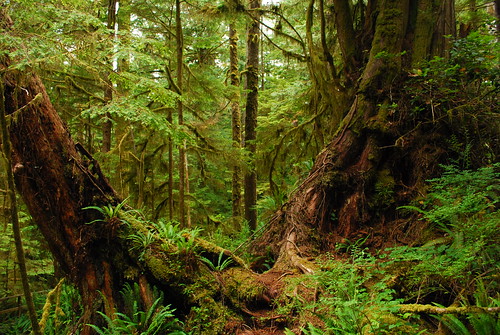
Not the Golden Spruce, but another Pacific Northwest reason to care about trees from Pacific Rim National Park.
Edit: Here's some supplementary video about the Golden Spruce from CBC's Six String Nation documentary:
Turns out that when you’re heading somewhere for a year, everyone and their brother wants to recommend books for, about, from, and only loosely inspired by that place. Such was the case with Japan, and I have been hard pressed to stay on top of the flood of book titles that have been thrown at me over the last few months.
Luckily, one of the recommendations stuck out. The book was Hitching Rides with Buddha, and it was recommended by the president of the company I used to work for. When I looked into the book, I discovered that it had been written by Canadian humourist Will Ferguson, who had traveled to Japan to teach English in his youth. Will used his hitchhiking trek from the southern Cape of Sata to the Cape of Sooya at the far northern tip of Hokkaido as a framing device for the book. Under the guise of chronicling his pursuit of the Sakura Zensen (Cherry Blossom Front) as the trees flowered from south to north, he presents a good humoured portrait of Japanese culture.
That being said, this isn’t meant to be a book review. I’m only about 50 pages in thus far, but Will just blew me away with his explanation/depiction of the indigenous Japanese Shinto religion, so I thought I’d share an excerpt from the book for anyone who has ever wondered about Shinto. Will’s description may just have nailed me because I tend to go in for that kind of world-worship, nature-hippy, odenic-pagan stuff, but I think there’s something pure and organic about the animate nature of Shinto beliefs that will appeal to people tired of theistic belief systems.
The following italicized passages are in no part my own and belong entirely to Will Ferguson, his publisher, blah blah blah etc. If you think you like his writing, well then help a Canadian brother out, and buy his book.
Of Shinto
…As a faith, it grew from the natural awe, the fear and trembling, that humans have for the world around them: the fertility of womb and earth, the natural forces and the mysteries of life.
In Japan, the world is filled with primordial spirits. The kami are everywhere. The unseen world is pregnant with them, rich in life and charged with energy. Historical figures have been elevated to kami, and so have abstract nouns and animals.
Deeper still, Shinto is about being Japanese. One is not converted to Shinto. One is born into it. One simply is Shinto in the same way that one simply is—or isn’t—Japanese. The idea of Shinto proselytizing is absurd. During World War II, the Japanese Empire built massive Shinto shrines in the countries it occupied: Singapore, Korea, Taiwan. But, removed from its Japanese soil, Shinto withers and dies. It is perhaps the only religion in the world that failed to convert the people it conquered.
Although it was used as a propaganda tool during World War II, and still contains heavy imperial connections, Shinto has largely returned to the more earthly, joyous roots from which it sprang. Shinto celebrates life. It is optimistic. Buddhism [the other widespread religion in Japan], in contrast, is gloomy. Shinto is for weddings; Buddhism is for funerals. Buddhist festivals are somber. Shinto festivals are freewheeling, drunken affairs, intent on entertaining the gods. Buddhism worries about the afterlife. Shinto is concerned with the everyday and the here-and-now.
Now that’s a religion I can get behind. “…It grew from the natural awe, the fear and trembling, that humans have for the world around them” sounds just about perfect.