Friday, July 23, 2010

The Return

I wrote this on Tuesday July 13th, but timing is complicated in the blogosphere—particularly when it's rocking back and forth between Eastern Standard and Japan Mystery Time. It's mostly about going home...or maybe it's about staying here.

On the bus from Haneda to Narita on my long way home to Canada, I sit behind a group of what must be high school students from the States. Their chaperone is asking them in a southern drawl about what they intend to eat when they get back home—their Welcome Return after all of this Japanese fare.

I think about my planned trip to Golden Star up at Yonge and Steeles with my former MHS colleagues when I get back to Toronto. I think of piping up, uninvited, to contribute “CHEESEBURGER!” and “MILKSHAKE!” to the conversation.

However, they move on to talking about how they'll be relieved not to have to eat with chopsticks anymore, and I recall how I’ve been telling the Japanese that I’m going to start calling them “Hashi” in English as chopstick is such a hideous word for such a graceful implement: one that makes food taste so much better by forcing you to savour it. I think about how I’d very much like to go on using Hashi to eat with long after I leave this place.

And it’s just one more piece of a growing realization: that it’s a damn good thing I recontracted for another year of JET because I’m certainly not ready to go home yet—not permanently, at least. I’m not ready to give up being surrounded by the constant hushed puzzle of Japanese conversation for the loud clarity of English. I’m not ready to give up the joy and wonder of my students, who I’m already starting to miss.

In the end, I wind up moving to the back of the bus, away from the unabashed, booming Americans and into a cloud of whispered Japanese.

Thursday, July 22, 2010

Modern Myths: Genkan

An ant scuttles across the rounded river stones set in the concrete floor of the elementary genkan (entrance way). The movement catches the corner of my eye, and for a moment I move to act.

But I hesitate.

I think of the magic of the genkan—an unquestionable threshold in Japanese society between soto and naka—out and in. The Japanese remove their outdoor shoes in the genkan and step up into their houses and schools in stocking feet. Often they’ll pull on indoor shoes or slippers, but in that instant before they do, they pay tribute to the separating enchantment that exists in the genkan: the one that reinforces the boundary between soto and naka. By observing the in/out binary of this place, they give it power over them—they invest it with the alchemical energy of belief.

Each belief act is simple, small; and the transference of energy is just as miniscule. However, over years and years it can build, and so does it do in the elementary school’s genkan—so has it been doing for more than a hundred and thirty years in this building’s various incarnations. It will continue to do so, simply, until a day comes when it is needed, and then the energy will act just as simply: like key magnetism or sympathetic gravity.

A man will come to harm the children. He will refuse to remove his shoes before stepping up into the school, and when he does so, the genkan will deny him entry. The polar ice caps will melt, and the Sea of Japan to the north will rise. However, its waters will only ever lap at those rounded river stones in the concrete floor, never to cross the low threshold up into the school.

Just as it was believed, that the genkan separates the out and the in, so shall it be as the simple magic vested in the genkan holds back the outside.

It is for this reason that I cannot follow through on my instinct to kill the ant. As he crawls among those enchanted river rocks, he is still without—just where he should be—despite being, bodily, within the doors of the elementary. Should I kill him while without, imposing the clean, organized dominion of within upon him in the genkan, I risk robbing the genkan of some of its magic. To do so would be to risk imbalancing that delicate, sympathetic formula with this one act.

Thursday, July 15, 2010

Pages 101


I did a “Yay! One year of BLOG!” thing a few weeks back, and it vaguely dealt with necessaries of what’s gone on in the last year. This is the “Yay! 101st post!” thing, and I feel like I’ve been planning this thing for longer, and it might be a little more the kind of stuff I like to write about than the last one. Here’s hoping it’s the kind of stuff you’d want to read about…

In the One Year of BLOG thing, I commemorated the birthday of this blog, but this blog started as a necessary evil for me—something I had a love-hate relationship with—and I gradually grew into it. I realized that I could channel some of my loathing for “guess what I ate for dinner today!” banal blogging into a motivation to do better. Yes, I’ve been guilty of banality (see: “BTW: Pocky, banana, and milk is AWESOME”), but I like to think that I’ve been guilty of more beauty. I try to put a lot into this thing, and I try to write things that are a little more interesting: things I would like to read.

But anyway. The Blog isn’t where it all started. The blog only served as a channel for the outcomes of the real inception:

My notebooks.

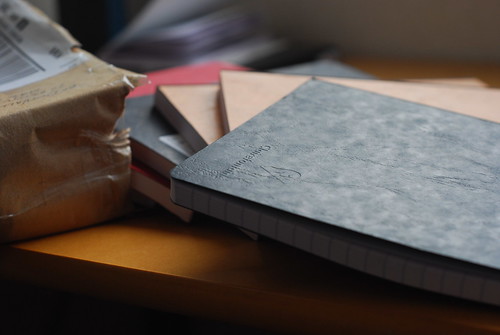
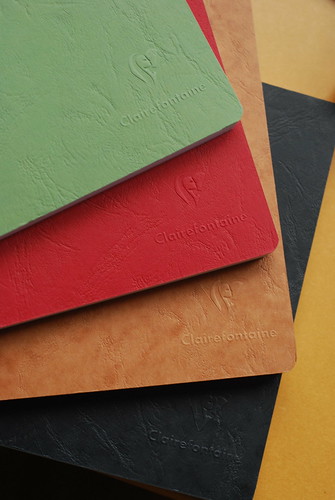
The Claire Fontaines.

The ever-present bundles of exquisite lined white that people infuriatingly insist on calling Journals or Diaries or Day Timers. Infuriatingly because, for some anal retentive reason, I believe branding them as such decreased their net worth—brands them as something much less than what they are. You label a thing with a loaded, clichéd word like that, and it becomes the label, losing all of its unique and inexplicable trappings. To call my books of writing "journals" or "diaries" is to render them less than what they are. It is to cheapen them in thought and risk that cheapening spreading to their bodies—to their physical stuff.

That’s a lot of English nerd talk for the idea that you can’t judge a book by its cover, I guess. I’ve always wanted these books to be something more than journals or diaries, just as I’ve wanted this place to be something more than a blog.

So though I might not have a concrete term for what these books are, I know what they were born of. Their ancestors started as Travel Writing, back in OAC (2001) when we went to Greece on a school trip and I needed a Writer’s Craft Independent Study Project. I took a random black notebook and a random black pen, and I held myself to writing in the notebook every day. People asked if it was a diary or a journal, but even then, roughly a decade ago, I aspired for it to be more than a day-to-day account of the quotidian. I tried to use the days events only as starting points for tangents of thought, grounding myself in the real and here and now only when it’d been a proper adventure. I called it Classical Studies.

It was the first, but when I went to Norway (and Sweden and Amsterdam and Denmark) with Amanda in 2004, I took a random red notebook and a blue pen with me. Though I didn’t keep to the same regimented schedule, I made sure to write as we traveled. I called it Viking Ghosts.

Then I did it again on the trip to Estonia, Finland, Germany, and Sweden with my mother in 2006: this time with a leather-sleeved, Estonian-designed, spiral-bound notebook number and the too-fancy pen mom had bought me for grad. I called it Baltic Son.

In 2007, when MHS sent me to the UK for the ICEI Conference we were hosting, and I took advantage to spin the free ticket out, for good or ill, into an English adventure, I took a blue notebook like the Norway one and a blue pen. I called it A Bit of Stuff.

Hell, when I headed out to BC in July of 2009, even then I had an insignificant—as of yet, unnamed—notebook with me, and I used it to note the thoughts and stories that all that ocean and trees and mountains bred in me.

It became like clockwork. Sure, I kept notebooks, and I wrote when I was kicking around Toronto. Sure, I had ideas. However, something about them was different: the consistency…the flow. I guess nothing inspires more uniquely than the unknown.

So that’s where they came from—their lineage, I guess. But what are they?

They are a record.

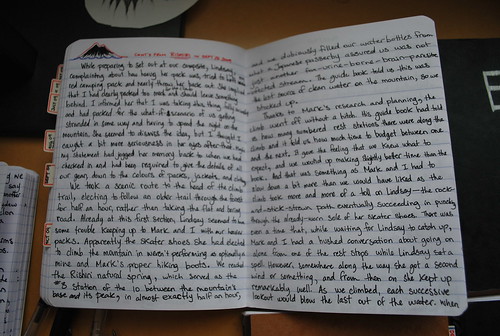
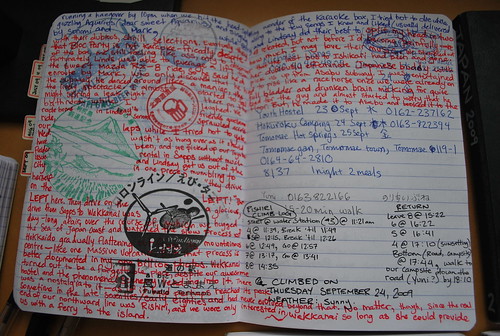
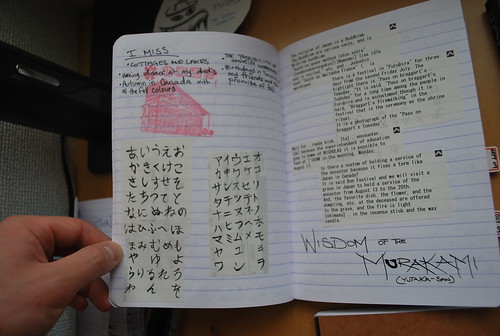
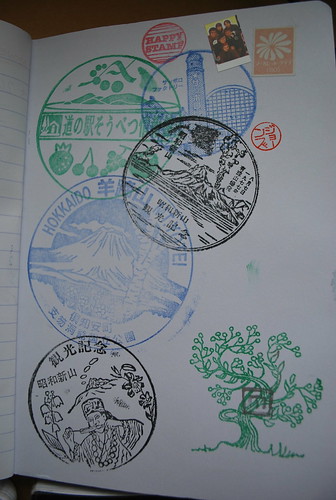
A record that I try to make as multi-faceted as possible by pasting in pieces of this or that, adding random pictures people print for me, scribbling stray thoughts and big ideas, noting banalities like (failed) budgets and useful Japanese words. I hold to dating most of the entries, and I hold to only using a particular kind of notebook (frustratingly, Made in France) and a very particular kind of pen (fortunately, Made in Japan), but other than that it’s no-holds-barred. A lot of the things that wind up posted here start as scribbles in there. They are blood samples or cores of wild and unknown trees. They are man made things that have been submerged in a flow of thoughts and experiences, and when they’re brought back up out of that flow you can see where bits of it have latched onto them—have become pressed between their pages or caught up in their spines or blotted into their paper.

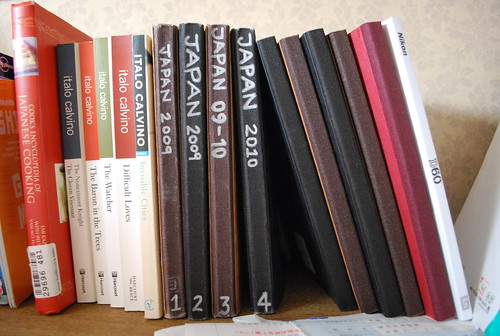
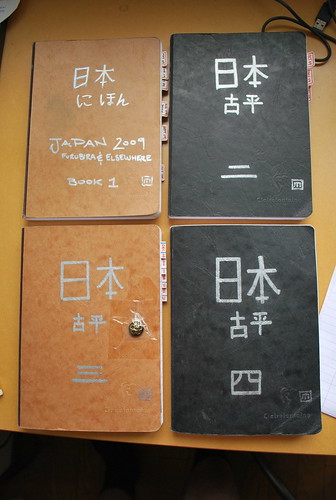
As for the books I’ve brought to Japan, specifically, they are still a work in progress. I’ve never held this travel writing regimen for this long before (as this is the longest I’ve ever been away from home). There are, of course, questions of whether this is still travel writing at all, if I might not be considered settled here and if some of the wonder might have gone out of the pages over the months. Regardless, I’m sticking to it, and I’ve filled four of them since I was accepted to JET and started attending pre-departure sessions last May. They still don’t have a name, but ideas like “Hokkaido Nights” or “I Was Promised Robots” have bubbled up from time to time. Some day I’ll do a better job of documenting them photographically, but they’re there if you want to see them, and here are some photos if you’re not kicking around Japan.

Wednesday, July 14, 2010

100: Gaijin no longer

Here's it is: Post 100, and in a weird turn it sees me back in Canada: having returned for Amanda's wedding this Saturday on Gabriola island. Right now, Amy is putting me up in her apartment on The Drive for a couple of days ahead of the wedding. It is the start of the Repatriation Tour!

The return was a surreal thing of time travel. I spent Tuesday July 13th in Japan traveling, with trains from Maggie's apartment in The Gash to Sapporo New Chitose Airport, and planes from Chitose to Haneda with me sitting in ridiculous business class, and buses form Haneda to Narita in grey, humid-enough-for-gills Tokyo with me begrudging the Americans in front of me who were happy to be getting the hell out of Japan, flight delays and then eventually planes from Narita to Vancouver, leaving at 19:30. I arrived in Vancouver just after 1pm, and I spent Tuesday July 13th in Canada touring around sunny, perfectly warm Vancouver with Amy, taking in Granville Island, fish and chips, Pimm's, beer, and the Vancouver Seawall, which we walked late into the night as, due to the wonders of non-Japanese time zones, the sun doesn't set here until about 21:30.

Bloody glorious.

Thursday, July 08, 2010

Crazy Hair

All credit for the following goes to Our Man Neil, and a far more beautifully illustrated version of this poem can be found Here.

This is Bonnie, this is me
I'm eleven, Bonnie's three
She says, I don't mean to stare
Mister, you've got crazy hair

Crazy hair? oh me oh my
Crazy hair, I thought I'd die
I said, miss, how do you dare
Talk about my crazy hair?

This hair you know is all my own
Since I was two my hair has grown
Birds fly down from everywhere
Nesting in my crazy hair

Butterflies and cockatoos
Reds and yellows, greens and blues
Make me look beyond compare
Walking with my crazy hair

In my hair gorillas leap
Tigers stalk and ground-sloths sleep
Prides of lions make their lair
Somewhere, in my crazy hair

Hunters send in expeditions
Radio back their positions
Still we've lost a dozen there
Lost inside my crazy hair

You hear music? Dancers too?
I can hear them, well can you
They play tunes beyond compare
Dancing through my crazy hair

Huge balloons come down to land
People wave, it's very grand
They take off from everywhere
Drift across my crazy hair

There are pools and water slides
Carousels and pony rides
All the fun of any fair
Waits inside my crazy hair

Twisting, tangling, trails and loops
Treasure chests and pirates' loots
These await the ones who dare
Navigate my crazy hair

Here's my comb, young Bonnie said
Run it now across your head
That's what I do with great care
When I have such crazy hair

Child, are you mad?! I cried
Combs and brushes have been tried!
One was eaten by a bear
Prowling through my crazy hair

Bonnie said, you bend down here
I will comb it, is that clear?
I said, miss, just be aware
This is really crazy hair

I bent down and Bonnie swiped
combed and curried, rubbed and wiped
Now, she said, you look-
But there came a rumbling from my hair

One huge growling head peered out
Said, what is this all about?
One huge arm reached out of there
Pulled her in my crazy hair

Bonnie has the finest time
Teaching lions how to rhyme
Riding slides and great balloons
Finding hunters, losing moons

Playing with the pretty birds
Teaching parrots naughty words
Sewing up the pirates' vests
Digging buried treasure chests

Hibernating with the bear
Dancing with the dancers there
Happy as a millionaire
Safe inside my crazy hair


Video of Neil reading Crazy Hair.

Friday, July 02, 2010

Happy Japanada Day

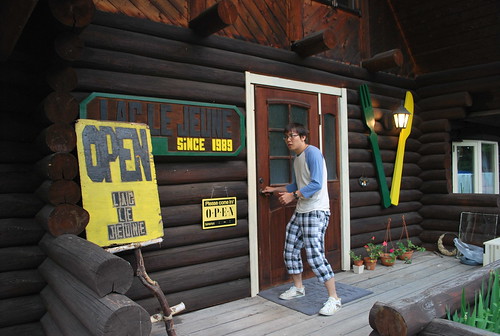
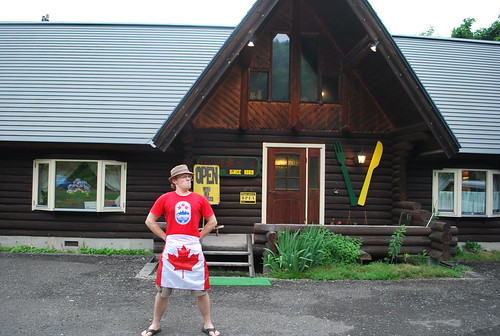
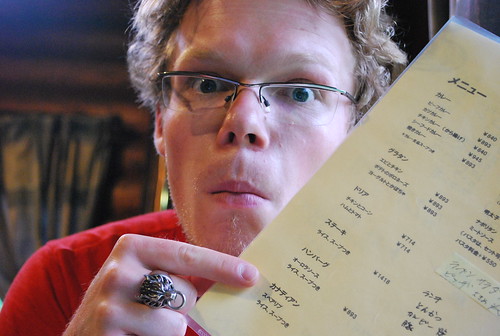
Inexplicably, Perry found us a Canadian cafe in his town, in the heart of Inaka Japan. In Perry's town--2000 fruit-growing souls spread along 8 kilometers of highway, inland from the slightly more densely populated coast--Perry found a log cabin called "Lac De Jeune" that serves steak and apple pie dinners, with a Canadian section on the menu and a Canadian flag hanging inside.

It was ridiculous.

And, of course, when we asked the proprietor about the Canadian connection and told her that today was Canada Day and we were Canadians, she looked at us like we had three heads.

Apparently Canadian food is comprised of spare ribs and nothing else.

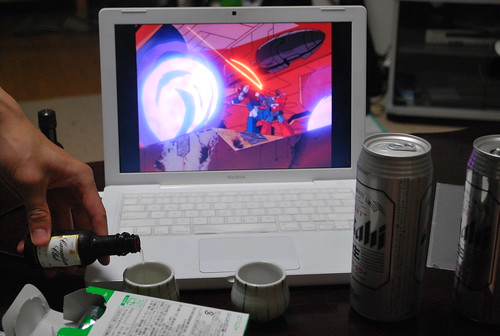
After dinner in Niki, we headed back to my place in Furubira and observed Japanada Day in true Japanada Day fashion, by drinking Canadian Club and beer, and taking in Transformers.

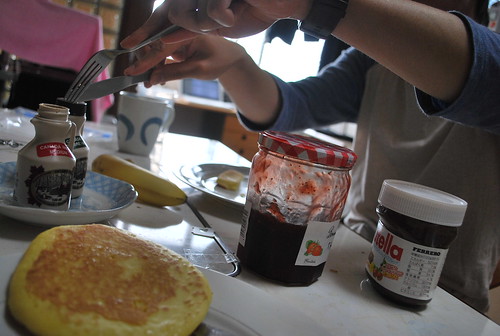
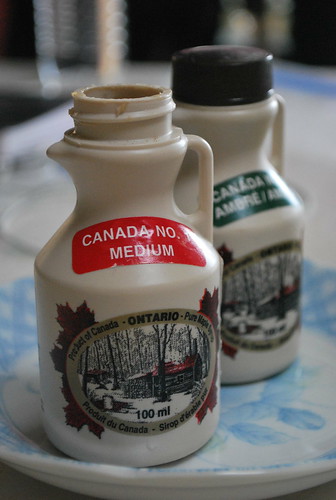
Also, pancakes and Maple Syrup--real Canadian Amy Thede Maple Syrup.

Thursday, July 01, 2010

Oh Canada

As I prepare to celebrate my first Japanada Day with my Canadian pal Perry from a couple of towns over, I started the day with the following kicking tune from MSTRKRFT (or Mastercraft, if you like vowels, or Death From Above 1979, if you like history), an outfit out of Toronto and some good Canadian theme music to get you going on a Canada Day (also, the video is rad).

Heartbreaker by MSTRKRFT (featuring John Legend)


Sure, John Legend's a Yank, but I'll allow it. As Perry and I quest for what little Canadian content there is in Hokkaido fishing towns tonight, the following will be beating in the back of my mind.

"You're in my mind
You're in my heart
I wish I knew right from the start..."

And then tonight, after we've drunkenly taken in Transformers the Animated Movie and all of its 80s Rock singalong wonderfulness ("You've got the TOUCH!"), as is tradition on Japanada Day, I will lay my head down to rest with the following running through it from the fine boys of Said The Whale out in Vancouver...

"Fighting with the currents of the Georgia Strait
Fighting with the wind and the tidal wave
I lost my love that day..."

Curse of the Currents by Said The Whale


It should be noted that I have Mark Rostrup to thank for the musical portions of the above.

Sunday, June 27, 2010

Two Sundays: The Souls of Cities

or “Two Sundays: Sunday The Second

This should likely be retconned back to here to go with the other Sunday, and I'll do that eventually, but I figured I'd post it today as I likely won't be posting much while I'm off in Van, and some of the Torontonians might be interested. Also, it's not Japan-related, but it is meant to contrast with that other Sunday. Though I took my sweet ass time agonizing over this, all of these thoughts materialized concurrently with all of that sweetness from the Sunday spent camping.

In Canada, or Toronto, specifically, Sunday was spent in tense anticipation of the kind of madness that had gone down the day before under the cover of the G20 protest. The kind of stuff I came home to find out about my city couldn’t have been a starker contrast to the leisurely, amicable weekend I had just spent in Japan. Witnessing the coverage of everything that went down in Toronto, I find the whole thing depressing and perhaps even a little sickening. It’s been kind of haunting me since, like a nebulous storm cloud over my head, and the first time I tried to sort through what I was feeling and thinking was in an email to Saff.

Sorry, sir. Was away all weekend when all the G20 stuff/messages from you dropped. I looked at all your tweets and a bunch of the pictures you took, and it only served to depress me, so much so that I've been completely unmotivated to read any of your blog posts.

You see, I'm a pretty passionate guy, and I can set myself on fire when it comes to ideas or certain beliefs, but...I don't know. I can't get behind either side on this G20 thing. I'm angry with the security force for making my city something it's not, but I'm angry with that black block bullshit for doing the same. If it's true that the cops were baiting the black block to legitimize themselves, then I'm pissed at the black block for being stupid enough and juvenile enough to take the bait and revel in the opportunity for destruction. They ruined everything, and they single handedly damaged the image of all of the other peaceful, legitimate protestors. The conflict seekers and the drama queens baited the police and cast their shadow over all the people behind them with real things to protest about.

I think it comes down to the fact that these people described themselves as Anarchists, and I don't think I can ever get behind Anarchists. I don't care what end they're trying to justify with their means: in my eyes they are devoid of beliefs. Their only god is chaos: their only moral, destruction. Anarchy is a cop-out masquerading as beliefs. To have beliefs, you have to be accountable to something.

If you’ll permit me a tangent, it reminds me of a university course I took in the Rhetoric of Dissent. As a group project, we were asked to start our own resistance movement. There were anti-smoking groups and anti-cell-phone groups and anti-meat groups, but the one I’m remembering now was the “X” group. It was populated by the hipsters and the counter-culture kids in the class, and it was…well I don’t really know what it was. It was anti-anti, I guess, and thinking themselves clever the group did little in their presentation other than sit at the front of the class, doing little, delighting in how much more clever and ironic they were than all the rest of us with our predictable, so-very-yesterday causes. They were the black block of our class, and they were a cop-out. They took advantage of their freedom, and they worked towards nothing. They claimed the nothing to be their cause, to be their end goal, but all they succeeded in accomplishing was a void. They insulted everyone who had come to that class with a purpose, and they mocked the authority of our professor.

The black block anarchists are as unwelcome in my city as the riot cop darth vaders that clashed with them. The only way I can adequately express my distaste for both sides is by saying I want them both to not exist; I want them all teleported to Mars where they will never again trouble Toronto the Beautiful.

At the same time, I don't want to dwell on this. It has affected me more deeply and more inexplicably than I would have thought it had any right to. I'm not someone who comes to depression naturally, but this has depressed me. Even if the Toronto police/the security force were unconstitutional and truly cruel, and even if there is some way they can be held accountable for their actions, I don't care.

I don't give a flying fuck.

The damage has been done to the soul of a city, and to drag it out with investigations and finger pointing and attempts to justify the violence and the cruelty will do nothing to heal that bleeding gash in what our city is.

A lot of people fucked up in all of this, and the Free City, as you call it, was the only one that paid the price for those fuck ups. No matter what either side tries now, after the fact, to validate their actions, it will never make it up to the city.

The main point that came out of all this, though, for me was the idea of the Soul of the City. Maybe that can be the kind of thing worth posting up here; the kind of thing worth sustaining with the madness of Toronto as an illustration. The notion of the Soul of the City if something I’d touched on before, with dutiful thanks to Italo Calvino’s Invisible Cities (Read this book. Why haven’t you read this book yet?) and Neil Gaiman’s Worlds’ End.

If cities were to have souls, they’d likely be mostly people-based. There is the city’s architecture and its infrastructure and its ecology, but I’d like to think these constants compose a body, and it is the people who breathe the life into that body. That being said, without the body of architecture and infrastructure and ecology, those people would be other than what they are within the body of the city.

Just as the souls of cities can become hot, running fevers that infect their bodies, they can become protective. Even if they’re composed of thousands if not millions of individuals, the souls function as one. The many, fractured views of what the city should be that are held by those millions of individuals average out and harmonize into an overarching identity just below the surface of the city. Its soul lives in their beliefs, in their impressions of what the city is.

And when the city is threatened, this collected soul reacts.

In Berlin, Germany, a hundred or so German Nationalists (Neo Nazis) need a cordon of officers to protect their freedom of speech as a crowd of thousands of ordinary Berliners gathers around them to silence them. They are the soul of the city, demanding that the same mistakes should not be made again.

In Tallinn, during the Soviet occupation of Estonia, the Estonian people in the capital created their own, non-soviet radio station and would broadcast from the former legislature building. A group of hundreds of Russians, possibly organized by Soviet authorities arrived to ring the building, attempting to force their way through the gates to silence the Estonian voice within. The radio station sent out a call to the city, telling it that their freedom was under siege. And it was the soul of the city that responded. Thousands of Tallinn residents of Estonian descent peacefully descended on the legislature building, ringing in the Russian protestors with a force dozens deep. In the end, Estonian police had to escort the Russians away through the gathered mass.

In each case, the city defended itself through its latent soul: through the tiny magic that it holds in the minds of its residents—a guarding enchantment disguised as municipal patriotism and an investiture in the clear notion of “home.”

However, when a violent darkness descended on Toronto, and it needed its soul to protect it, that soul was drained away. The foolhardiness of the few was favoured over the averaged wisdom of the many. Ahead of the G20, great walls were erected through the heart of the city, obstructing its natural flows and pushing the residents that made up its soul out of the city’s heart. Soldiers were fashioned out of peace keepers: they were armed, they were encased in armour.

I think John Cruickshank, Publisher of the Toronto Star, said it best in his article immediately following the madness over the weekend in Toronto. I think it was the following statement from him that set me off down this contemplative path about cities and their souls. I think it was the following statement that was the only sanity I’d heard in all of this:

“The only force that can prevent vandalism and mayhem in a city is the presence of its population.”

The soul of the city responds.

When the city is in peril, its citizens move to protect it.

When the nihilistic black block infiltrated our city, we didn’t need riot cops: we needed civilians, living in the city and making it alive as they do every Saturday and Sunday. In the presence of civilians—in the presence of the soul of the city—violence and anarchy will not be tolerated.

And let it not be the case that people think the black block as the only threat to this city—the only force that the soul of the city would have rejected. Though the authorities would tell you that they emptied the core to protect the civilians, I don’t doubt that they made this decision to protect their force of Darth Vaders as well. Just as the Soul of the City would not have tolerated the black block, I very much believe that it would not have tolerated the gas-masked and plexiglassed black cops, either.

Gah. I’m not sure what this was meant to be, and I know it has little to do with Japan, but I’ve agonized over it for long enough, so here it is as it is. Here’s hoping something in it speaks to you, even if it isn’t as artfully wrought as it could have been.