Thursday, February 04, 2010

Test for Echo

I’ve been trying a lot of things over here in J-Pan, and getting into a lot of things I had absolutely no interest in before: things like biking and snowboarding and mountain climbing. These days I regularly get completely naked in front of good friends and complete strangers, sitting around in a tub with them and not giving it a second thought. That’s not the end of it, either. These initial forays have got me mulling over things like surfing and skydiving and white water rafting. It’s getting to the point where pretty much every time Mark asks me about trying something crazy, my default answer is “yeah! We should do that!”, and the truly crazy thing is I actually mean it.

Sometimes I wonder what it is that's driving me to try these new things in Hokkaido: to try to pick up these new hobbies or sports. Me, the guy who hadn't seriously ridden a bike in over ten years goes out and commits to a $700 road bike at the chilly end of October. And, before the snow flies, I ride that bike like the devil: deep into the Furubira valley and up the mountain towards Kamoenai. As evening temperatures dip, I'm layering long johns and tshirts and sweaters so that I can strike out at night, riding up the dark valley with only the full moon and my meager handle bar light to guide me. And it's cold and it's exhausting and it's beautiful.

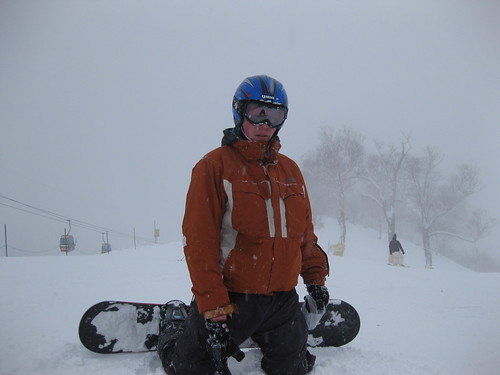
In January, as the snow was piling up, I finally followed up on my promise to myself to pick up snowboarding here in Hokkaido. With skiing as my only experience to go on, I asked Mark to book us in for three days on the hills of Niseko. I resigned myself to take lessons and learn from Mark and not leave that mountain until I could ride a board. It kicked the crap out of my body (so much so that I bowed out on the third day and returned my gear—so much so that I wound up having to take my first sick day at work to recover from the aches and the pains and the chills of two solid days of falling on my ass), but I loved it, and there were moments when I would shift smoothly from backside to frontside—heelside to toeside—in an action mere fractions from a loss of control, and in those moments I felt agency; and I felt unity with the mountain and the scene spreading out below in a way I don't think I'd ever done on skis. With two days on the board I already loved it more than I had my many years on two planks.

And now, in a fit of adventurous madness that is becoming all-to-familiar over here in Japan, I am buying snowboard jackets and boots and old boards with old bindings. I'm throwing myself into it with the same hope and hair's breadth of control that I throw myself into my turns.

But what is it?

The adventurous madness?

Where does it come from? Why does it grip me here? What feeds it?


The unimaginative might brand it a "quarter life crisis," but I would tell you that attaching such a cliché to it curtails your ability to better understand it—to learn more from it. To give it that overused name is to avow to understand it, through and through, and I don't believe that we do.

I think these so-called X-life crises are cries for creation, or re-creation. They come from the realization, whether overt or subconscious, that your life has begun to go on without you. The crises are cries for Agency, as we notice that our day-to-day has shifted to auto-pilot: that all of those smart life choices we've made over the years have formed up as soundly as we'd hoped into this vast supporting structure in our lives that would just keep on running if we just sat back and followed along its predetermined path. The structure isn't a prison or a gallows or an oppressive regime. Whether we admit it or not, we choose this auto-pilot course as we build it up one good decision at a time.

However the realization of this structure in our lives, and the way that its self-sustaining processes almost make our decisions for us, can be shocking. It's from this shock that the crises come.

As individuals find themselves tangled up in such an automated framework, they crave to wrestle back control. They feel they must regain Agency in their lives. In the clichéd examples, they take this Agency by buying sports cars or motorcycles: they regain a sense of control by making decisions uncharacteristic of them—decisions that the automatic structures they've developed could never precipitate.

Unfortunately, it would seem that our society only really perceives the material in these matters: we see the sports cars and the motorcycles, but we only scratch the surface of the true motivations behind them. We label the whole situation an X-Life Crisis, and in so doing we pretend to have a firm grasp of the event. In labeling it, we profess to understand it, and we forget it in our drawer of loose-ends-securely-tied.

So, in the snowboards and the bikes of my adventures here in Japan, you might tell me I've had myself a little quarter-life crisis. You might tell me that this is a phase: that this, too, shall pass.

But, me, I'd tell you that you’re wrong: that what I'd experienced here is a phenomenal opportunity.

In Canada before I came, as well as during my first months in Japan, I would wish on stars for something meaningful to come of Japan: for something to take home from here, whether it be a Love or a Revelation.

Now I wonder if I've already received what I'd hoped for, and I'm thinking it's the fertile gift of rebirth.

Highfaluting, grandiose, and sweeping, yes, but, to ground it a bit, I find myself in an alien country with only the meagerest of responsibilities tying me to home, and I have been given world enough and time to recreate myself in any way I so choose. I have been given license to do whatever it is I feel, for there is no one here who has known me long enough to tell me such a course would be uncharacteristic of me.

Most important of all, I think I’ve managed to free myself from a control more oppressive than peer pressure or group consensus. I’ve managed to break down part of my own expectations for myself: my own internal concept of what is and isn’t characteristic of me.

And so has Japanimated Jones been born into the flesh of what once was me. He eats less and writes more. He's training to be a samurai with ceremonial armour and shinais. In the summer, he rides bikes, and in the winter, he rides boards. On weekday evenings he convenes with the stars and the moon in an utterly silent town, and on the weekends he sets off on wild adventures with his fellow foreigners. He's growing hobbies where before he only had interests. The change isn't perfect and all-consuming. There are still the pitfalls of procrastination and good intention, but we're working on that.

It’s lead me to think that transformations like this are made easier by geographic distance from the who and what you used to be. I have a friend who lost her job in Toronto, and took the whole thing as an opportunity to relocate out west. At that distance from home and what she was, she found the possibility to create a new is for herself. Now when I visit her, I sometimes don’t recognize her new present when I compare it to the past I remember. She’s got all the care and the love she ever did, but she’s existing in new places now, with new interests and new opportunities, and she seems to glow as a result of them.

These shifts in perspective, inspired by shifts in setting, cast our lives in new light. What is important remains, while what is superfluous falls away. And in that falling away, we are treated to openings for the new and the different: time to pursue the things you said you always wanted to but never did.

And I recognize that not everyone can just up and relocate for a bit for that necessary shift in perspective. I’m just saying that I’ve seen first hand what such a shift can do, and, in the end, I feel like I have been given a gift in the shift, along with the money and the time to seize the opportunities that precipitate from it.

Finally, because this last realization precipitated from all of this, but I couldn’t find a clever place to slot it in, I’ll leave it as the final word on this rambling tangent:

In Canada, I used to think myself a rather lucky person.

In Japan, I have fully realized that I live a charmed life.

Thanks to all of you who make it so.

Tuesday, February 02, 2010

Six

Well, this is me six months into this mad thing.

On August 2nd, 2009, I and my fellow Toronto JETs landed at Narita airport in Tokyo a good 2-3 hours later than we were expected. Night had fallen, but the humid heat of Tokyo still had the Japanese cicadas singing. As we wound through the airport, Sonomi reminded me we were now in Japan (a good thing, that), and she asked me if I was excited.

I told her I didn't know, that it all didn't seem real.

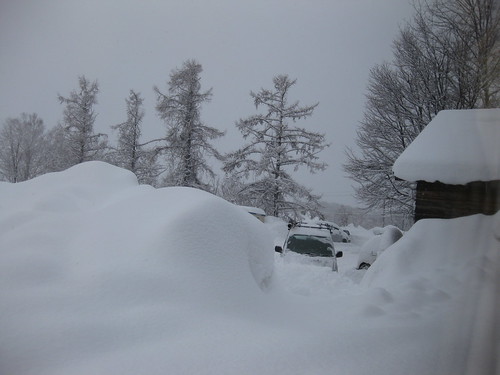
Here now, sitting in the teacher's office at the end of a day at the junior high, with the snow still coming down outside (as it has done for something close to two months straight), I realize I've been here for six months now: half of the one-year contract I signed on for.

I try to get a handle on that: six months past. Six months living in a foreign country for the first time with only the internet and one brief visit to provide me with pieces of home. I try to take a bearing from those six months, but it's just like day one:

I still don't know, and it still doesn't seem real.

Well, I should say it doesn't seem real. Now it all seems a little too real. It doesn't seem strange or different or life-changing and unique in that epic way that you may think such things should. Those strange and different and unique things are still happening; lives are being changed, but it is all happening in increments. Gradually and behind the scenes; not in epiphanies and revelations.

What I do know is that it's different enough to force timelines to be revised, to cause the Master Plan to be altered. I've become wrapped up in the experience, and something that I swore would only be a year long has grown to two.

Here: at a time of year when Hokkaido is at its least hospitable; in an apartment that is so unreliably heated and insulated as to force me to sleep on the living room floor; during a winter so deep and snowy as to make one forget what summer was ever like; with a class that tells me to "go home" on good days and to "die" on bad days...

Here, at the heart of all this, is where I am asked to make my big decision about the next year of my life. At this cold, bleak point, the fact that I can still happily make the decision to stay on for another year says more about how the last six months have been than any detailed timeline or list that I could hope to give.

Friday, January 29, 2010

Mochi Mashing

Last Sunday the Furubira International Society put on their annual Omochi Suki party. The fact that my town of 3,800 people actually has an international society is a bit of a laugh, but it is a testament to my very internationalized Japanese Mom/Patron Saint of Furubira JETs: Asano Sensei.

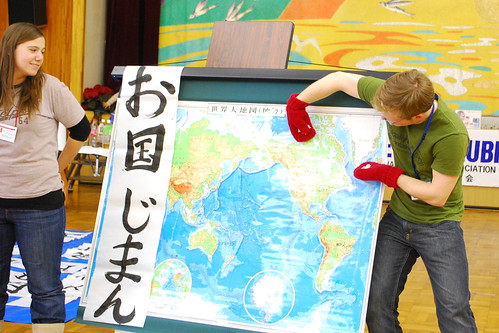
She’s the one who graciously invites me into her home every Monday for elaborate, Japanese dinners, and she’s one of the loudest cheerleaders behind our International Society. With good reason, too, as she’s traveled to/lived in something ridiculous like 25 countries. In Canada, such a feat would be impressive. In a sleepy fishing village in Japan, such a feat is pretty much unheard of. So, every time one of these international events rolls around (and that’s more often than you might think), she makes sure I’m going to be there, and she goes out of her way to invite international students in from the Universities of Sapporo. She hooks them up with homestays and Japanese meal, and she encourages them to present their particular corners of the globe in front of gathered townsfolk.

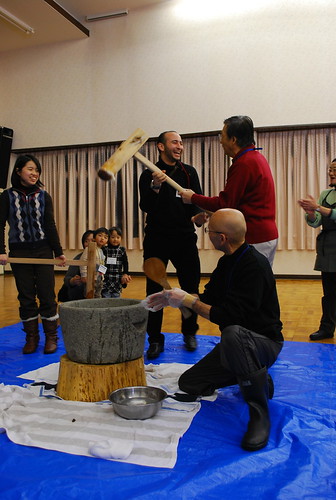
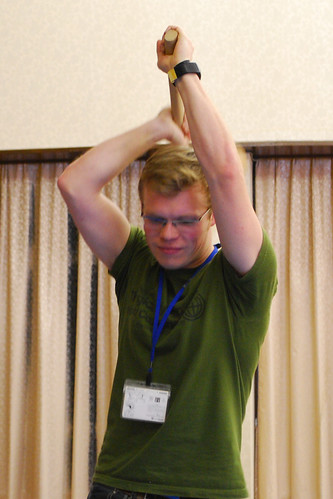
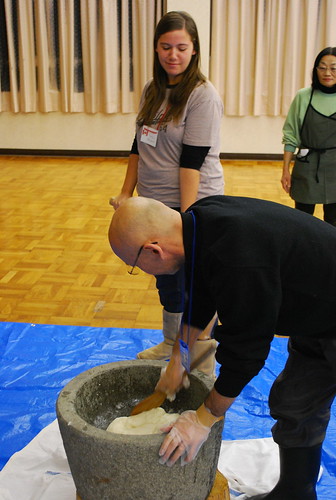
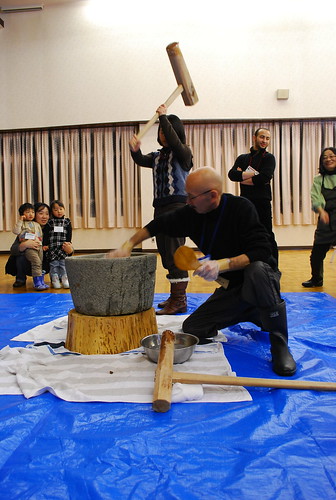
And last Sunday she had the students in for the Mochi Party. It’s not really any surprise that the students decided to show up, though, as a mochi party involves hefting a wooden mallet high over your head before bringing it down with gusto on cooked rice in massive stone mortar. Who wouldn’t want in on something like that?

Again and again you pound the rice in an action the Japanese euphemistically refer to as “whacking the rabbit,” all the while trying deftly to avoid the hands of the person who’s kneading the ever-stickier rice paste for you.

Don’t be confused by that last bit. You’re not supposed to break your whacking rhythm to wait for the Kneader to get his hands out of the way. In fact, you’re pretty much supposed to aim for the hands and hope they’re not there when your mallet connects with that sticky THUD. So artful is the rhythm of this perilous dance that professional Mochers (mochi-ers? moochers?) heft the hammer blindfolded, without any concern for the frantic kneaders below.

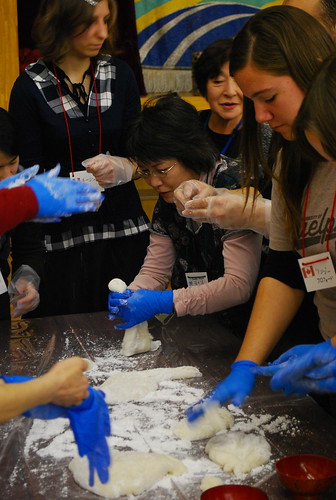
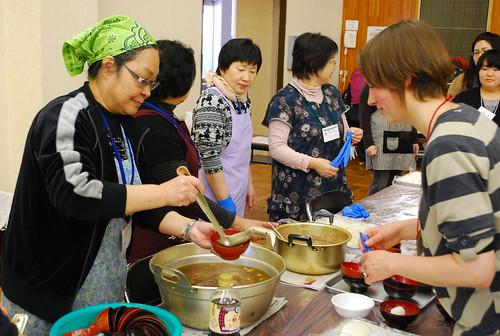
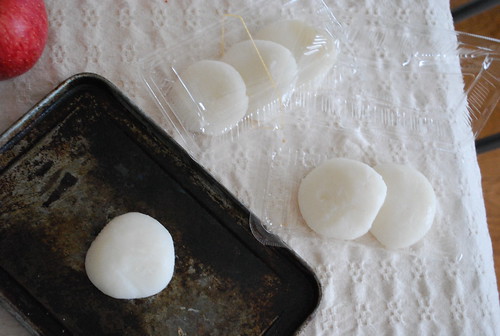
To make the whole thing even more fun, after all this whacking you actually get to eat the fruits of your surprisingly-intensive labour, one round, dense, choke-tastic mochi ball at a time.

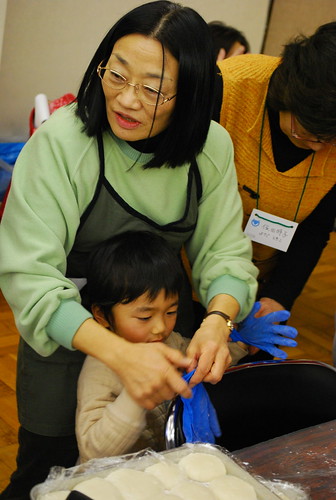
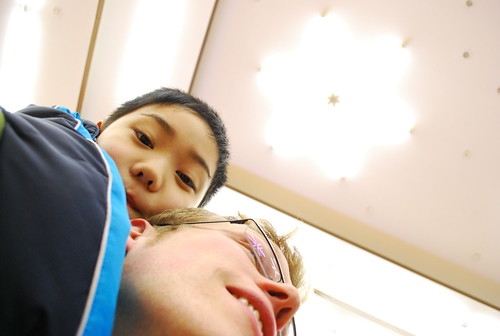
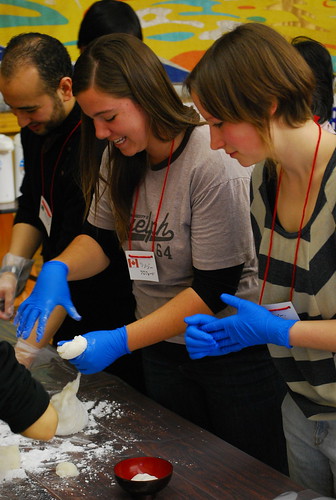
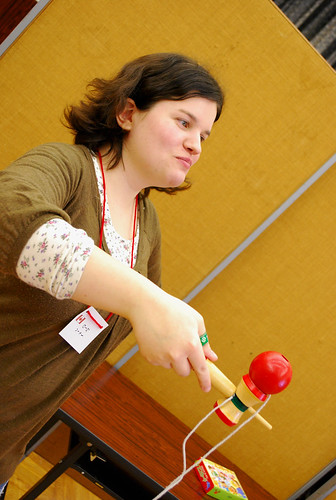
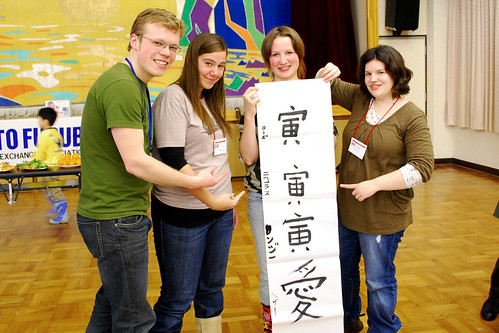
Just as it was no surprise that the international students wanted to get in on this edible form of whack-a-mole, it should have been obvious that some of my JET buddies would want to be part of the action. Lindsay, Roz, and Heather showed up for the event, further bolstering Asano-Sensei’s contingent of gaijin-on-display. They all performed wonderfully in the whacking, shaping, and eating parts of the day’s events. Here’s proof of that.


Here’s a look at the fruits of their labour, more for Craig than anyone as he’s shown himself to have an unnatural love for this particular Japanese food item.

And this one's for me.

Wednesday, January 27, 2010

Time Travel by Thought (of Italo Calvino)

WARNING: this is another one of those glimpses into the literature I get into over here in Japan. It's got nothing to do with Japan other than the fact that I'm using some of my time over here to get caught up on reading. Highest on the catch-up list is Italo Calvino, who I've mentioned before and who is, likely, my favourite author (don't tell that Neil guy). People say he's a modern fabulist. I've likened his lucid style to a literary incarnation of intercourse. I guess this is a literary response to his t zero, and if you're interested it might give you a look at what he's all about. That being said, if you think you might be interested in him, best to start with Marcovaldo or Invisible Cities as t zero is still a rather dense read.

From the sometimes indecipherable word stew of Calvino, a realization takes form. In the midst of the story I was about ready to abandon due to the sheer density of verbiage and thought, the long meandering streams of Calvino logic begin to crystallize and slot themselves in along one another like Tetris blocks. And, all of a sudden, “t zero” is the literary synthesis of time travel, just like that one scene in the sandstorm in Coelho’s Alchemist is the literary synthesis of magic. The words align so perfectly to express such a very abstract and, seemingly, insurmountable subject.

As my eyes grow wide and the corners of my mouth pull back in that which is none other than amazement, I read the words on the page, and like they did with Coelho, they seem like a spell: an incantation. The suspension of disbelief goes out of my mind as I sense it is no longer required due to the utter clarity of the prose. Calvino in “t zero” details moving forward or backward a second in time, and each second stands like a finite demarcation on the Z-axis of a time-space graph. It is like four dimensions are existing sustainably in my mind: forward and backward on the Z-axis is forward or backward in time, and the thin plane of X and Y actually contains the three-dimensional span of a universe. The narrator in the story talks of how he wants to move forward or backwards on this Z/time axis to get a perspective from outside of the co-ordinate t0 (or Z0, I suppose) where he resides. I picture him rising above or sinking below the seemingly two-dimensional plane of the milky way to gaze down upon or up at the physical location of all points within it at that moment of Z/t0 from a position in the future or in the past.

It is the clarity, though; the unerring logic of the paragraph that seems to make all things possible. Just as I thought that magic could exist as a rational force when reading that particular passage in the Alchemist, so, too, do I now think that time travel is as easy and as comprehensible as a shift forward or backward on an axis when I read Calvino’s “t zero.” It is this clean, clear, world-skewing logic of Calvino’s that always sets my mind alight when I read his work. He steps outside the X-Y three-dimensional plane that we all inhabit, and he looks down upon it from point W to cast our everyday in new perspectives.

Normal things, seen from obtuse angles.

That is Calvino, for me.

If you can get past his vocabulary, once you boil down Calvino’s prose, it is simple. It’s almost plain, really. If you can follow him to his point W, and you can look down upon our XandY from his perspective, it knocks your mind on its ear, broadening horizons in a world where there no longer seemed to be any space for it.

Sunday, January 24, 2010

This Place Yawns

Due to living a way out in the countryside and doing most of my socializing in other, more lively, more developed locales, I never have that very many people stay over at my apartment here in Furubira. I mean, it has happened, it’s just that, until recently, my apartment has felt like a pretty solitary place. Not in a lonely way, really, just in a private way. It was my space, and there wasn’t any problem with me being the only one to fill it.

And then my father and my brother (and, at times, Sonomi and Lindsay along with them) came here to stay over the Christmas/New Years break. My expansive apartment, thankfully, had room enough for all of us.

However, I didn’t realize just how fully all those people filled the place until I returned to it after I’d left my father and brother in Tokyo.

In the absence of all those people, there seemed to be a tangible emptiness at the centre of the rooms in this place. They were the same rooms they’d always been, with the same furniture they’d always had, but they’d had those people filling them with their life for so many days that the rooms now seemed to be hurting for the people. It was almost as if I felt the absence of the people as something present in the rooms of my apartment.

And it’s no different today, after a weekend spent in Furubira with some of those excellent people who helped me decide to stay on here for another year. They’re some of the best people I’ve met over here, and they lent their scents and their energies to the apartment for a weekend.

Now, in their absence, the place seems twice as large and twice as quiet. For the first time, I find the leisurely, me-paced, solitary existence that I’d happily accepted here in Furubira for the past five months start to show signs of wear. Back in Toronto, it would often seem as though you couldn’t keep me in my apartment. I’d always be off, trying to socialize with someone. After years of that, I managed to adapt rather well to the introverted social vacation that my sleepy town has provided. It was a rest, and I felt like I needed it.

But now, I wonder if the combination of never-ending winter and good friends has finally gotten to me, setting off the first blush of cabin fever. Thankfully February looks to be shaping up as the busiest month yet in terms of weekend social commitments, so I won’t have to worry about getting too squirrelly by being shut up in my town, in this apartment that seems to be getting only bigger by the day.

Tuesday, January 19, 2010

Omiyage

Omiyage is one of those Japanese words for which there is no equivalent in English.

The uninitiated would tell you that it translates as “souvenir.” But that equivalency will start to fail you the first time your Japanese mom tells you that she’s brought you a souvenir from Shikoku and it’s made of sweet potato. If omiyage is souvenir in Japanese, then la souvenir (to remember) in Japan is to forget. It is to share a place by returning from it with pieces of it to cannibalize. It is to experience a place by devouring it. La souvenir lasts for only as long as it lingers on your tongue, and the memorable places visited become those that ensconce themselves in the flavour centres of your mind.

Omiyage is something different.

Omiyage is a transferable flavour memory. Despite its stick-thin, rice-reverent surface, deep down Japan is a nation ruled by its gut. From metropolises to fishing towns, every place in this country seems to have a signature food item. When the Japanese travel, the consumption of these regional dishes seems to be as important as visiting a region’s physical attractions. And, just as the Japanese take pictures of these attractions, preserving them and carrying a part of them home, so, too, do they aim to capture the flavour of a region by returning with its omiyage.

Omiyage is a food act. It is thoughtfulness made manifest. When the Japanese travel for business or pleasure, they return to their offices with boxes of omiyage from wherever they’ve been. To give omiyage is to prove that you were thinking of your coworkers; to prove that you care about them. To neglect omiyage is to be heartless and indifferent.

Omiyage is a self-perpetuating cycle. Though undoubtedly once founded in something profound, the notion of giving omiyage today seems to exist only to create demand for the production of more omiyage. So ingrained is it in the culture that you are judged if you are not generous with your omiyage, but the background justification for this judgment has been long lost. Omiyage shops thrive like mushrooms at attractions all across this country: a massive industry sustained by a point of Japanese etiquette.

Omiyage cannot be the Japanese equivalent of a souvenir because a souvenir is permanent. It is a bauble or a trinket or a chotchkie. It is a material piece of something likely destined for the bin. You hang onto a souvenir for a time, you may put it on display in a place of honour, but, eventually, all but the very best souvenirs degrade into clutter. Omiyage is temporary. It is given with emotion and it is consumed while that emotion is still fresh in it. As it is meant to be eaten, it does not sit around; it is—by definition—incapable of collecting dust.

What it comes down to is the cultural weight behind the words. When you give someone a souvenir, you are being thoughtful, and they’ll likely appreciate it. It will hang around on their desk, and they’ll think of you fondly when they look at it, but, eventually, the wonder will go out of it, and it will become just one more thing. In Japan, however, when you bring omiyage, you insert yourself as an observant member in an existing cultural framework. You become part of a web of significances, and it serves to magnify a simple sweet beyond the realm of thoughtfulness.

I’d do a better job explaining it, but I must admit that it’s something I can more feel than truly understand. I’ve just learned that, when you go somewhere, you bring back omiyage for the teachers back in the office. I’m told that they don’t really expect it from foreigners such as myself, but when I see how very grateful the teachers are to receive it, their reactions seem to far outweigh any difficulty in buying and transporting the stuff home.

EDIT: Leave it to Sarfaraz to pick up on the French in something. Actually, I was kind of hoping he would and am now glad that he has done so.

Also, thanks for the proofread ;)

Saturday, January 09, 2010

Snowy Mountain Rider

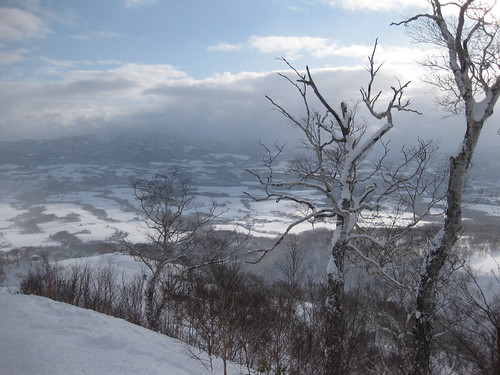
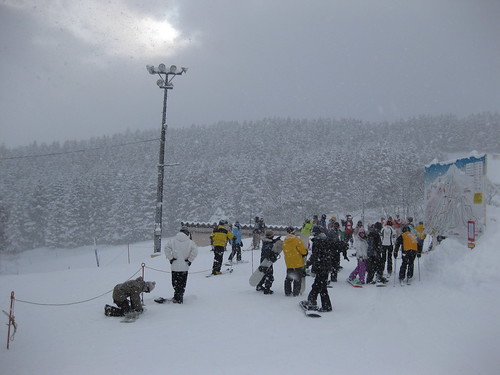
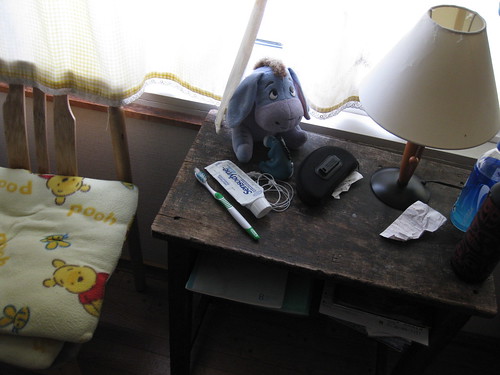
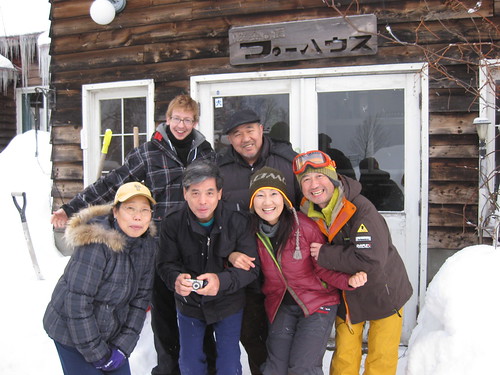
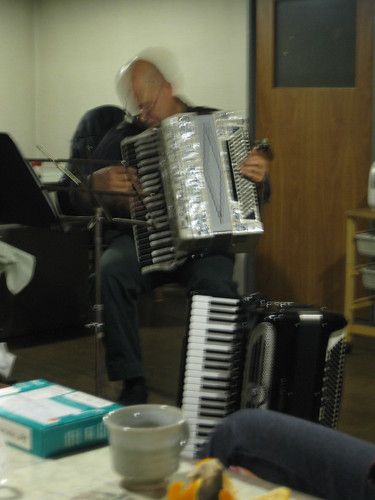
You wouldn't believe what I was up to if I told you. There are perfect snowscapes and looming mountains and me slowly getting the hang of toe-side on my first day on a board. There are vistas of seas of hills, seen from on high when the blizzards rolling around in the heavens part for short spells. There are schools that have been converted to hostels, where everything is Winnie The Pooh (more Milne than Disney), and you wind up staying in the Eayore room, which--hilariously--translates to "iiyoo" (or, for the un japanified, "it's alright") in Japanese. And these magical little schoolhouse hostels are staffed by kind Japanese couples who will pick you up from the Niseko train station, and truck you to the mountain and back, and truck you to the onsen and back. And when they're not trucking, the wives are whipping up sumptuous, elaborate Japanese meals worth far more than the ¥1260 you paid for them, and the husbands are playing the accordion in the parlour, eyes closed with intensity, beside cast-iron, wood-burning stoves. They set their keys alight with polkas or see-sawing carnie waltzes while you eat your clementines and your cookies, rapt. With their last warbling notes, the husbands slump back into their chairs: marionettes with strings cut or earthen golems with the last archane Warsaw magiks of animation ebbing from their now-inert frames.

I'd tell you these things, but you wouldn't believe them--just as I'd never believe they could happen to me at this afterthought tail ending of my holiday.

Mountain Days 1, 2

Friday, January 08, 2010

Of Bonding

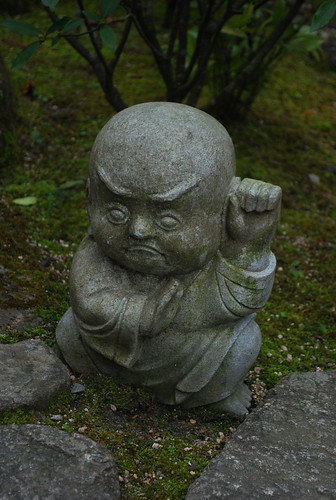
Angry Chibi Buddha

The subtitle for this one should probably be "(A Rant for Saff)" since he's, likely, one of the only people who will be motivated to follow this through.

I think it's appropriate to go here as it's about my trip with my brother and my Dad, and it's about New Years Resolutions, and it's about being repressed (as the Japanese sometimes are), and it's about the ways that our society approaches certain things--approaches that really piss me off.

What's more, it's about something I believe in very passionately.

So, without further screwing around, here she be:

You have to realize something:

The majority of our Supercalafragilisticexpialidotion Father-Sons Miracle Bonding Vacation was spent in silence. We'd walk around, we'd look at stuff, and, if pressed, Dad would reveal how amazed he was about the construction of the stuff we saw. We didn't sit around, crying and giving each other hugs. It's not how we do things. Not ever. It's not who we are.

You go on and on and on about how we need to have this epic, father-son bonding vacation together. What you have to realize is that we don't need it because we're beyond it. We don't need to have two weeks together in a foreign land to tell each other how much we mean to one another because we do it every time we have dinner together. I don't need some big bonding adventure with Dad because a long time ago I realized I needed to see him and talk to him more, so I made a point of going over there every week for dinner, and we'd talk for hours thereafter. Every time Craig, Dad, and I sit down together around Dad's table, we're bonding. We've been doing it for years.

People who don't talk about their feelings and don't tell their loved ones that they love them often enough need big, epic, bonding experience adventures. They need a new setting to share their feelings because they are, for some reason, too afraid to do so in their standard settings. It's like the Japanese when they drink to let go: relying on a change of state--whether it be a mental one from inebriation or a physical one from travel--to break down the barriers you've set up around yourself.

People who talk about "Bonding" need an excuse to do it. They give intimacy and sharing a name, set it on a shelf, and they keep telling themselves they need to get to it some day. And, in so doing, they never get to it. It's like making a New Year's Resolution: you realize you're not doing enough of something, and you set that something on a shelf as a lofty goal and one of two things happen:

1) You achieve your goal by forcing yourself to do it. You don't do it because it's natural or right or it moves you. You do it because you have to, and you're motivating yourself with guilt.

OR

2) You never achieve your goal precisely because you've set it on a shelf. By making it your Resolution--your Goal--you endow it with an extra bearing...you make it bigger than it ought to be by making it something that's so hard to do that you need to make a resolution to do it. It carries all the guilt of you not having done it before, and that guilt makes it seem all the more insurmountable.

People who never mention the word bonding are, in all likelihood, the people who are already doing it. Instead of attaching a name to it, putting it down on their list of things to do, and saying they need to get to it one day, they do it naturally--organically: just like breathing, just like circulation. They go to the people they need to go to, they say the things they need to say. I'm not saying it's easy to do. I'm saying that when you do it, you have to do it naturally.

If you slot in "bonding experience" on your calendar, and you schedule a defined amount of time for it, you are destined to fail. The exchange will be stilted, synthetic, defined. At 11:00 am The Bonding will commence, and at 1:00 pm The Bonding will be completed. You cannot bond with someone on a schedule. It's not a matter of gaining bonding points through scheduled interactions until you gather enough to trade in for a bonding level.

I guess what I'm trying to get down to is a cliché:
Talk is cheap.

Don't talk about bonding. Don't talk about New Year's Resolutions.
Just do it.

I don't like talking about bonding; I just try to do it.

So, on our Jones Family Trip, what we did was spend time together and see stuff together. There was nothing overtly deep and meaningful about it in the instant; that kind of stuff comes with time. The kind of Hallmark, saccharine sentimentality that you seem to be hoping for never transpired, and I'm glad it didn't as it would have been false--for all of us. Any bonding or life changing that occurred occurred silently, inside our heads, and it's the kind of bonding and life changing that Daddio will seldom if ever talk about, but it's the thing that will occur to him with a smile when he's sitting on his own somewhere.

We are what we are, and this trip will be what it will be. To try to force it to be anything else--to try to force it to be meaningful in a loud, showy, let's-talk-about-it way would be to counterfeit the experience. The meaning exists inside our heads. It's as real in there as our names and our passions. To try to make broad, sweeping, heart-warming statements about it is to cheapen it.

In short, I don't think I can give you the answer you're looking for because that answer would be a lie. Just know that this was good. I enjoyed it, and I think Craig and Dad enjoyed it, too.