Distance: 375km
Today was an early start for Erimo. We were determined to have more time today than we did yesterday, when we failed to make it even as far as Samani before 6:30pm--when the sun had pretty much set. The fact that Ali had to go into work today certainly motivated us to get out of her hair early.
The drive down to the cape of Erimo was a pretty quick one, and I think we made it in about an hour. All along the road on the way there, we saw tiny pick-up trucks with tiny cranes on the back, being used by aging fishermen to haul in catches of long, lasagna kelp up off the concrete break waters.
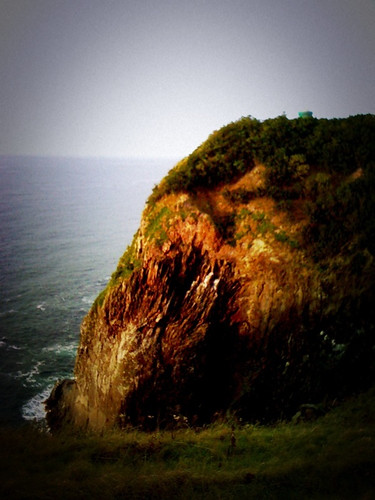
As we drove out onto the grassy jut of land that is Erimo, the Hidaka mountains to the north came to an end, seemingly in a wall. There were still small, seaside cliffs as we drove down the triangle of land, but there were these grassy, inland valleys, almost completely devoid of trees, that sometimes seemed to give the illusion that they were dipping down below sea level.
Arriving at Erimo Misaki, it wasn't the misty, windy, rainy thing that we were told to expect, and the sun was gleaming silver on the Pacific out off the rocks beyond the point, coming down between the clouds. There was still a fair clip of wind, though, and it caused the various structures of the wind museum to vibrate forbiddingly, as if warning that a storm could blow up out of the open ocean at any time.


The walkways belonging to the Erimo wind museum that crossed the surface of the cape were wound into spirals themselves, seeming to imitate a child's illustration of the natural force when they were viewed on the aerial map. The innards of the museum were mostly underground, and it was a surprisingly artful collection of curved concrete tunnels that were part in and part outside. The high-ceilinged main tunnel had curly-cues of wind pressed into its walls on one side and ever-changing spotlights on the other, projecting their growing and fading light onto the moss-smelling condensation. And the sounds playing in the tunnel were just a little too sentient to be the breeze in the trees. They were a very basic kind of gale music that, imitated on the correct instrument, could be plied to summon the four winds.

The next stop after Erimo was the wetlands of Kushiro, just outside our last stop for the day at Nemuro. These eastern marshes are famous for serving as the breeding grounds of the Japanese crane when the birds return to the area in February of every year. The drive from Erimo was the same comforting collection of waves and tunnels and rocky cliffs falling into the ocean. At one point we even drove a dirt road, high on a grassy hill overlooking the Pacific, behind the very construction vehicle that was trying to level that road out enough for it to be paved.
We had to head in from the coast to reach a viewing point for the Kushiro wetlands in the form of another one of Japan's phenomenal nature centers. The view from the viewing deck on the roof, at the top of a rise over the marshes, was beautiful in the sunny day. However, I was more taken with the mad, organic detail of the center's innermost room, which seemed to be formed like some massive eye. It was part sculpture and part evil mastermind's lair. While everyone else wandered up onto the roof, I lay on the floor of the place and obsessively took pictures of the shape of it.

After the nature centre, we attempted a trip to a crane sanctuary to see some of the actual birds, but it turned out to be closed and birdless, and Lindsay was left driving us down corduroy dirt roads across the marshes to get us back on track to Nemuro.
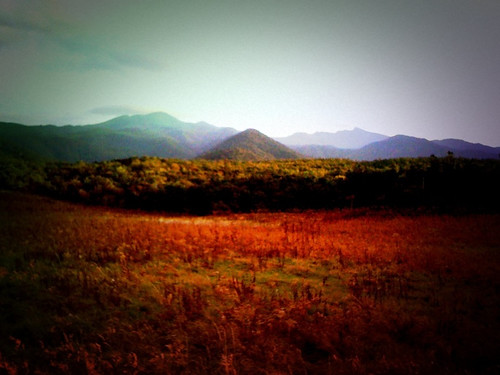
Once we had finally made it back to paved civilization, Mark as navigator plotted us a scenic route to Nemuro that would take us back to the coast and through an interesting wetland region near the town of Hamanaka-cho. The goal was to hit an onsen in the town that boasted a particularly fantastic view at sunset. Unfortunately, we didn't make it to the onsen itself until well after dark, but the route was worth it for the forests we drove through near Hamanaka, as well as the vast, marshy plain that we stumbled across in the twilight. As the last of the sunset colours went out of the clouds, we took them in from a ridge high above the marsh lands below, and it seemed that the scenic detour had been well worth it.

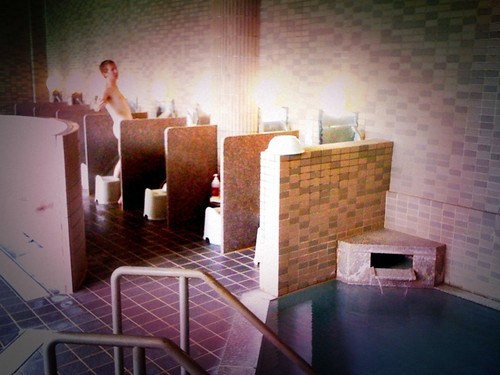
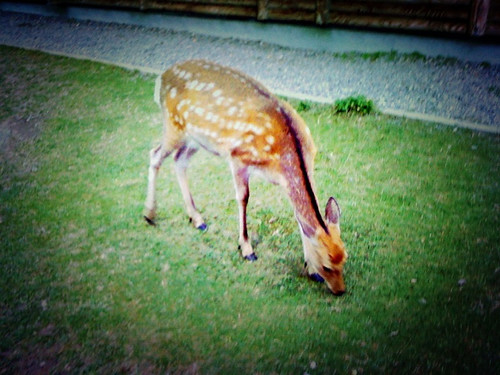
From that lookout, it was only a short drive to the Yuuyu onsen above Hamanaka, and after a relaxed hour or so in there, Mark drove us along the country roads into Nemuro. There were close calls with deer and herds of cattle on those lightless roads, but we eventually made it into Nemuro proper, found some groceries, and made our way to our friend Kyle's house (on the grounds of one of his junior high schools), where we'd be staying for the night. Though we didnt start the preparations until at least 9:30pm, Mark whipped up some Yakisoba, and Heather slapped together some salad for dinner. We enjoyed our first truly home-cooked meal of the trip, which had so far been crammed with a lot of Kombini food and the occasional restaurant. And, with that meal finished some time around 11pm, we very soon turned in for the night.