Monday, September 20, 2010

Four Points Day 3: Onuma Koen to Samani

Distance: 396km

Despite our early start this morning (getting up at 6am and on the road by just after 7 from Onuma), we either took on far too much in terms of a drive all the way from Onuma to Erimo, or we took too many long stops, but we wound up finishing dinner at our halfway point in Tomakomai at 3pm.

That isn't to say we didn't have fun along the way. There was a necessary stop in Yakumo for Ross' now-infamous Panorama Park, where we go to watch to big white fuwafuwa creepily inflate itself.

The birth of a fuwafuwa

Balls

Gaiman Riding

There were kombinis and ice cream and Tyranosaur-topped second-hand-chique boutiques. There was also delicious, perfectly-spiced, overly-large portions of Japanese curry. There was also piles of rain, interspersed with perfect sun. It lead me to conclude that if you ever tire of the weather in this place, you should probably just drive a hundred kilometers.

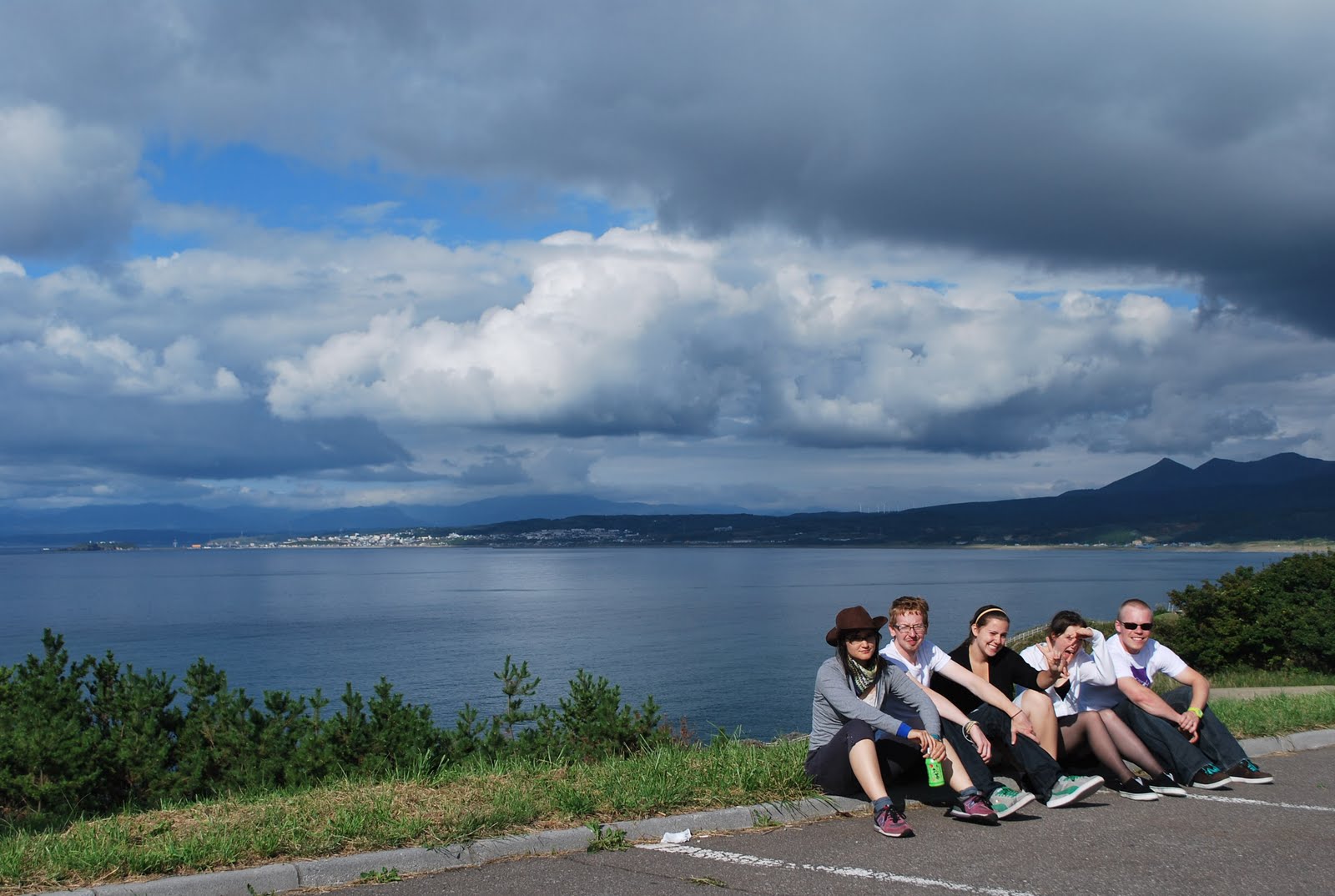
We attempted to recover some ground by blazing down the Hidaka expressway to its end, then taking to the coast proper. From the expressway, the region hadnt seemed that exciting, but once we got to the coast and the grassy hills along it started to swell, Mark and I seemed to react to it at almost the same time. Down this way, Hokkaido makes up for it's reputation as the horse capital of Japan with all kinds of them roaming the coastal rises.

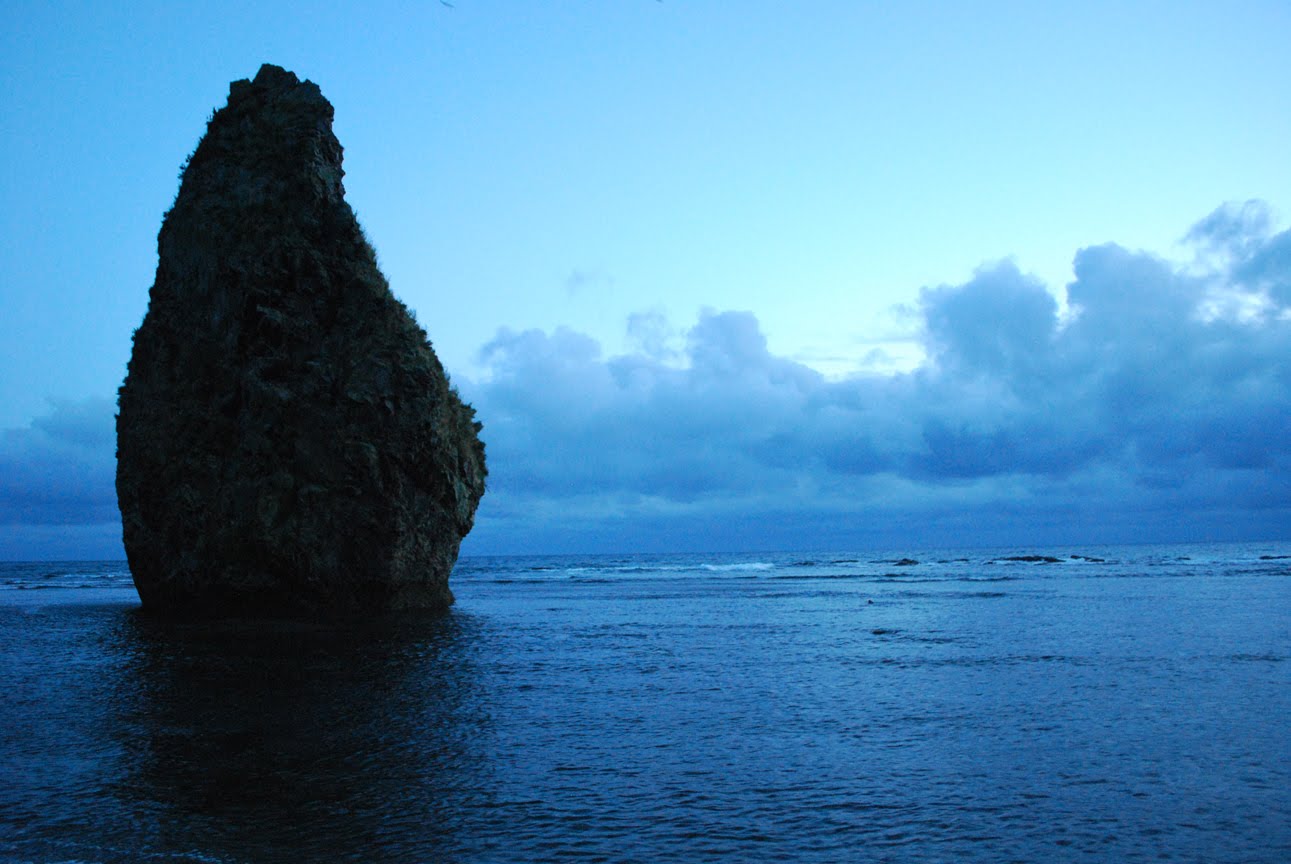
The shore isn't as rocky as the Sea of Japan coast or as cliff-like as the Pacific coast of the southwest, although as we got further and further along, the straight coast started to grow back the rocky spires, seemingly just as we arrived in Samani, where we would be staying with co-ALT Ali, just shy of Erimo.

Day 3 Highlight

Rock in Samani

Our long ride meant that the sun set behind the clouds before we ever reached Samani, and we were clinging to the last of the light as we waited for Ali to meet us in a pull-out along the ocean just outside her town. Together, we drove to her place, dumped our stuff, and then headed to an onsen resort nearby for one of the hottest onsens I've had in a while up on mount Apoi.

After, we headed to dinner at one of the only izakaiyas open on this long weekend Monday, and then back to Ali's in the rain. Compared to last night's midnight tent pitching at Onuma, the futons that Ali laid out for us on the floor of her living room were the definition of swank.

We'll be looking to make another early start tomorrow as we need to take in Erimo Misaki, Kushiro, and Nemuro all in one day.


Sunday, September 19, 2010

Four Points Day 2: Iwanai to Onuma Koen


Distance: 365km


Our clever plan to get up early and get on the road to Matsumae this morning went up in a meat-and-beer-fueled cloud of stinky stinky fartiness. We breakfasted on the delicious baked goods that Heather and Sonomi had prepared (an apple pie and a chocolate chip banana loaf, respectively) while Mark last-minute packed, and we were on the road shorty after 9am (a good hour later than we'd hoped).

It was pretty much a textbook road trip day as the drive down the coast wound us through all manner of weather, from clouds, to sun, to rain...mostly the sun and the clouds, though. There were rocks...lots of rocks. My camera has probably got more rocks on it than it ever has, but when you see the odd spires along the south-west coast, you can hardly blame me.

Benke's Scabbard
Benke's Scabbard

Seicomart
Official, Hokkaido-only Kombini sponsor of Four Points: Seicomart!

We got so used to driving with the sea of Japan off our right shoulders that when we had to turn in land briefly before Esahi to bypass a mountain at the coast, it felt oddly wrong, and we had to put our GPS back on to make sure we weren't getting lost.

Switching it up

Steerage

Islands

Once we returned to it, the sun persisted clear through to Matsumae, which, turns out, not only houses the only edo-era castle in Hokkaido, but also a temple complex. When lost in the mossy middle of it, you could almost believe the place was mainland Honshu and not the fairly-recently-developed northern outpost. With Matsumae being one of the points on Hokkaido closest to mainland, you start to wonder if, perhaps, the ancient culture might not have come over on the breeze from Tsugaru to the south.

Matsumae Castle

As a castle, Matsumae was cute and picturesque on the outside (even when not ringed with its famous sakura), but its interior was a concrete and glass museum bastardization of what the castle once was. That's likely uncharitable, but, unfortunately, my only basis for comparison is the finest-Japanese-castle-ever: Himeji Jo.

At Matsumae

In the temple grounds at Matsumae, the surrounding clouds filtered the light that made it through into a sepia yellow, giving the moss spread across pathways and gravestones a lurid glow.

The Temple at Matsumae

At Matsumae

At Matsumae

As we drove away from the castle, the setting sun shot through the clouds, all gold glinting off the sea. We rounded the coast towards Hakodate, and we had to crane our necks more and more, hanging our cameras ever further out the windows to catch the fire of it going down until we rolled into Fukushima and the hump of the mountains blocked the sun entirely from view.

And here, in their shadow, twilight came up--material in faerie veils and plumes of mist between trees and hills. So vast were they that there could have been whole towns hiding behind them. They were unlike anything I'd seen in Japan before, and they were the perfect hazy end to this ever-changing day.

The mists of Fukushima

Certainly nothing beyond Fukushima was as momentous, from our decent Italian restaurant, found randomly on the side of the road to Hakodate, to our over-packed onsen (also, randomly on the side of the road).

Mark and the Janken-bot

Now all that's left is a long, dark drive up to our free campsite at Onuma in the hope that we can actually find it in the black.


Saturday, September 18, 2010

Four Points Day 1: Sapporo to Iwanai


Distance: 155km

We kicked off the road trip with all of us meeting in Sapporo at the car rental joint, and we were on our way around 2pm. We made a brief stop in Ishikari to pick up Lindsay's stuff, and then we were off westward in the direction of the Shakotan peninsula, where me and Mark live.

Our goal today was to reach Mark's place in Iwanai with enough time to watch the sun set into the Sea of Japan. We made a further stop in Furubira to pick up my own crap as it was on our way, but the greyness of the day and the late hour we got to Furubira inspired us to take a shortcut across land and skip the shakotan coast as there would be no sunset to see (so the map above lies).

It was a good detour, though, as we got to take a road through the mountains that I'd been meaning to try forever. I'd been told it was a sight to behold in late fall with all the colours, bit even on this cloudy day, the green and mist of the mountains and valleys from on high was pretty spectacular--as was the science fictional things that the Japanese managed to accomplish with tunnels in those high places. Sonomi quite rightly commented that, winding through those artificial, rounded caverns of concrete and asphalt and orange fluorescents and grey skylights, it was like driving through the bowels of alien spacecraft. They must have been built for the snows as we could see their segmented lengths standing out among the forests from the high points in the mountains.

We came down from the mountains into the towns of Kamoenai and Tomari, where the dying light of the day was still bright enough to pick out the mad stone formations of their shores. Though I'm pretty proud of the unique and lonely rock formations along my own coast of this island, Mark was right in commenting that Tomari takes the prize for the most ridiculous coastline on the Shakotan peninsula.

The last of the light died as we rolled into Iwanai, leaving us just enough to pick out the mountains behind the town against the dark sky and the slightly greyer clouds of burning rice paddies drifting before them. The smell on the cool air was one of tatami mats and bonfires, seeming to herald autumn--finally--at the end of this never-ending summer.

In Iwanai, Mark had set us up a barbecue with some of his high school teachers who were eager to meet some other English teachers. He'd clearly been doing a good job plying them with English as we were all able to carry on pretty well in a pidjin amalgam of English and Japanese...or perhaps that was the nomunication brought about by the keg of beer they tapped in our honor. That should make getting up in the morning early enough to make good time to Matsumae a bit of a challenge.

Hokkaido Man, ready for action, mate...or maybe being punched in the face by a Ghost.


The epic ride we failed to secure for our road trip.


The actual ride, rented cheaply from ちょいのり, the Honda Stream. The thing's a BEAST with a third row of seats, and is far newer than we'd expected.


Mark and Lindsay, making our way out of Sapporo.


The rest of the Peanut Gallery in the back seat.


The very wavy Sea of Japan, near Furubira, on this grey day.


Mark, looking like J-Ho, picking up some Special Meat in Iwanai before our Yaki Niku party with his high school teachers.


You'd think they were filming a movie in this place with the tents and lights they set up so we could barbecue in the rain, in the night.


Delicious lamb Genghis Kahn.


Oh, and Neil Gaiman early birthday presents from Mark and Sonomi.

Friday, September 17, 2010

Four Points Begins!

Blah blah blah. Huge road trip. Eight days. All of Hokkaido.

Enough talk. Time for some driving. We leave Sapporo tomorrow some time around 2pm, and it's all go from there. I can't freaking wait.

In the interim, here's a little something something I whipped up with my new favourite thing: Photoshop's photomerge tool. It's a look at all of the planning that goes into a thing like this. Also, there's something designerfic about it.

Four Points Paper Trail


Thursday, September 16, 2010

Moving

The dregs

As if preparing for Four Points next week wasn't enough, last Friday my boss also sprung on me the fact that, as my new apartment was ready ahead of schedule, they would be moving me into it starting Monday after school. I had expected the whole process to occur after I'd returned from Four Points, so I had, of course, packed nothing. I was able to delay them until Tuesday night to give me Monday to pack and get ready. That involved finally getting rid of a lot of cardboard and plastic bottles and general junk that the complicated Japanese waste systems prompts us whities to collect in our spare rooms. For example, here's all of the milk I've drank in my apartment since I showed up in this place:

About 70L

Despite waylaying my eager movers, I was still caught with my pants down when my boss and three of my coworkers from the sports center erupted in my apartment not a minute past 5:30pm on Tuesday. They set to work like efficient monkey home invasions or Grinch Who Stole Christmases or sentient black holes: wandering around and removing anything that wasn't nailed down, heaping it like spoils in the backs of their tiny Japanese pick-up trucks. As we ferried the surprisingly large loads to my new place, the lawnmower go-kart engines in those two-seater pick-ups would bemoan with a voice like a thousand bees my fat gaijin ass and all of the useless gaijin crap I'd accumulated over the last year.

My coworkers were relentless. There were no breaks, there was no standing around talking about what to move next. Up and down the stairs they went, stopping only to suck their teeth at how I hadn't packed more. When they saw that the load I'd prepared for them was mostly furniture with no boxes, I heard them mutter "dorumbo" and "hako" and "yakuba," and then one of them would run off, only to reappear not five minutes later with all of the boxes a person could ever need. They broke me to their unyielding pace, and the result was an apartment's worth of junk (including huge china hutches, refrigerators, and washing machines) being relocated in no more than four hours over two days. I'm still reeling from how quickly they accomplished it.

All of the hubbub does have its benefits: a freshly renovated apartment, with shiny new bathrooms and sinks and stoves and tatami floors. And then there's the sunrise, knocking at the window of my new bedroom, the best housewarming gift I may have ever received.

Dawnlight

Wednesday, September 15, 2010

Modern Myths: The Tengu

Furubira Festival July 2010

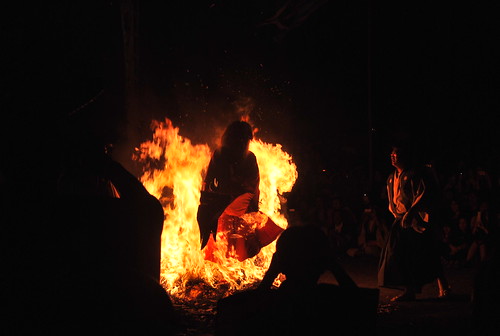
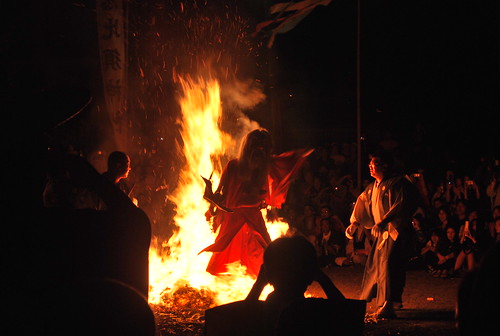
The Tengu: braggart. goblin.
Elsewhere in Japan: a once-winged demon that would carry you off in the woods.
Here, In Furubira, a beneficent (if irritable) spirit who brings catches and harvests aplenty.

That red skin, white hair, and suggestive nose: all so clearly constructed, so impossibly implausible…
…yet.
Something in his movements gives the impression this is more than costume: that this might, more accurately, be a man possessed.

Even the lions that attend him—the ones I can clearly see my high school students puppetting—the clack of their wooden jaws gives me shivers, and they seem to flow too smoothly around the Tengu in the fire light.

Furubira Festival July 2010

In the town of Furubira, the people honour a mythical Japanese creature known as the Tengu. In days long-passed, Tengu were bird-men or dog-men, best equated with our ideas of goblins or demons. Today the people of Furubira worship a beneficent incarnation of the Tengu; summoning him bi-annually to bless their catches and their harvests. The sons of town officials or the relatives of important business men are asked to don the red robes of the Tengu: to study the wild, dance-like gait of the character, and to practice the controlled teeter that goes along with its stilt-like geta.

©Photo Copyright Ross Cole-Hunter/Pekoism

But, despite the red wooden mask and the white, horse-hair wig; despite the vermilion robes and the alabaster gloves, the Tengu is not a man in a costume.

The Tengu is a man possessed.

Sure, the tradition started as a dramatic attempt to only emulate long-gone mythical creatures. The man behind the mask became the player, and the whole town, his stage. However, emulation is a dangerous practice. One can only emulate something so closely before one’s identity outside the emulation begins to shift and give, losing more of the original self and taking on more of that which you emulate.

The process is even more perilous when that which you try to emulate was once a god.

To better emulate its movements, the man behind the Tengu mask puts himself in the place of the Tengu, lending it not only his body but also his mind. It is a willing possession: a man of flesh and blood inviting a creature of the ether—a creature of Myth—to inhabit him for the length of the festival. I can’t help believing that such a process must leave something behind; that the thing which walks out of the great bonfire at the culmination of the festival might, somehow, be cardinally different from the man who walked in. The town officials change the man behind the mask regularly, as if to spread around the honour. But could they, instead, be doing so to keep that man from taking on too much of the Tengu?

Though some may take the term “mythical creature” to be synonymous with “non-existent creature,” the reality is that the term indicates a creature that exists in myth—making its home in story and sustaining itself on belief. In our modern, empirical world, where all that can exist is that which you can touch, hold, and trade, mythical existence is relegated to a lower level of being—far removed from the things that we allow to bare consequence on our lives.

But that which lives can also die, and that which is material will crumble and fade.

All the while, myth and memory and story live on.

If things like the Tengu only ever existed in imagination and belief, is it not the case that they exist still—that as soon as one remembers them, these entities live again? By paying tithe to the Tengu twice every year; by giving it physical form in the act of lending it a body; do the people of Furubira not make the creature more alive than the once-real-and-now-very-much-dead former emperors of this land?

©Photo Copyright Ross Cole-Hunter/Pekoism