Wednesday, May 12, 2010

Geographic Illiteracy

Matthew, my tatami timeshare/biking guest and I almost come to blows over how little of Canada he's seen, despite being born and raised on Vancouver island in Victoria. Well, I say come to blows, but the reality would have been one of me laying blows upon a hapless Matthew. Worse still was when we were talking about sights on Vancouver island itself. Though he was based in Victoria, at it's extreme southern tip, I thought that--surely--he would have roamed a bit across the island. I called back to my adventure last July, mentioning names like Coombs and Cathedral Grove, and Ucluelet and Tofino. I mentioned Pacific Rim National Park; I mentioned Clayquot Sound. Through it all, Matthew sat with a vacant, scantly searching stare on his face.

"I think I went to Tofino once or twice," he replied.

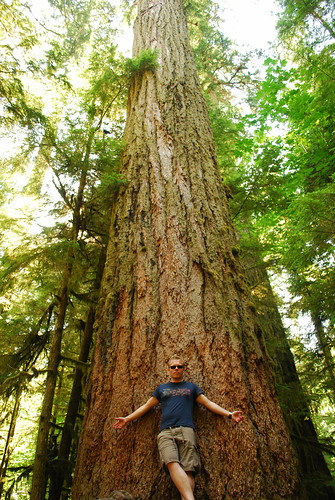
"Well then SURELY you stopped in Pacific Rim to see the coastal rain forests? SURELY you would have turned in at Cathedral Grove to try and wrap your arms around some of the larges trees in Canada?"

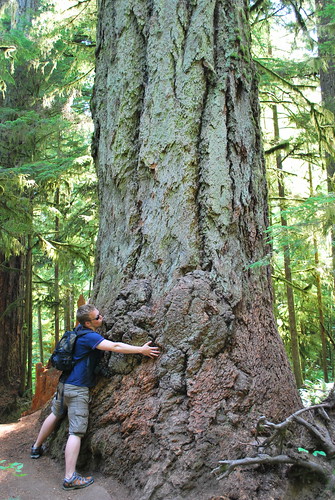
He replied that he hadn't, replied that be was amazed to discover that not only did Canada have rainforest but that they were located so close to where he'd lived all of his life.

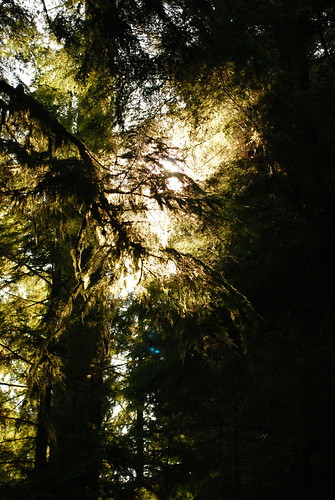
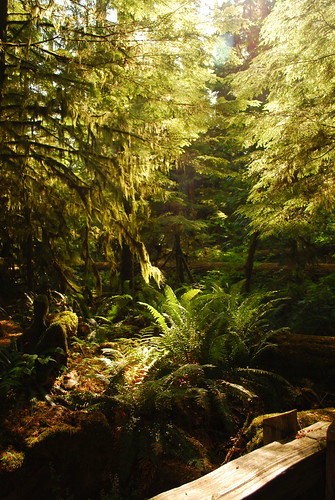
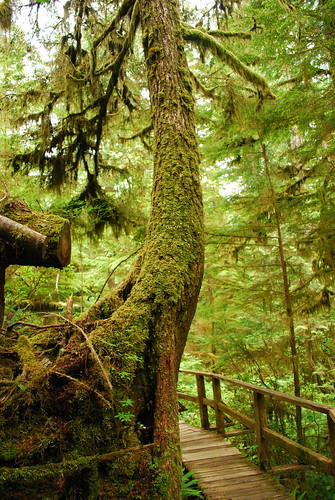
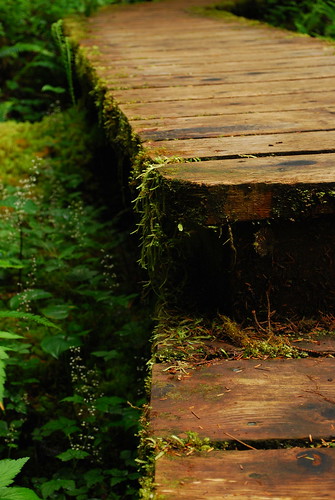
My eyes misted slightly as I told him about the Douglas Firs like colossal columns in Cathedral Grove, about the forests of Pacific Rim where the bark of trees was so moist as to serve as soil for ferns and mosses and other trees. Each was a place so full of life that they could serve as archetypes for Nature and Growth and Forest.
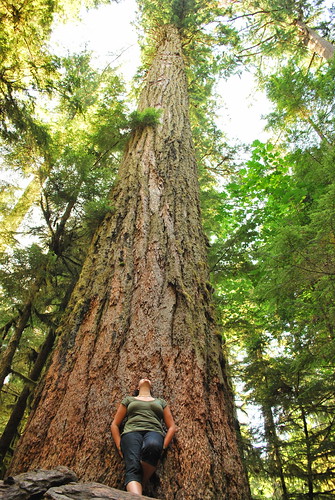
He mused that he'd have to put them on a list of places to visit when he got home, seeming to imply that he'd never thought there was all that much to see on Vancouver Island.

In an alternate reality, wherein failure to appreciate beauty naturally wrought was a corporally punishable offense, I could have throttled the guy. He lived within spitting distance of some of Canada's greatest natural wonders, and he'd gone his whole life without knowing they existed. Some people have joked about me moving to Japan and never coming back (and there have been times when I've had fleeting thoughts of it), but the place they should really worry about losing me to is British Columbia.

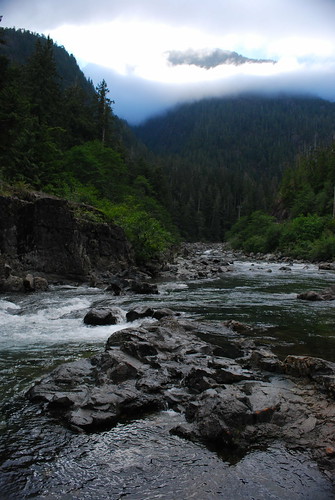
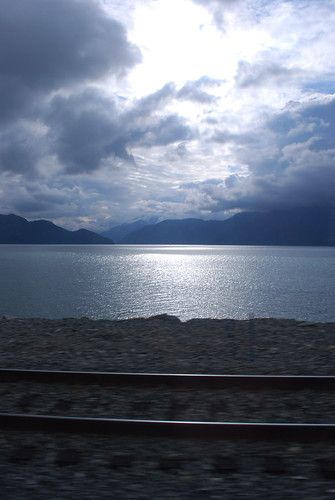
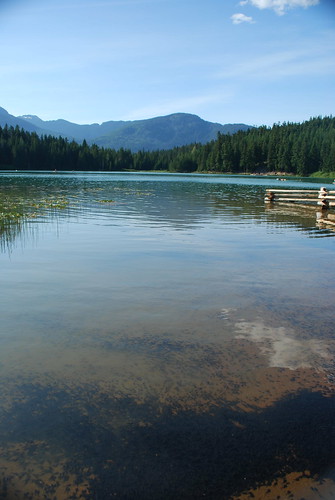
Though when I come back to visit Canada this summer I will be stopping in BC on a point of business (attending Amanda's wedding), I nonetheless am relishing the excuse to be back in that place--secretly hoping that I had MORE time on the coast to rent a car to go climbing up the sea-to-sky highway along Howe Sound, on the way to the mountain valley of Whistler, or taking that car up through Coombs and Cathedral Grove, over the mountainous hump of Vancouver Island, and down into the mists of the Pacific Rim.
I reigned in my shock and disappointment, and I tried to put it to Matthew straight:

"There is so much of Canada that you have yet to see: so much in your very backyard that is essential and you have yet to experience."

And that is advice that I feel I should perhaps endeavour to diseminate more widely. Even if the only person who ever takes it to heart and actually sees these wonders on Vancouver Island is Saff, I'll feel like it will have been worth it.

You should all go, though: to Tofino and to the Avalon Penninsula and to Peggy's Cove; to Lake of The Woods and to Haida Gwaii. We all seem to spend so much time dreaming about the foreign climbs we'll summit when there is still so very much to see in the country where we lay down our heads to sleep every night. I feel like being so far away from it all in this foreign place has given me more perspective on it; an absence to make my heart grow fonder of its lakes and its trees. As I give my advice to Matthew, my fellow Canadian, in far-off Japan, I can't help taking the advice myself--planning already to practice what I preach when I say "there is still so much to see in Canada."
Wednesday, May 05, 2010

Golden Week, Post Mortem

Despite having seven days off between April 29th and May 5th for Golden Week (Japan's version of March Break...sort of), I didn’t get up to any great adventuring as the cost of my plane tickets home this summer convinced me to stay closer to home.

I did manage to make it out to Heather’s neck of the Inaka for a couple of excellent days inside (thanks to the rain).

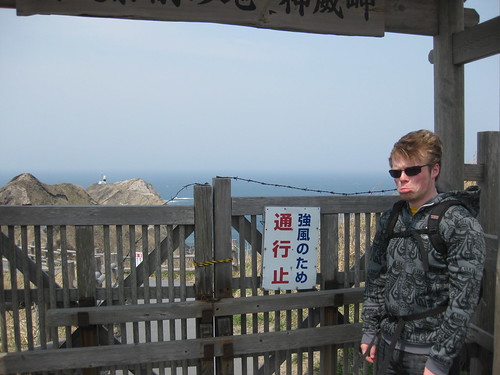
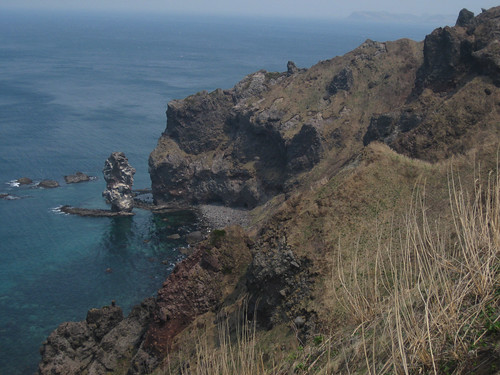
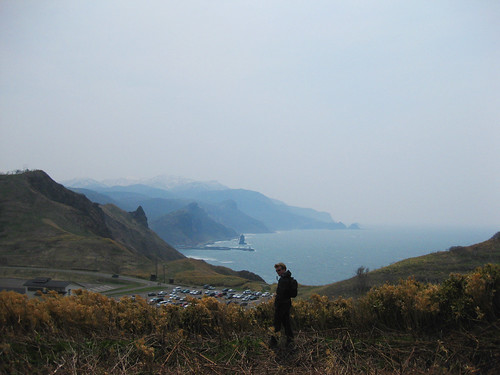
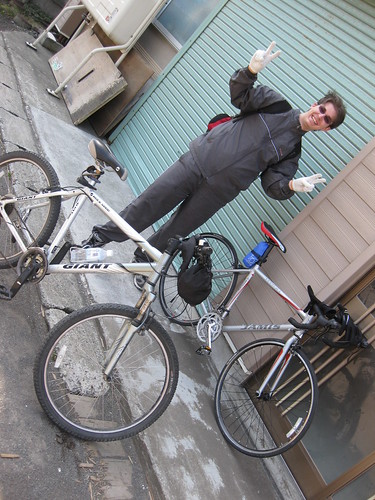
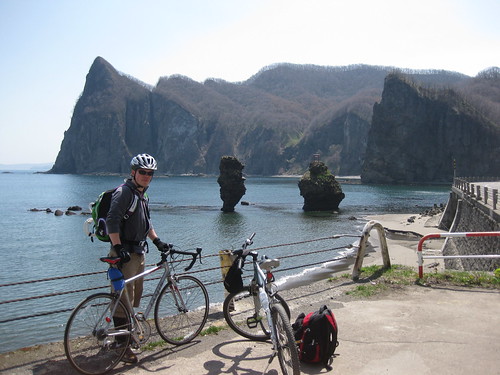
I also put up a fellow Canadian JET/ALT who what biking roughly 600km across Hokkaido in 8 or 9 days, and I took him out to see Kamui Misaki, one of the prettiest (and on that Monday, windiest) parts of my corner of Hokkaido.


On the Tuesday, I went on to bike from Furubira to Lindsay’s town of Ishikari, on the outskirts of Sapporo, with him. We did the 65 kilometer ride in one day, and it was easily the furthest I’ve ever biked. There were also a fair few more mountains between here and there than we’d both expected, which was…fun. The weather was good to us, though, and I wound up with my first sunburn of the season at the end of the day.

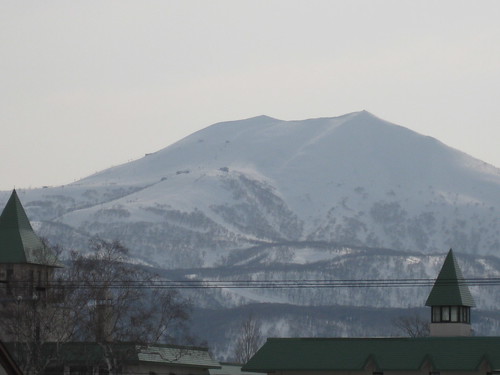
Despite the burn, there is still snow on Teine, and Heather's friends from the UK proved that Niseko was still skiable on that same day that we were biking and getting sunburnt.

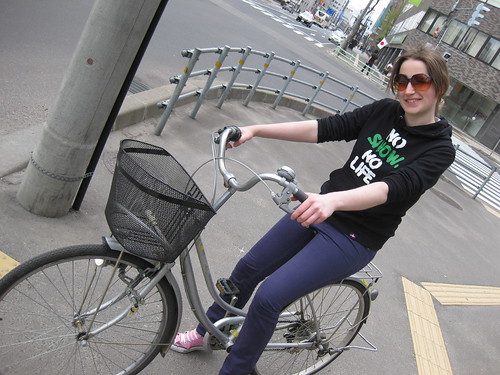
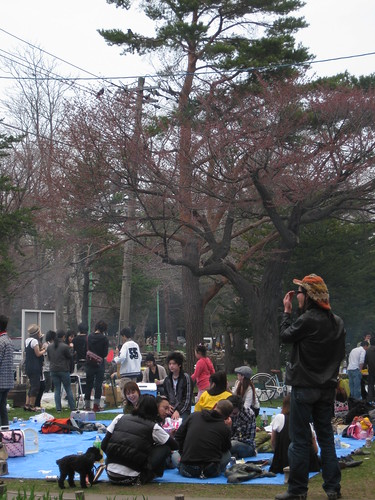
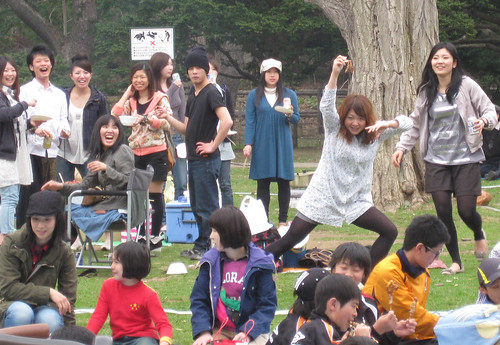
The following day was spent biking around Sapporo for the first time with Heather, talking in the mad people in Maruyama park who were drinking and barbequing to celebrate the as-of-yet non-existant sakura (cherry blossoms).

This girl was my hero.

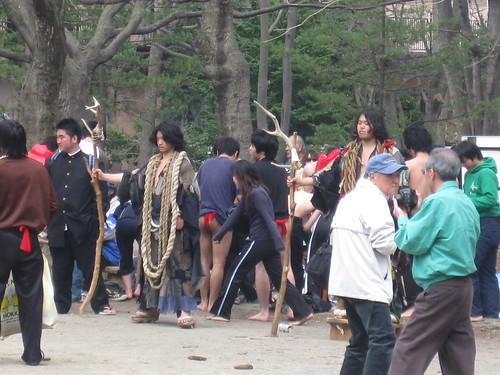
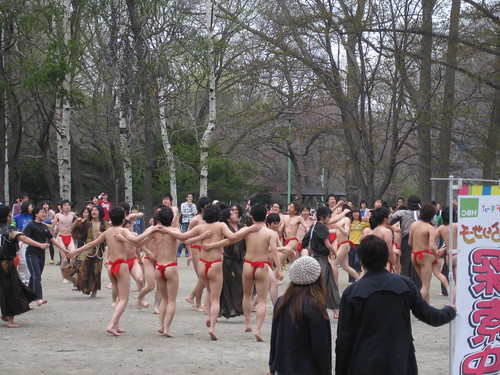
Also, there was spontaneous madness afoot.

Here and Now

Pedalling through the park, after I'd told you my dream about losing you in time, we sat up straight on our bicycles, and we started to put the pieces of us together. We realized that there were just too many coincidences: Too many congruencies, too many parallel tangents. We were too right. We were too goofy, and we were too mad.

And suddenly it all made sense:
Time travel.

It had to be time travel that conspired to bring you here when here was the last place you'd ever want to be. Time travel that landed us in this right place, at this right time.

It was likely me who sprung it: ever the grandiose romantic. In my greying years, I popped out of a temporal singularity, all pinstripes and bowler hats and walking canes, all monocles and curly moustaches and intricate pocket watches. I must have strode into that office, and pinned that dragon of a co-ordinator to her chair, telling her in a faux british intonation, some four decades wrong, that Okinawa couldn't have you, that you were meant for the frozen north.

And stepping back off her, I adjusted that pocket watch and winked off back to the future.

She, for her part, was left agog, wondering why an apparition so similar to her decades-dead daddy should come to her over a matter so minuscule as the appointment of exchange English teachers.

Monday, April 19, 2010

Spring Snowboarding

I’ve been getting a bit behind on these things this month, but I figured that since stuff was still going on, I should endeavour to catch up.

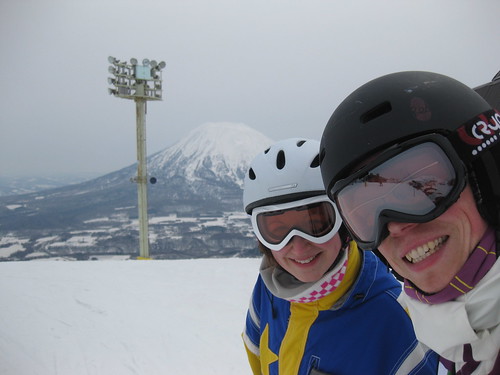
Least there be any doubt, there is still snow in Hokkaido. Heather and I struck out to make the most of it by getting in our last boarding weekend of the season at Hirafu/Niseko. Though the HAJET musical/after party/late night/our 11 am check out time and plans to meet up with Sonomi and Mark for lunch in Kutchan all conspired to keep us off the hill for most of the weekend, we did get in a few hours of boarding on Saturday.

It was definitely the latest in the season that I have ever been out in the snow in a meaningful way, but I would say the conditions were as good as my last visit to Niseko, if not a little better since, well, we could actually use a lot of the hill. A guide had described the base as “corn snow,” and I have to say that I far prefer it to the slushy alternative that Ontario yields late in the season. Though it’s not as forgiving when you fall as the standard Niseko powder, its granular consistency makes turning a breeze.

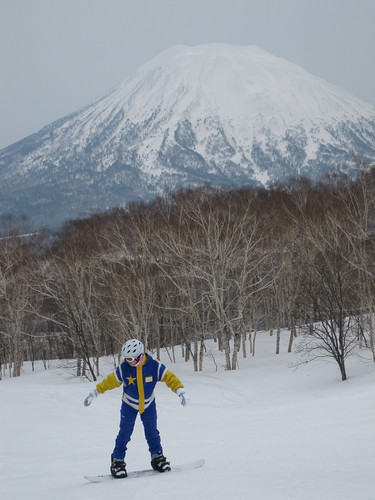
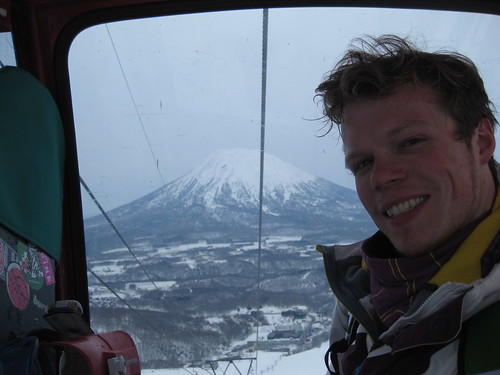
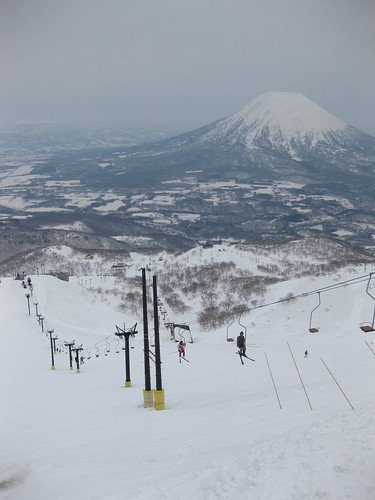
Foolishly, I got either over confident or ambitious and decided to leave Heather in the low lands while I rode the lifts as high as they would go on Hirafu that day, heading to the top of the peak chair. It was somewhere I hadn’t been since that first weekend on a board with Mark back in January, and I was determined to show up the mountain with how far I’d come in the interim. From near the peak, I was treated to a spectacular view of Mount Yotei, Kutchan, and the surrounding towns…

…but it was all down hill from there{sic}. While the lower elevations with their corn snow were in some happy transition between winter and spring, the peak area held on to winter tenaciously. This late in the season, there hadn’t been enough snow to coat it in powder, and what snow there was had frozen up into a slick sheet on one side and a rocky field of micro glaciers on the other. Being unable to get much purchase on the slick sheet, I took my chances with the glacier field and wound up going down hard on one of the ridges of ice knee-first. I could almost hear the mountain laughing at me and my confidence.

In all, though the boarding was fun, seeing the mountain so far along in its melt was a little sad. Every time I’ve rolled up on Niseko this season, it has been a postcard example of a winter wonderland. The consistent soft white of it has inspired Heather to draw comparisons to a wintery Narnia. And yet now, though the majority of the runs are still good and snowed in, the trees and the cliffs peek out along their peripheries a little too much these days, killing our ice age fantasies more and more. It’s like coming back to what was once a perfect, crisp ice sculpture, only to find it a far, sagging, watery cry of what it once was. You can still see what you saw in it, but the loss makes it almost not worth the second glance. I guess I’m happy to be done with the mountain for this season, happy to allow it to return to summer on its own, happy to wait until December before I return to it for another run.

But I will be back in December, and I will ride back up to that peak, and the joke’s on the mountain because this time she will be mine.

Oh yes, she will be mine.

Mountain Day 12

Tuesday, April 13, 2010

Uniformity Check

They’re conducting uniformity checks at the junior high school today. Every student is getting measured and weighed. I feel like that kind of think never happened back in Canada when I was a kid, but maybe that’s my memory humoring me. Though these health tests have been long scheduled, I can’t help imagining them as crackdowns by the uniformity enforcers after the recent individualistic dissention among the student body.

You see, one of the single greatest hellraisers in my third year class (grade 9) dyed his hair the other day. Back in Canada, where we all have unique hair naturally, switching from one shade to another at will would hardly elicit a reaction from school officials. However, here in Japan, where hair colour is standard-issue, electing to change your mind about yours is a suspendable offence.

Honestly.

This student came to school with hair some shade of faux-blonde no different from the majority of the actors and j-pop stars and media personalities you come across on Japanese TV, but he was sent home for it. He was told that he could return to school when he had returned his hair to something better resembling its natural colour, and I picture one of the staff greeting him at the door upon his return, holding up a set of black hair swatches to his head, much like those used in the second world war to identify true Aryan blonde.

And this isn’t the first time it’s happened, either. A couple of my third year students last year were repeat hair offenders.

All of a sudden the kids freaking out about my blonde hair makes a little more sense. Because of how I was born, I get away with something they’d be sent home for.

The whole thing gives me a little more respect for this particular student. King hellraiser or not, he was looking to differentiate himself from the self-same, uniformed masses in one of the last ways left to him. When I was his age, I was coming to high school with snowcone vivid fuscia and aquamarine stripes across my scalp, and I was never subject to any kind of reprimand. He shows up with something similar to my hair colour, and he’s suspended. For an instant, I contemplate dying my hair black in a show of solidarity, but then maybe it would be I who was getting turned away at the door: sent home and told not to return until I looked a little more gaijin.


For all of my gaijin immunity, I’ve got a uniformity check of my own coming up in the next month or so. Every year Japanese teachers are subject to health testing, including blood testing. Many ALTs/JETs balk at such a practice, feeling that the medical tests are unwarranted to the point of being invasive. For my part, I didn’t much care, even going so far as to muse on the topic of what, exactly, the Japanese are doing with all of that gaijin blood they’re collecting (hybridizing the gaijin gene?). It was all one big laugh until I came in to my board of education on Monday and the office lady told me that my health test was coming up and I had the choice of either drinking barium and having the doctors X-ray my stomach, or drinking local anesthetic and having the doctors run a endoscope down my throat.

I asked her what this was all about, informing her that I felt fine.

“It’s preventative,” was her only response.

Craig tells me that they’re surely checking to see if I’m turning Japanese yet from all of the tasty Japanese food…that or they’re checking to see if they should extricate the alien they’ve implanted within me before it bursts out of my chest.

Monday, April 12, 2010

Modern Myths: Inari

I once commented that there was something organic about the Japanese practice of erecting Torii Gates in naturally sacrosanct places among nature. I noted that I thought I’d seen similar gates growing out of trees in various wondrous natural places in Canada. But I never put two and two together: that Torii gates must, too, grow naturally somewhere in Japan like trees, and they would have to be transplanted to their final destinations.


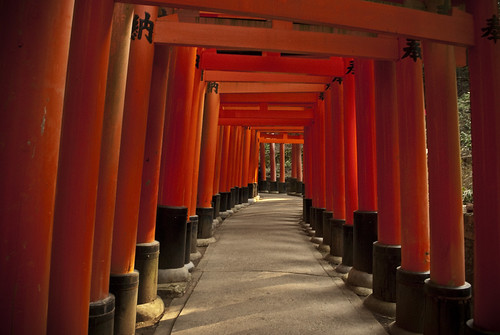
There is a thing of wonder that exists in the burbs of Kyoto, the Japanese Holy Land that has been home to wonders for more than 1100 years. It is a large hillock to the southeast of Kyoto Eki: a mountain shrine that has become more shrine than mountain. They call it Inari, and it is home to one of the rarest species of tree in Japan:

The Torii.

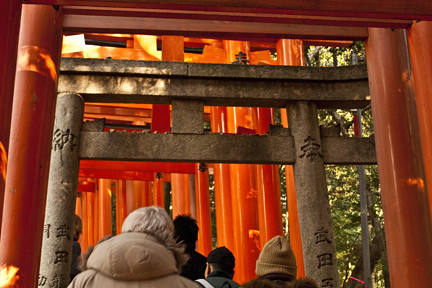
Yes, it is at Inari that Torii gates are grown for Shinto shrines all over Japan. A close inspection of the vermillion gates in your town may lead you to believe that they are, in fact, built and not grown, but a visit to Inari would show you otherwise. For the Torii grow thick like a wood across the surface of the mount, snaking rows of them running from base to summit. So dense and well-ensconced are they that one can no longer determine whether the trails up the mountain came first, as planting paths for the Torii, or whether the Torii were always here, and the paths were laid out as dictated by the spaces between their twin trunks.

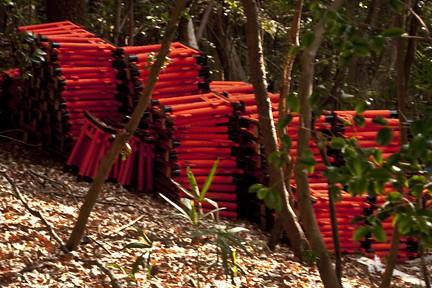
From sproutling to sapling to shrine gate, you can watch the life cycle of the Torii at Inari. Where mature gates have been harvested and transplanted to their shrines elsewhere in Japan, the fertile soil at their stumps already seeds their tiny successors.

In wooded glens just off the beaten trails, Torii saplings sit stacked, waiting to be moved to the secret nurseries on the mountain’s back side.

In a few, rare places among the growing, living Torii, there are also Torii of stone that cross the paths. They are far older than the vermillion forest at Inari, and their mysteries are deeper still. They could well have been the first Torii: their histories stretching back to a time immemorial, when Gods descended on mountain tops and rock was as alive as wood.

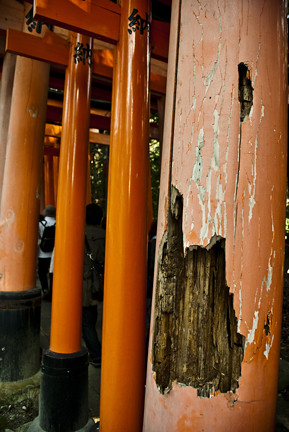
The Torii Wood at Inari will not last forever, though. It is a creature of myth like the dodo or the dragon or the Douglas fir. It requires faith to exist, and as the mountain shrine becomes more tourist trap than sacred site, the Toriis are beset by the first signs of disease, of rot.

It becomes harder and harder to grow new Toriis here, and every year more shrines across Japan resort to steel or timber facsimiles of the living shrine gates as their orders to Inari go unfilled.

Monday, April 05, 2010

Ross Nickle (or Death: The High Cost of Living*)


Death is quick.

Back in Mississauga, my good friend Ross Nickle was struck down in an instant. His story is one so common as to be cliché: Loving husband and father of one, seemingly perfectly healthy, dies suddenly sitting at home on the computer on a Monday night.

Just like that, it’s done and he’s gone.

But, Death is also slow.

I joke that I’m living in the future over here in Japan, but news of this death only reaches me now, when it is already in the distant past. March 22nd. Two weeks to the day, for me. In our digital age, it happens upon me in an email so brief and strange as to resemble comedy. I accuse it of being a bad joke—April Fools lost somewhere in the complications of email and time changes—so I check facebook for proof of life. And, sure enough, your profile is your pulse, and Ross’ has been showing signs of death for days: filled with a litany of eulogies from his friends, each eerily addressed to him in the second person:

“Ross, you will…”

“Ross, you were…”

“Ross, you always…”

And I am faced with another reality of Japan for the first time.

People have gotten sick while I’ve been over here, and I’ve contemplated having to make returns for them should situations turn dire. People have died while I’ve been over here, the sad outcomes of long, old-aged declines. In those events, I’d felt the distance between me and Canada growing. However, those were, essentially, all warnings. They all gave me time to react if I needed to: time to say things that needed to be said. They were conclusions slowly drawn.

This is a fragment. This is a story that ends mid senten

What’s more, I am too late for this by an order of magnitudes. Ross’ death is now past tense. He has died; he was mourned; he was buried. No matter how many planes I jump on, no matter how the paradigms of datelines can land me in Canada an hour after I left Japan, none of it can bend time back two weeks plus a day.

Yes, it's a truism of wishing I had made more time and wishing I had said what I’d always meant to, but I maintain that the frustration of it all is compounded significantly by being so far away: mentally just as much as physically. As his friend Norm informs me when I question him on not telling me all this when he added me on Facebook, this news was sitting, waiting for me, on Ross’ profile for two weeks. However, I was too caught up in all of this Japanification to ever notice it. I now wonder what earth-shattering things I might discover should I go looking at all of your profiles…

And here’s one more thing while we’re on the topic of online presences. For those of you familiar with the terminology, had Ross and I not lived so close to one another, he surely would have been another of my internet boyfriends. We were both mixed up in the same dorky worlds, and now, as the one from those worlds who knew him best, it falls to me to go out and inform them of his death. Should that seem like some meager thing in your eyes, then I would tell you that you know little of the worlds that exist out in the digital cosmos; know little how someone like me or like Ross can grow to be many times our size and extend our reach to touch many more lives around the world than we ever could have hoped to in the worlds of flesh and bone. That’s not a boast; that’s a truth. His passing will happen there, again, tomorrow when I have to tell them, just as it happened again for me today, and how it happened initially for his family and friends two weeks ago.

Eventually I want to say more about Ross here, as it seems as good a place for it as any, but for now this is all I’ve got.

* It should be noted that I stole the alternative title for this from a Neil Gaiman comic of the same name. I take no responsibility for the man’s brilliance.